


President Donald Trump has ordered the National Institutes of Health to establish a Women’s Health Division within 90 days, part of an executive action that also creates a White House task force spanning major health, research and cabinet agencies.
The Oct. 19 order could reshape how the federal government coordinates research on conditions affecting women and how NIH monitors consideration of sex in federally supported studies. But it does not appropriate money, set a staffing level or identify research grants and disease areas that would receive new support. Its practical reach will depend on decisions made by the Department of Health and Human Services, NIH and Congress.

What the order requires
Under the executive order, the HHS secretary is to act through the NIH director to establish the division within an appropriate NIH institute or center. Counting 90 days from the order’s Oct. 19 date puts the deadline on Jan. 17, 2027.
The division is directed to work alongside, not replace, NIH’s existing Office of Research on Women’s Health. It is an organizational addition to an NIH structure that already coordinates women’s-health research and develops policy across the agency. The directive calls for the division to coordinate scientific review and research on understudied women’s-health conditions across the life course, including replication studies.
It also directs the division to support research methods aimed at improving understanding of sex-specific outcomes, to encourage the inclusion of women and girls in clinical trials, and to develop accountability for grant recipients’ adherence to NIH policy on sex as a biological variable. Those instructions identify areas HHS and NIH must address, but they do not prescribe penalties, reporting standards or performance measures for grantees.
The executive action does not announce a clinical study or present evidence that a new division will improve diagnoses, treatments or patient outcomes. It establishes federal policy and administrative responsibilities; whether those steps translate into changes in research or care will require later funding and implementation decisions.
An existing NIH policy becomes a focus of oversight
The order’s grant-accountability language builds on a policy NIH already uses. NIH’s Office of Research on Women’s Health says investigators are expected to consider sex as a biological variable in the design, analysis and reporting of vertebrate-animal and human studies. Researchers proposing to study only one sex are expected to provide a strong scientific justification.
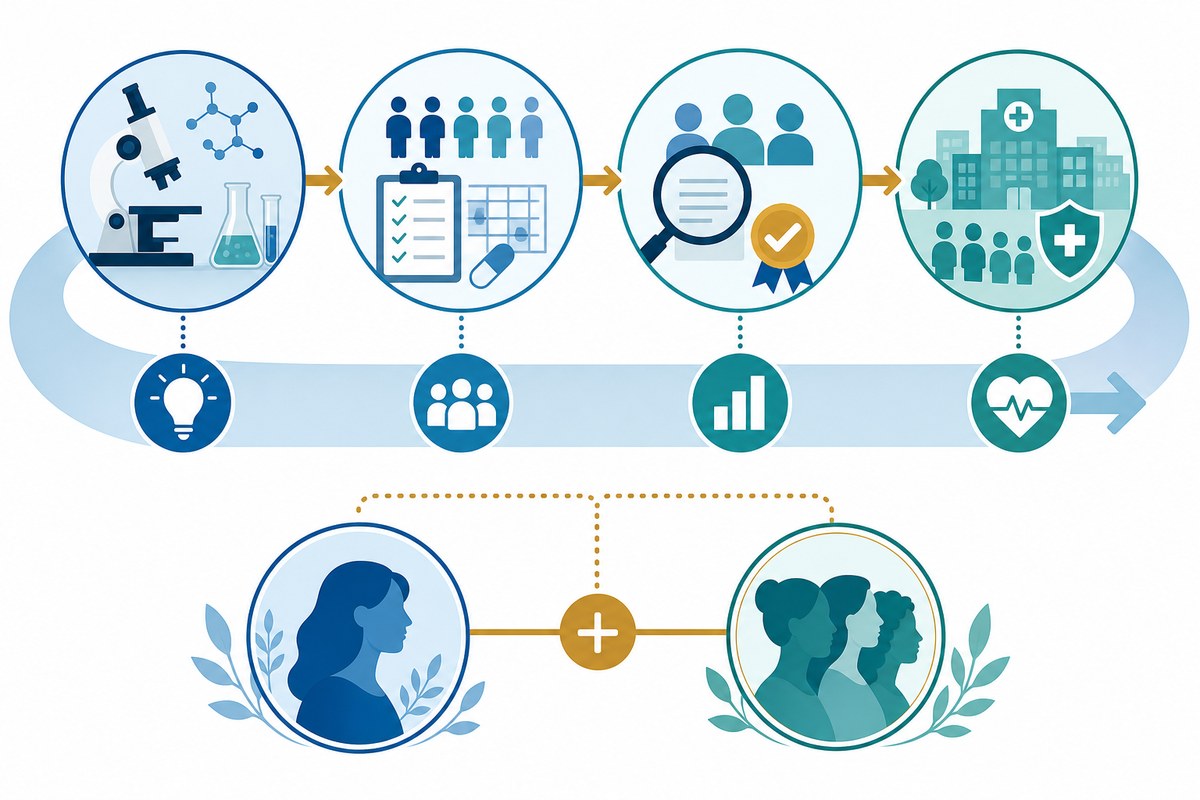
That policy is broader than enrolling women in a clinical trial. Sex as a biological variable can affect questions posed in laboratory experiments, the animals or cells selected for preclinical work, the way results are analyzed and whether findings are reported separately by sex when appropriate. The executive action directs the new division to improve accountability around that existing expectation, rather than creating the underlying NIH policy.
NIH says women make up roughly half of participants in NIH-supported clinical research, while basic and preclinical research has often concentrated on male animals and cells. Its account of research inclusion policies describes the agency’s longer-running efforts to make biomedical research more representative. The order does not provide a baseline for compliance with the sex-as-a-biological-variable policy or specify what change would count as success.
Task force brings research agencies and care programs together
The executive action establishes a White House Women’s Health Task Force, co-chaired by the HHS secretary and the assistant to the president and chief of staff. Its named members include leaders of HHS, the Defense, Agriculture, Labor, Education and Veterans Affairs departments; the Environmental Protection Agency; and health agencies including the Food and Drug Administration, Centers for Disease Control and Prevention, NIH, the Advanced Research Projects Agency for Health and the Centers for Medicare & Medicaid Services.
That membership extends the initiative beyond NIH research administration. The order directs the task force to coordinate federal efforts on women’s health and to help translate research findings into clinical and public-health practice. It assigns HHS responsibility for the task force’s administrative costs.
Several of those agencies oversee different parts of the path from research to care: NIH funds and conducts research, FDA regulates medical products, CDC addresses public-health programs, and CMS administers major health-insurance programs. The order identifies the agencies that must participate but does not establish a shared budget, require new coverage decisions or spell out how conflicts among agency priorities would be resolved.
Fierce Healthcare reported that HHS Secretary Robert F. Kennedy Jr. described the division as a way to accelerate prevention and treatment research and move discoveries into care. Those outcomes are administration goals, not results established by the order.
New structure, unresolved resources
The order explicitly makes implementation subject to available appropriations and applicable law. It provides no dollar amount for the division, no number of positions, no grant target and no timetable for the task force to issue recommendations. Independent coverage by the Los Angeles Times similarly noted that the initiative came without specified funding goals.
The executive order alone cannot be read as a new appropriation or a guaranteed increase in women’s-health research spending.
The action also changes the policy framework left by the prior administration. It revokes Executive Order 14120, issued March 18, 2024, as well as a Nov. 13, 2023 presidential memorandum that established the White House Initiative on Women’s Health Research. The revocations do not abolish NIH’s Office of Research on Women’s Health or erase NIH’s sex-as-a-biological-variable policy; the new order expressly relies on coordination with the office and seeks stronger adherence to that policy.
The immediate question is whether HHS and NIH establish the division by the Jan. 17, 2027, deadline calculated from the order’s Oct. 19 date and disclose how it will operate alongside the office already charged with coordinating women’s-health research.

