


Social Security’s retirement and survivors trust fund is projected to exhaust its reserves in the fourth quarter of 2032, three months earlier than projected a year ago, according to reporting on the latest trustees update. The broader 2034 estimate for Social Security’s two trust funds combined did not change. The split is more than an accounting detail: the earlier date applies to the fund that pays retirement and survivors benefits, while the later one includes the disability fund.
For the roughly 71 million Americans receiving monthly Social Security payments, depletion would not mean checks stop. Payroll taxes, taxation of benefits and other continuing revenue would remain available. But the new projection indicates that income at the point of depletion would cover 78% of scheduled benefits from the Old-Age and Survivors Insurance, or OASI, fund. At the projected 2034 depletion of OASI and Disability Insurance, or DI, combined, revenue would cover about 83% of scheduled benefits, according to CNBC’s account of the trustees report and AARP’s analysis.

Two dates reflect two legally separate funds
The 2032 and 2034 dates describe different financial measures, not competing forecasts. OASI finances retirement and survivor benefits; DI finances disability benefits. Though commonly discussed together as Social Security, the funds are maintained separately. A combined balance can show reserves lasting longer even when OASI, on its own, reaches depletion first.
That separation constrains what the headline 2034 combined date can mean in practice. The DI fund is projected to pay full benefits throughout the 75-year forecast window, AARP reported. But its reserves do not automatically become available to meet OASI obligations. A transfer between funds, a change in benefit formulas, additional revenue or another financing measure would require legislation.
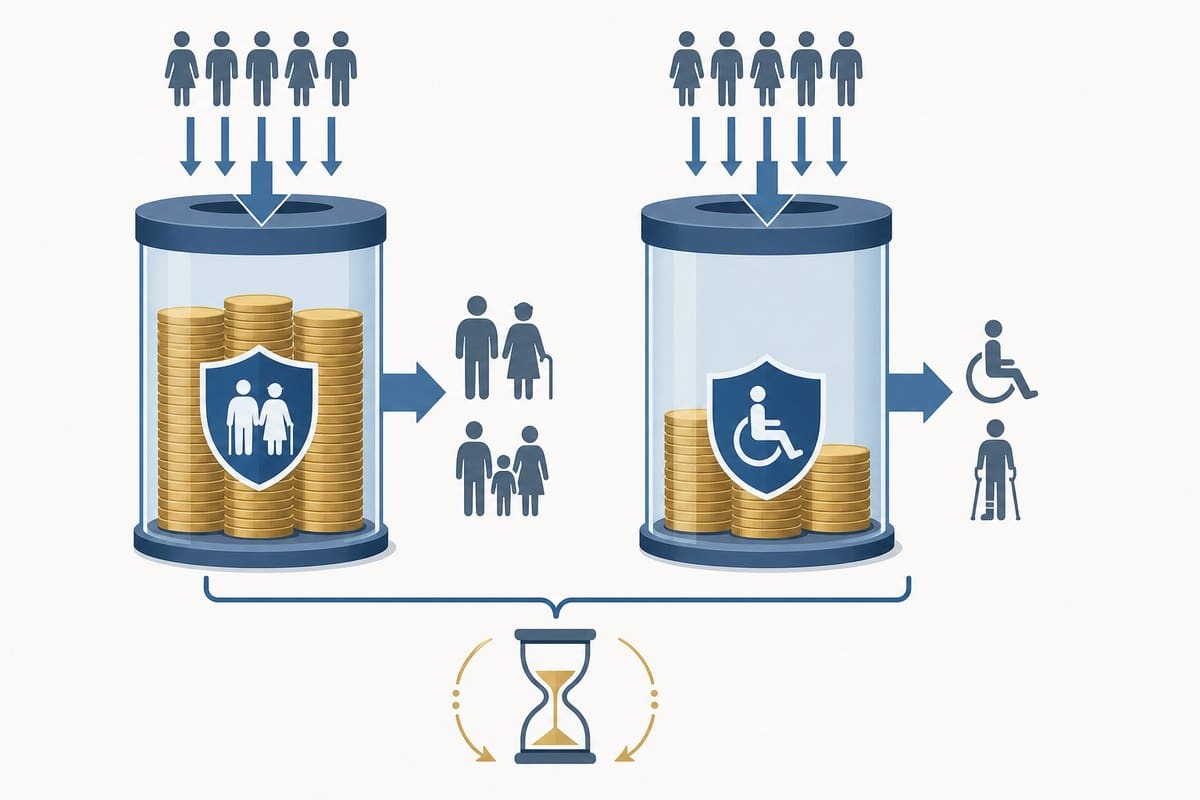
The comparison with last year’s forecast clarifies where the deterioration occurred. In June 2025, the Treasury Department said the combined Social Security funds were expected to be depleted in 2034. That estimate remains in place. The OASI-only forecast, however, has moved from the first quarter of 2033 in the prior report to the fourth quarter of 2032 in the new one. The change is only one quarter on the calendar, but it brings the fund’s separate statutory constraint closer.
Reserve drawdowns are already under way
The trust funds are not simply prospective financing vehicles. They have been covering the gap between annual program costs and recurring income. In 2025, the combined Social Security funds collected $1.45 trillion and paid $1.61 trillion, reducing reserves from about $2.72 trillion to $2.56 trillion, according to AARP’s review of the report. The roughly $160 billion decline illustrates the annual deficit that reserve assets have been absorbing.
That arithmetic also explains why depletion is not the same as insolvency in the everyday sense. Once reserves are gone, Social Security would still have a large continuing revenue base. Under current law, however, it could not pay benefits beyond the money available to the relevant trust fund. The projected 78% payable share for OASI implies a gap of about 22% relative to scheduled retirement and survivor benefits; the 83% combined figure implies a gap of roughly 17% across both programs.
Those percentages are projections rather than preordained cuts. They depend on economic growth, wages, employment, demographics and the laws governing taxes and benefits over the coming years. They nonetheless frame the scale of the adjustment Congress would need to address if it waits until reserves approach exhaustion.
Demographics and tax changes shaped the new outlook
The revised OASI timing reflects changes in the trustees’ underlying assumptions as well as policy effects. AARP reported that lower projected fertility and immigration worsened the program’s revenue outlook relative to the prior year’s estimates. Both factors affect the ratio of workers contributing payroll taxes to beneficiaries drawing benefits, though their effects play out over different periods.
Reporting on the update also identified effects from the 2025 tax-and-spending law. Social Security’s chief actuary said in an August letter, as described by CNBC, that the law has material consequences for the trust funds because it changes the income taxation of Social Security benefits. That tax revenue is credited to the program, making changes to benefit taxation relevant to its financing even though payroll taxes remain its principal dedicated income source.
The latest update arrives after years in which public discussion has often compressed Social Security’s finances into a single depletion date. The official Treasury release for the 2025 trustees reports used the combined-fund measure when it cited 2034. The newer reporting supplies the separate OASI date that is especially relevant to retirement and survivor payments. Both figures are useful, but they answer different questions.
Congress faces choices, not an automatic outcome
Lawmakers could address the shortfall through some combination of increased revenue, benefit changes, trust-fund transfers or broader program restructuring. Each route allocates costs differently among workers, beneficiaries and taxpayers. A transfer from DI to OASI could change the near-term calendar but would not erase the combined program’s projected financing gap, a point Bipartisan Policy Center executive director Shai Akabas made in comments reported by CNBC.
No policy response is embedded in the trustees’ projections. AARP has urged Congress to strengthen the program without benefit cuts, an advocacy position rather than a trustees recommendation. The report’s practical conclusion is narrower: without legislative action, OASI’s continuing income would be insufficient to pay all benefits scheduled after late 2032, even as the combined OASI-DI trust-fund measure continues to point to 2034.

