


President Donald Trump’s April 18 executive order directs federal health, drug-control and veterans agencies to support research, regulatory review and potential access pathways for certain psychedelic drug products aimed at serious mental illness and substance-use disorders. The action does not approve any psychedelic treatment, but it sets a more explicit federal policy agenda for products that remain investigational under U.S. law.
Six days later, the Food and Drug Administration announced initial steps under the policy: national-priority vouchers for three development programs involving psilocybin or methylone, and permission for an early-phase U.S. study of noribogaine hydrochloride for alcohol use disorder to proceed. The distinction between those regulatory actions and a finding that a treatment works is important. FDA said specifically that allowing the noribogaine study to begin was not an approval and did not establish the drug’s safety or effectiveness.

What the order directs federal agencies to do
Executive Order 14401, titled “Accelerating Medical Treatments for Serious Mental Illness,” directs the Department of Health and Human Services to use the Advanced Research Projects Agency for Health, or ARPA-H, to allocate at least $50 million from existing funds. The money is intended to support and work with states developing or operating programs to advance psychedelic drugs for serious mental illnesses, through funding, technical assistance and data sharing as appropriate.
The order’s operative language does not require states to provide matching dollars. That is narrower than a characterization in a White House fact sheet suggesting the federal funds would match state investments; the signed order is the controlling document for the federal directive.
It also tells HHS and FDA to collaborate with the Department of Veterans Affairs and, where appropriate, private-sector participants on clinical-trial enrollment, data sharing and generation of real-world evidence. Those provisions could be relevant to veterans and other patients with difficult-to-treat psychiatric conditions, but they do not substitute for the controlled clinical trials generally needed to demonstrate that a drug’s benefits outweigh its risks.
FDA Commissioner’s National Priority Vouchers are to be available for appropriate psychedelic drugs that have Breakthrough Therapy designation and meet the voucher program’s criteria. Such designations and vouchers can affect the pace or priority of agency interactions. They are not evidence that a product is safe or effective, and they do not guarantee approval.
FDA’s follow-up actions name specific products
In its April 24 announcement, FDA said it was issuing national-priority vouchers for programs studying psilocybin for treatment-resistant depression, psilocybin for major depressive disorder and methylone for post-traumatic stress disorder. Methylone is distinct from MDMA, a related but different compound whose PTSD development history has received substantial attention. The FDA announcement identifies methylone, not MDMA, as the PTSD voucher recipient.
The agency also said DemeRx NB could proceed with an investigational new drug study of noribogaine hydrochloride for alcohol use disorder. An investigational new drug authorization allows clinical testing under FDA oversight; it is not a marketing authorization. FDA described the work as an early-phase, closely monitored U.S. study and did not report a sample size or clinical results.
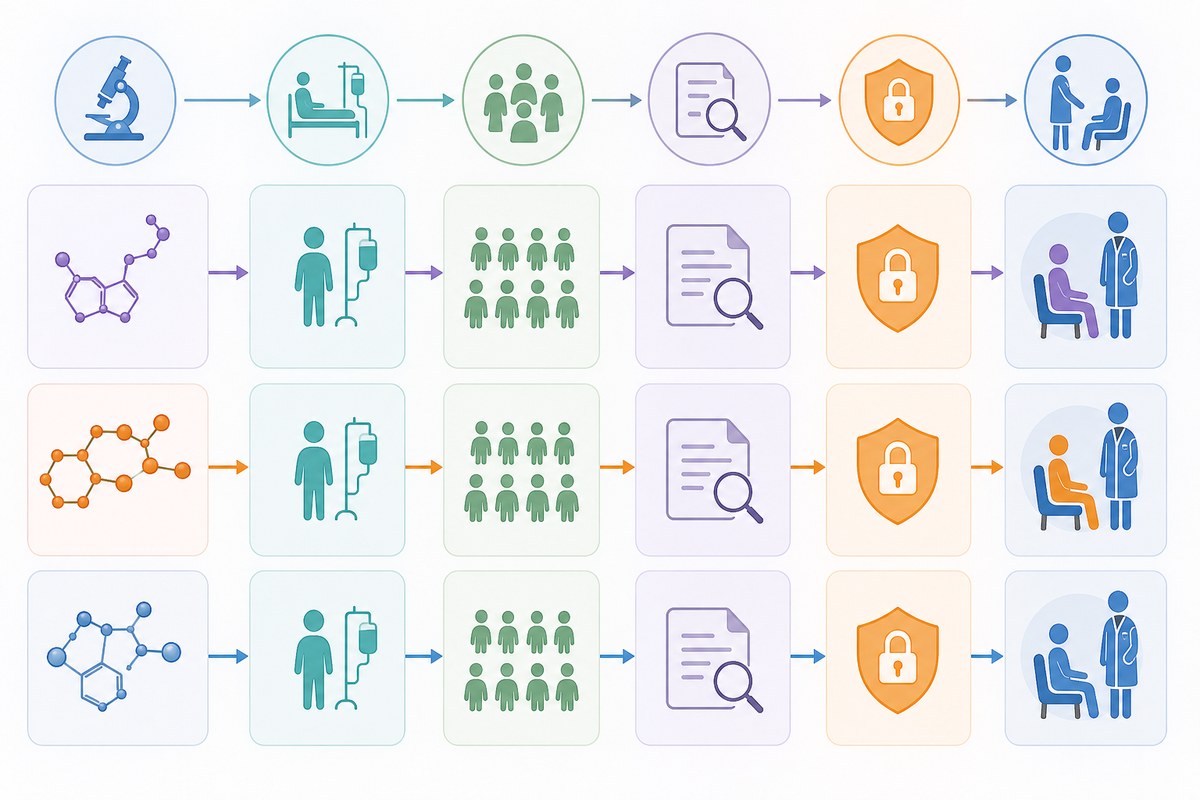
Psilocybin programs are further along than the newly authorized early-phase U.S. noribogaine study, but advancement in development does not settle whether a treatment should be widely used. FDA said it plans final guidance on development of serotonin-2A agonists and related products, addressing trial design, data collection, patient monitoring and the need for adequate, well-controlled investigations.
Why evidence and safety cannot be generalized across compounds
Psychedelic drugs are not a single treatment category in clinical terms. The evidence can differ by compound, dose, condition, treatment setting and the psychotherapy or other support that may accompany dosing. Experts at the Penn Leonard Davis Institute said promising findings must be followed by larger, more rigorous and better-blinded trials with replication before broad adoption. Blinding can be especially difficult in studies of psychoactive drugs because participants may recognize the effects of the assigned treatment.
Ibogaine-related compounds present an especially cautious case. ABC News reported that evidence on ibogaine for conditions including depression, PTSD, anxiety and traumatic brain injury has included animal work and small early human studies, and that the compound has been associated with potentially fatal heart-rhythm problems. Noribogaine is related to ibogaine, but FDA’s decision permits a study of a particular product; it does not establish that evidence or safety findings for one compound apply to another.
Even an eventual FDA approval would not by itself answer every practical question. Delivery of these treatments may require clinician training, monitoring protocols, appropriate facilities and decisions about reimbursement. Those implementation issues are particularly consequential for products with acute psychoactive effects or significant medical risks.
Rescheduling and Right to Try remain conditional
The order directs FDA and the Drug Enforcement Administration to facilitate and establish a pathway, subject to applicable legal authorities, for eligible patients to access psychedelic drugs, including ibogaine compounds, under the federal Right to Try Act. It does not give patients automatic access. Eligibility, the status of a product and controlled-substance requirements would still govern any pathway.
It also calls on the attorney general, in consultation with HHS, to initiate and complete review of qualifying products containing Schedule I substances after successful Phase 3 trials, so product-specific rescheduling can move as quickly as practicable if appropriate and if the products are ultimately FDA-approved. The language is conditional and product-specific; it does not automatically reschedule an entire drug class.
Legal scholars I. Glenn Cohen and Mason Marks, in a Harvard Petrie-Flom Center analysis, noted that an executive order cannot itself compel controlled-substance rescheduling. They also questioned whether the directive would materially accelerate a process that may already be required after FDA approval. The immediate change is therefore chiefly administrative: a directive to agencies to prioritize and coordinate work on a field whose clinical evidence, safety profile and readiness vary widely from one product to the next.

