


Lycia Therapeutics raised about $317.5 million in gross proceeds through an upsized initial public offering and then finished its first Nasdaq trading session 67% above its $18 offer price, according to IPO-market tracker Renaissance Capital. The debut gives the clinical-stage drug developer a substantial financing base for medicines designed to remove disease-causing proteins outside cells, while adding another strong data point to a busy market for biotech listings.
The company sold 17.64 million common shares, all newly issued by Lycia, at $18 each. Its IPO market capitalization was about $1.06 billion at the offer price, Renaissance Capital reported. Investors are backing a platform and early human testing rather than marketed products: Lycia’s two disclosed lead programs remain in Phase 1, with further data expected in 2027.

Offering expanded before Nasdaq trading
Lycia announced the pricing on Oct. 22 after increasing the deal from a planned 14.7 million shares to 17.64 million. The arithmetic produces $317.52 million in gross proceeds, consistent with the company’s estimate of approximately $317.5 million before underwriting discounts, commissions and other offering expenses. Shares began trading on the Nasdaq Global Select Market on Oct. 23 under the ticker LYCA.
Underwriters also received a 30-day option to buy up to 2.646 million additional shares at the IPO price, less underwriting discounts and commissions. That option equals 15% of the base deal and could lift the total number of shares sold to 20.286 million if exercised in full. It is separate from the shares sold in the priced offering, not part of the stated $317.5 million expected proceeds.
The company’s pricing announcement said the transaction was expected to close Oct. 26, subject to customary conditions. The available announcement does not establish that the closing had occurred, so the proceeds figure remains the company’s pre-closing estimate.
Early pipeline defines the investment case
Lycia is developing drugs based on what it calls LYTAC technology, intended to degrade extracellular proteins that can be difficult to address with conventional medicines. Its most advanced candidate, LCA-0061, is designed to reduce immunoglobulin E, or IgE, for allergic diseases including food allergy. A second program, LCA-0321, targets autoantibodies implicated in Graves’ disease.
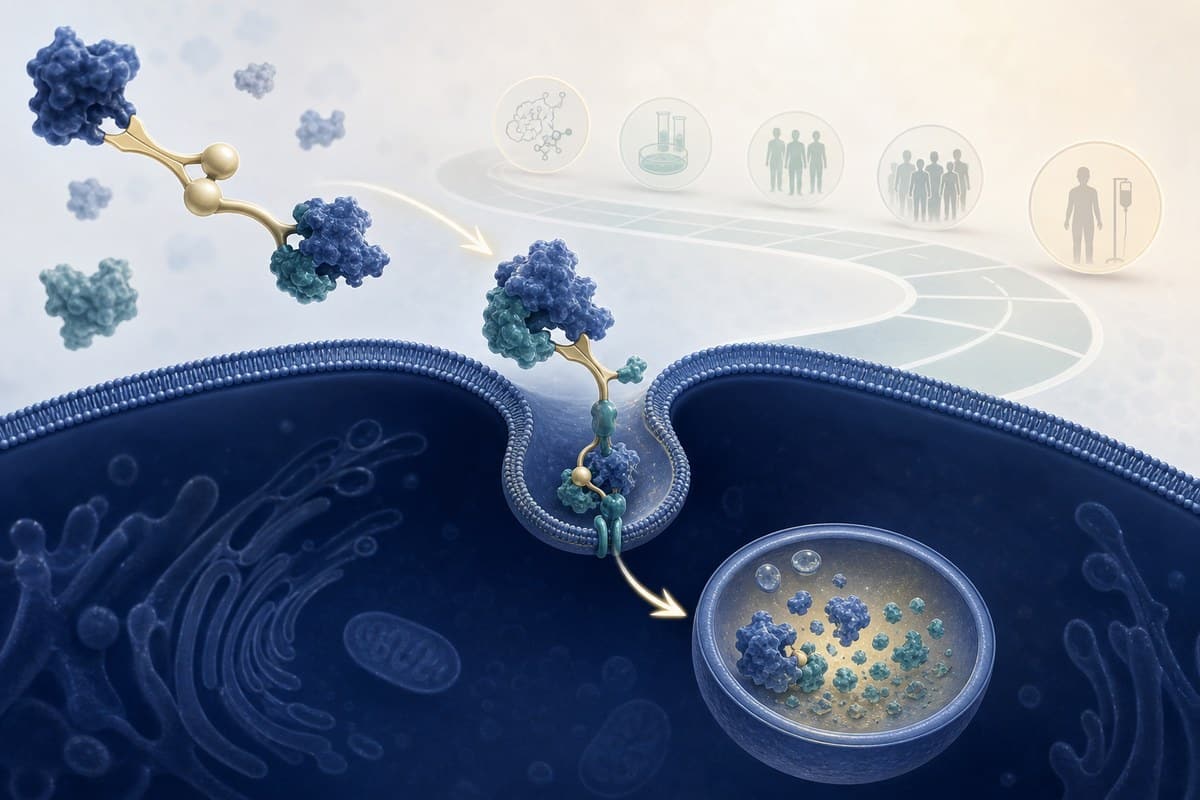
Those programs are in Phase 1 trials, not late-stage efficacy studies. BioPharma Dive reported that data from both programs are expected in 2027. That timing frames what the IPO proceeds can accomplish: the money may support development through important early clinical milestones, but it does not resolve whether the candidates will provide clinical benefit or advance through larger trials.
An early LCA-0061 cohort reported by TIKR included six treated participants and two placebo participants. Lycia said a single dose reduced IgE by an average of 96%, with most treated participants more than 95% below baseline at day 28. The reported measure is a biomarker result in a very small early-stage cohort; it is not evidence that the drug has demonstrated a treatment benefit for food-allergy patients.
Separating the closing gain from intraday moves
Reports on Lycia’s first session cited several different gains, but they appear to reflect different points during the trading day rather than conflicting closing results. A Yahoo Finance article based on Investing.com reporting described shares as up nearly 33% around midday, while TIKR described a 47% gain in its intraday account. Renaissance Capital’s 67% figure is explicitly its completed first-day return and is the more appropriate measure of the debut’s full-session performance.
The same timing issue applies to valuation. Renaissance Capital’s roughly $1.06 billion figure is market capitalization at the $18 IPO price. Estimates cited after the shares began rising reflected higher intraday trading prices and should not be read as the company’s IPO valuation.
Lycia was the only IPO debut in the week tracked by Renaissance Capital, even as biotech issuance remained active. BioPharma Dive said more than two dozen drugmakers had gone public in 2026. The upsized offering and sharp first-day gain indicate that public-market buyers were willing to fund a sizable, pre-commercial biotechnology company, but the durability of that support will depend on clinical results still expected next year.

