


PHP administrators are racing to update internet-facing applications after disclosure of critical flaws commonly called PHP2Shell, a vulnerability cluster linked to the risk of unauthenticated remote code execution. The episode has already produced precautionary service disruptions among governments and companies, according to wire reports, and it is forcing a familiar but difficult task: finding every live PHP deployment before an attacker does.
PHP’s security advisory for CVE-2026-109619 describes a stale-global-state bug in which request-owned memory can remain accessible after being freed. Under particular conditions, a carefully arranged heap layout can lead to memory disclosure and remote code execution with the privileges of the web worker handling requests. PHP says installing a release with the complete state-reset fix is the only reliable mitigation.

A web-scale exposure problem, but not a vulnerability census
PHP is widely embedded in the internet’s application layer, from bespoke business software to large content-management installations. Associated Press reporting says it powers roughly 70% of websites, a figure also repeated in CNN-derived coverage. But that is an estimate of PHP’s web usage, not evidence that 70% of websites are vulnerable, reachable or exploitable through these bugs.
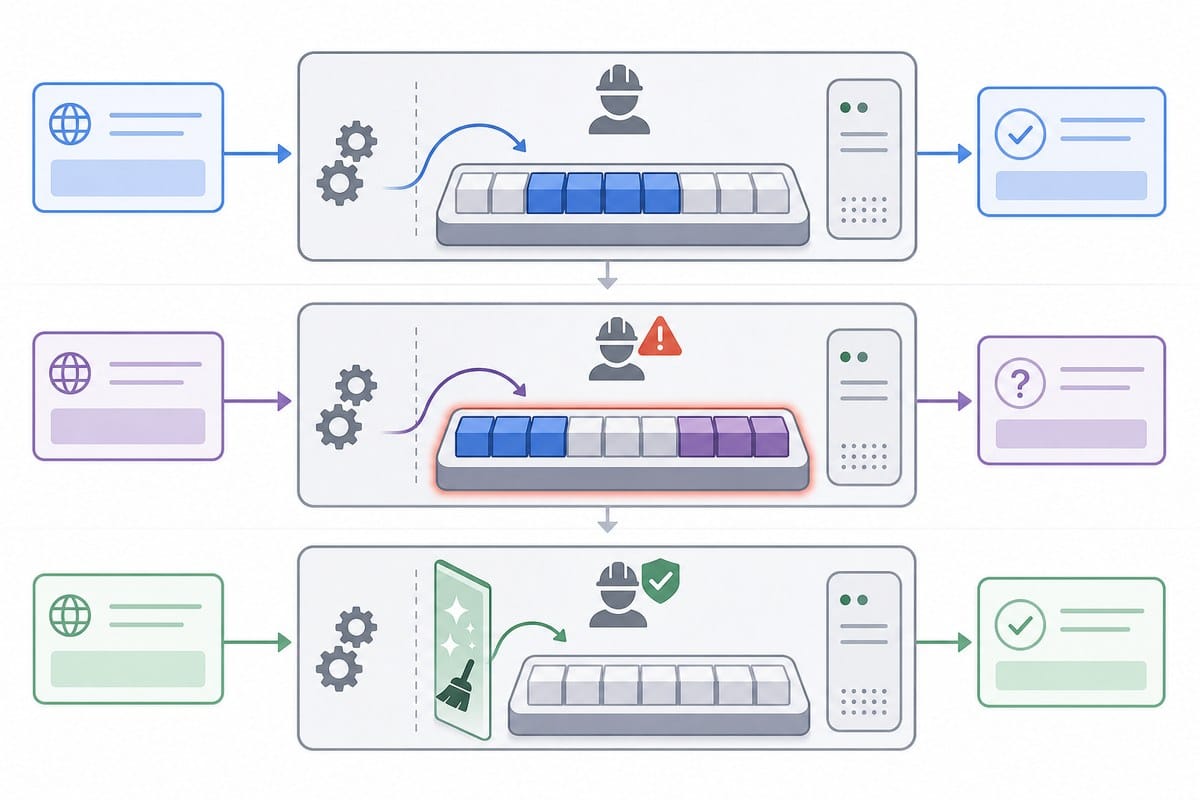
The distinction is operationally important. PHP’s advisory says the demonstrated producing and consuming operations can occur in separate HTTP requests served by the same worker. Its exploitability therefore depends on the application’s behavior, request lifecycle and server configuration, rather than simply on whether a website uses PHP. A site can run PHP without presenting the necessary sequence, while a less visible application endpoint may be more exposed than a public homepage.
That nuance has not reduced the urgency. Associated Press reporting republished by WBAP said government and corporate services had limited availability while remediation was under way. AP also reported that the FBI’s cyber division urged urgent action and advised operators unable to update promptly to take websites offline. Separately, Scripps News’ CNN-derived report described outages and cited warnings from U.S. and European authorities.
What PHP has confirmed — and what remains attributed
The public discussion covers two CVEs, 2026-109618 and 2026-109619, often grouped under the PHP2Shell label. The official PHP advisory documents CVE-2026-109619’s stale-state mechanism, impact and mitigation limits. PHP’s 2026 news archive identifies October 21 as the publication date for that advisory.
Several additional details circulating among defenders come from security company watchTowr rather than PHP’s advisory. In its PHP2Shell FAQ, the company identifies the two-CVE pair, lists CVSS v4.0 scores of 9.2, and says its honeypot network began seeing exploitation on October 21. It also lists patched supported releases as PHP 8.2.35, 8.3.36, 8.4.27 and 8.5.12.
watchTowr’s telemetry is a vendor observation, not a public measurement of all internet activity. The same watchTowr account said the flaws had not been added to CISA’s Known Exploited Vulnerabilities catalog as of October 22.
The chronology has also produced avoidable confusion. PHP’s archive posted an item on October 23 about CVE-2026-115560, a separate issue involving a narrower configuration scenario, while referring readers back to the October 21 CVE-2026-109619 advisory. The October 23 notice should not be treated as a new disclosure for the main PHP2Shell pair.
Patching is an inventory and restart exercise
For administrators, the immediate work is broader than replacing a PHP binary. Teams need to identify PHP behind reverse proxies, in container images, on older virtual machines, and inside applications maintained by outside vendors or hosting providers. Unsupported branches may require a vendor package, a backport or a planned upgrade; they cannot simply be assumed safe because they are no longer receiving routine releases.
A complete update also has to reach the processes actually serving traffic. The flaw’s cross-request behavior makes worker lifecycle relevant, so patch deployment normally includes restarting the affected PHP worker pools or application services under a controlled change process. PHP explicitly warns that configuration changes address only particular demonstrated paths and do not replace the complete patch.
The incident is also becoming a test case for claims about AI-assisted security research. Scripps News reported that Wiz researchers said AI substantially shortened the work needed to turn longstanding weaknesses into an exploit, while Cloudflare’s chief executive said the company had seen millions of attempted exploits in recent days. Those accounts point to a changing speed of vulnerability weaponization, but they do not alter PHP’s guidance: apply the complete fixed release rather than rely on a temporary tuning change.

