


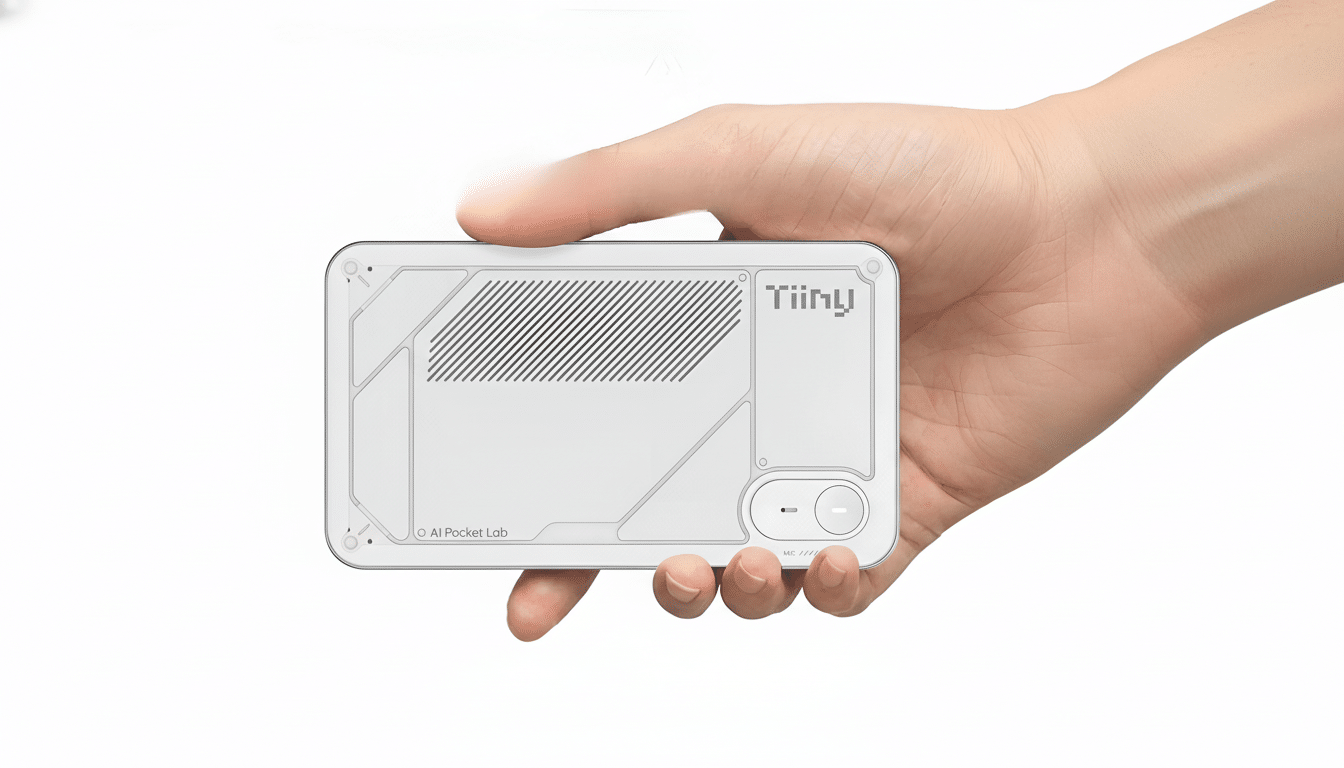
AI PCs are all over the show floor, but there’s one gadget you can’t miss because it’s so tiny. Behold, Tiiny AI’s Pocket Lab — a palm-sized artificial intelligence computer announced at CES — which holds the Guinness World Records title for smallest mini PC and is capable of running contemporary AI models locally.
Tiny box, big specs: Pocket Lab hardware highlights
At first glance, the Pocket Lab resembles a sleek power bank. Behind that bricklike shell, Pocket Lab has 80GB of RAM and a 1TB SSD — plenty of headroom for a device you can slip in your pocket. That capacity is important for local inference in cases where memory bandwidth and storage speed determine how quickly image generators, video models, and language models respond.
- Tiny box, big specs: Pocket Lab hardware highlights
- Why On‑Device AI Matters for Privacy and Performance
- Hands‑on impressions from CES floor demonstrations
- Software that lowers the bar for local AI workflows
- Where it fits in the AI PC landscape and edge computing
- Price, availability, and caveats for Tiiny AI Pocket Lab
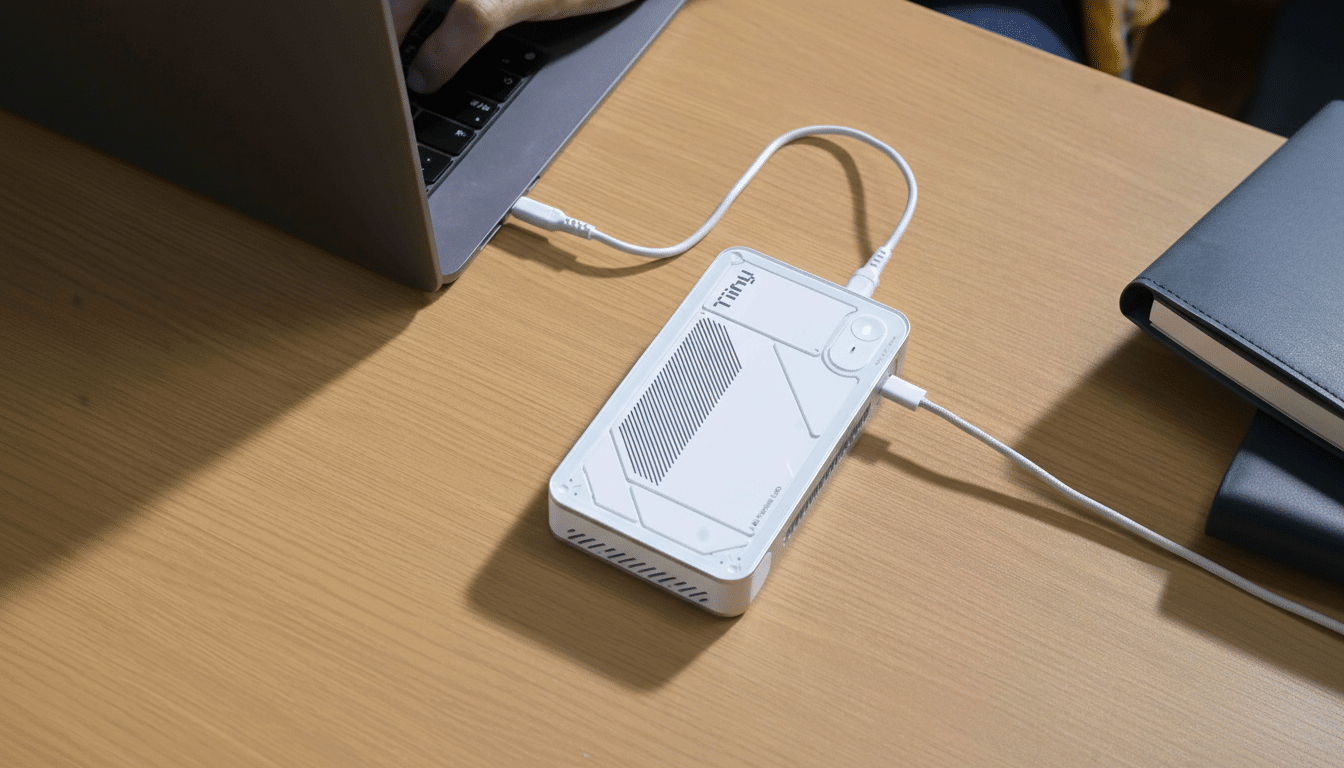
Albersweiler has bigger plans for the Guinness World Records designation than just a party trick. Scaling down a PC with the power to run AI software to that size without making it into a hand warmer is not easy. Thermal design and power efficiency are the unsung heroes that help make a form factor like this possible, beyond just the confines of a demo booth.
Why On‑Device AI Matters for Privacy and Performance
Today, most AI workflows rely on cloud GPUs. That purchases elasticity at the cost of latency, ongoing subscription fees, and your data in someone else’s cloud. Staying local to process data, Tiiny AI embraces three priorities that enterprises and creators are increasingly laying claim to: privacy, predictable cost, and offline reliability.
Analysts at IDC and Gartner have been following the gradient of “AI PCs” as companies want to run more models on the edge. For regulated domains like healthcare imaging, legal doc analysis, and field research, local inference makes compliance easier. It also eliminates data egress fees and allows teams to work in environments with limited bandwidth.
Hands‑on impressions from CES floor demonstrations
On the exhibition floor, Pocket Lab performed prompt responses with speed similar to those of common cloud services. Even after hours of constant demos, the units remained incredibly cool to the touch and didn’t bat an eye under load — both good signs for workloads like batch photo generation or lengthy transcription.
Real-time response is essential for creative iteration. This rapid turnaround on the device makes it feel almost conversational, rather than queued, to iterate on a storyboard with an image model or tweak a draft with a local LLM.
Software that lowers the bar for local AI workflows
Hardware is only 50 percent of the story. Tiiny AI ships a desktop app that abstracts away model wrangling so non-coders can select from and run dozens of models for text, image, and video without ever looking at a command line. It’s a local AI studio: pick a model, tweak a few parameters, and hit run.
It’s similar in concept to what devices like Ollama and LM Studio popularized for laptops, but it comes encased around a dedicated box meant exclusively for always‑on AI tasks. Good UIs matter in edge AI; they decrease setup friction and make actual experimentation with various architectures and quantizations feasible.
Where it fits in the AI PC landscape and edge computing
Chipmakers are racing to integrate NPUs in mainstream laptops, and MLCommons benchmarks are pushing local inference forward. Tiiny AI isn’t looking to replace your notebook; instead, it’s positioned as a pocketable, single‑purpose AI workstation you can toss in a bag and attach to any display.
That separation can be useful:
- Creative teams have a portable rendering box for generative pipelines.
- Journalists or field researchers can transcribe, summarize, and translate without a network.
- Privacy‑concerned users can keep sensitive datasets out of third‑party servers and still enjoy the use of modern models.
Price, availability, and caveats for Tiiny AI Pocket Lab
Tiiny AI says Pocket Lab will hit Kickstarter in the next few months, with a retail price of $1,399. That’s a lot compared with mini PCs, but competitive against purpose‑built AI rigs and continued cloud usage. As with all crowdfunded hardware, customers should carefully weigh delivery dates and support promises.
The early readout is good on paper: plenty of memory for local models, a simple app, and a thermal profile that doesn’t match the form factor itself. If Tiiny AI can ship at scale with the kind of performance the floor has seen, Pocket Lab might just become a go‑to companion for creators and teams craving modern AI without all that cloud drag.
