


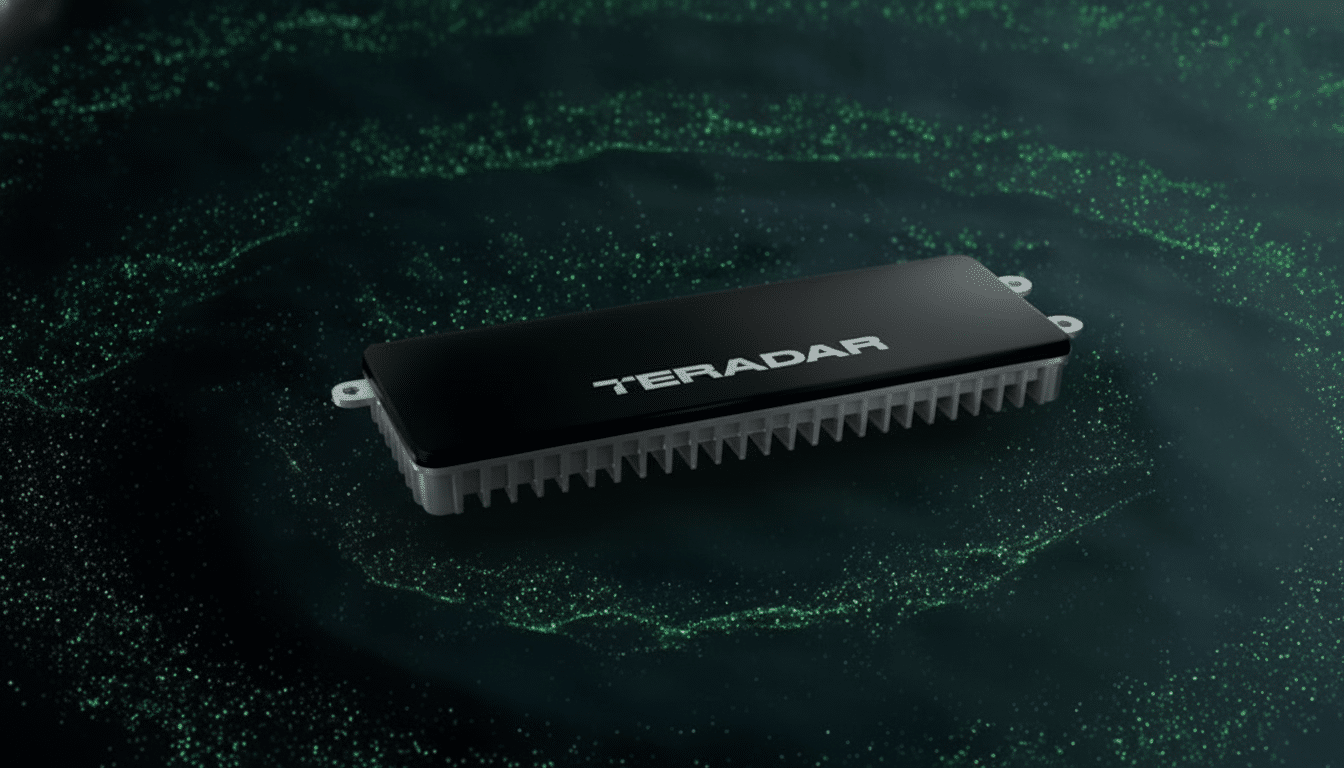
Teradar has introduced Summit, a solid-state terahertz-band vision sensor intended to provide vehicles with long-range, high-resolution perception ability in the rain, fog, snow, and road spray. The Boston startup pitches Summit as a new sensing modality that fuses radar’s all-weather toughness with lidar-like detail, looking to fill what has plagued advanced driver-assistance and autonomy programs.
The company has said it is collaborating with several global automakers and Tier 1 suppliers, and plans mass production later this decade, dependent upon design wins. The payoff: more straightforward sensor stacks, better performance in bad conditions, and a path to greater degrees of automated driving without the cost or reliability handicaps that have held back many deployments.
What Terahertz Adds to Autonomy in All-Weather Driving
Terahertz lies between microwaves and infrared on the spectrum. Its shorter wavelengths can provide more acute angular resolution than traditional automotive radar, and with an ability to penetrate aerosols and some obscurants, it enables the system to see through visual clutter that confounds cameras and lidar. In theory, that combination should yield sharper object boundaries and more reliable detections in the conditions that most frequently lead to perception dropouts.
The stakes are significant. Weather plays a role in about 20% of crashes, according to U.S. federal data from the Federal Highway Administration. If a sensor is capable of keeping range and resolution in the fog or thick spray that billows off trucks, it can cut false positives, shrink braking distances, and slash those handovers to humans. Teradar’s solid-state approach—no moving parts—is also in line with the automotive industry’s demand for devices that satisfy ASIL safety targets and can be packaged behind body panels.
Physics still matters. Terahertz signals are prone to absorption by the atmosphere and attenuation by water vapor at specific frequencies, which may restrict range. Vendors generally work in “atmospheric windows” and exploit phased-array beam steering to enhance the channel gain budgets. Teradar isn’t revealing frequency specifics, but packaging options such as antenna-in-package and SiGe or compound semiconductor front ends are going to be crucial for maintaining linearity when chasing performance in the real world.
How Summit Could Change Automotive Sensor Stacks and Costs
Today, most production vehicles are combining cameras with 77 GHz radar, and premium systems also include one or more lidars for long-range depth.
Each has trade-offs: Radars are cheap and rugged but can only resolve angles to an extent; lidars provide rich maps in 3D environments but can falter in precipitation and come with cost and complexity. If Summit can provide lidar-class resolution with radar-class robustness, automakers could simplify bill of materials by eliminating a long-range radar and a front lidar altogether, replacing them both with a single terahertz unit, along with cameras for classification.
Integration will be based on compute and fusion. Terahertz outputs will have to integrate seamlessly into current perception pipelines with camera and inertial data. Latency and synchronous calibration drift over temperature are as important as raw range. The secret sauce for OEMs is going to be predictable: a sensor that can reach automotive-grade reliability, pass ISO 26262 functional safety audits, deliver consistent performance across trim levels, and fit on a cost curve that allows it to be widely deployed rather than just placed in the flagship.
Market Timing and the Competitive Landscape for Sensors
Teradar’s arrival comes as the sensor market is in flux. Leaders in lidar have suffered contract reversals and consolidation; one high-profile U.S. lidar company, for example, is seeking bankruptcy after key deals collapsed. Meanwhile, China’s ecosystem has scaled hard—for example, Hesai has announced it crossed the 1 million lidar units produced mark—proving that cost compression and manufacturing maturity can be driven when volumes come.
Automakers remain pragmatic buyers. They are also skittish about single-supplier risk and are hesitant to jump on technologies that increase cost without moving one of the safety needles by a measurable amount. Others in the industry, such as McKinsey & Co., are estimating that automotive sensor hardware will hit over $40 billion a year by the end of the decade, but share will go to platforms that can prove clear advantages for edge cases and total cost of ownership. If terahertz comes up with fewer disengagements in low visibility and allows us to operate at higher operational design domains, it pays the rent.
Manufacturing and Regulatory Hurdles for Terahertz Sensors
Making a terahertz sensor that’s tough enough for vehicles is as much a manufacturing challenge as it is one of physics. A front-end module has to handle heat, withstand vibration and shock, and keep its calibration through years of thermal cycling. Chipsets might use SiGe BiCMOS or III-V for efficient generation and detection of high-frequency signals. Packaging, which incorporates antennas and reduces loss while meeting EMC specifications, will differentiate.
Regulatory clarity is also essential. The FCC’s Spectrum Horizons framework requires new devices at frequencies above 95 GHz to satisfy a specific set of rules, and European authorities through CEPT have studied similar bands. All production automotive deployments will require coordinated allocations, interference compensation, and intensive EMC testing. Those stages, combined with AEC-Q qualifications and ASIL certification, represent the critical path to scale.
Beyond Cars and the Defense Signal for Terahertz Tech
Teradar’s $150 million Series B, which also included the venture arm of Lockheed Martin and VXI Capital, reflects the dual-use appeal of terahertz sensing. The same physics that lets a car see through spray can help drones fly through smoke, perimeter security in low visibility, or industrial inspection of dust and steam-reddened cameras. Spreading revenue between automotive and defense can stabilize unit economics while automotive programs ramp.
For now, the things to watch for are simple:
- Repeatable performance in independent tests
- Pilot deployments with Tier 1s
- Evidence that Summit sustains range and resolution on the nastiest real-world data without driving up compute or maintenance cost
And if Teradar can tick those boxes, terahertz could at long last make the jump from lab demo to a core element of the modern vehicle sensor suite.
