


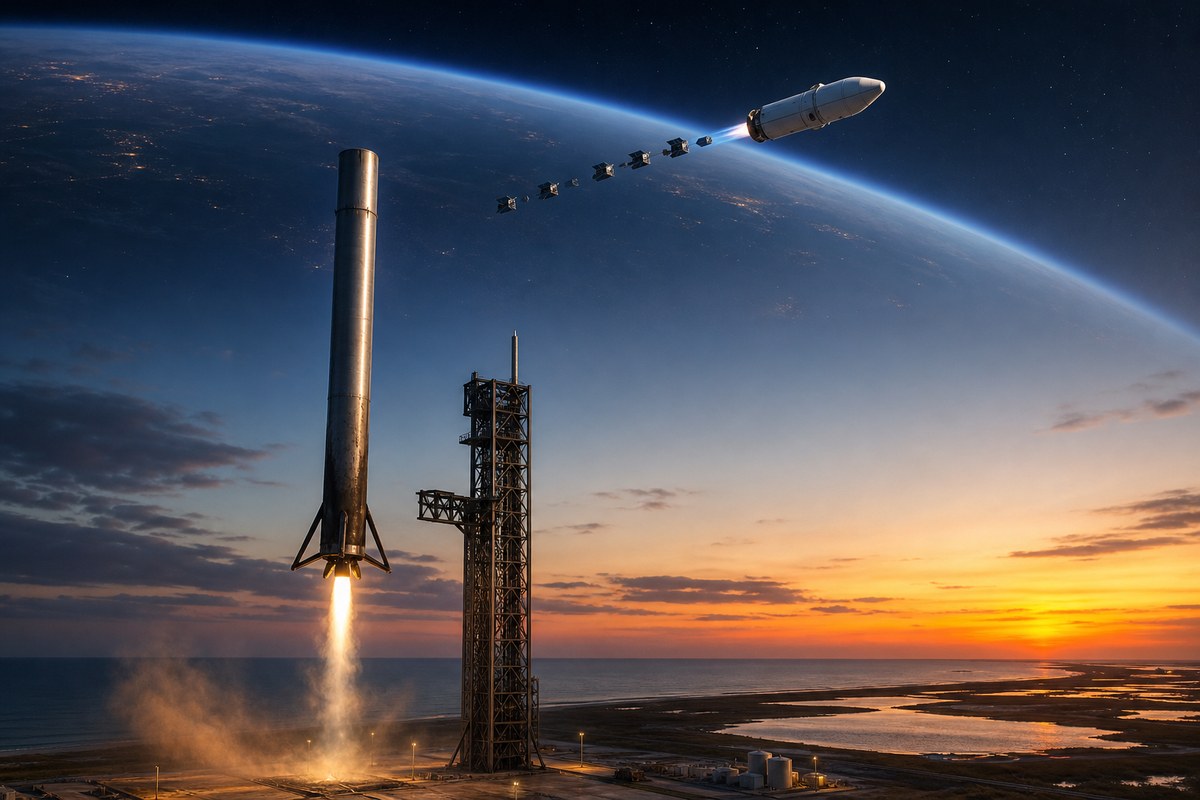
SpaceX is targeting Starship Flight 15 from Starbase in South Texas for a test designed to attempt something the company has not previously tried: returning both major parts of its launch system to the launch site. The Super Heavy booster would aim for a catch shortly after liftoff, while the Starship upper stage would first spend more than 22 hours in orbit, deploy satellites and then, if it remains healthy, attempt its own return to Starbase.
The planned flight would test the central premise behind SpaceX’s Starship program: that a very large rocket could be turned around quickly by recovering its stages rather than discarding them. But the mission remains a planned test, not a completed milestone. An FAA Current Operations Plan Advisory lists airspace periods for launch and reentry, which help establish the schedule for aviation planning but do not guarantee liftoff, a landing attempt or final mission outcomes.
The FAA advisory lists a primary launch period beginning at 2245 UTC on Nov. 13 and running into Nov. 14, with an additional operational period beginning Nov. 14. It also lists a primary reentry period beginning at 2056 UTC on Nov. 14, followed by a backup period on Nov. 15. Those are broader operational windows than the 75-minute launch opportunity SpaceX described to Space.com, which was reported to open at 2245 UTC on Nov. 13. The difference is not necessarily a conflict: airspace reservations can extend beyond the narrower opportunity in which a launch provider intends to fly.
Two recoveries separated by more than 22 hours
Flight 15’s two proposed returns have very different jobs and timelines. The Super Heavy booster is expected to turn back toward Starbase after sending Starship toward space, with its catch attempt planned about 6.5 minutes after launch, according to Space.com’s account of the mission plan. The upper stage would continue into orbit.
That upper stage is expected to deploy 26 Starlink V3 satellites and complete roughly 14 orbits before its proposed return. Spread across a flight lasting more than 22 hours, that works out to an average of about 94 minutes per orbit, consistent with the short orbital periods spacecraft have at low-Earth-orbit altitudes. The reported plan calls for an orbit near 275 kilometers, though actual flight parameters could change.

SpaceX has characterized a successful recovery of both stages as the first full recovery of an orbital launch system. The claim describes a specific combination of accomplishments: an upper stage reaching orbit and returning to the launch site, plus recovery of the booster from the same mission. It should not be read as a prediction that Flight 15 will achieve it. The schedule and mission objectives remain subject to operational, weather and regulatory conditions.
The long upper-stage flight is also a more demanding test than a booster return minutes after liftoff. A vehicle returning after orbital flight must maintain the systems needed to navigate, manage reentry heating, conduct a landing burn and approach the tower. Space.com reported that controllers would attempt the Starship return only if they determine those systems are in suitable condition. That makes the upper-stage catch an explicitly conditional objective rather than an automatic final step.
Fallback paths are part of the test plan
A decision not to return Starship to Texas would not, by itself, mean the vehicle had become uncontrolled. The reported plan includes ocean deorbit or splashdown alternatives if the upper stage cannot complete the planned return. Such alternatives give flight controllers options to end the mission away from Starbase when vehicle performance, weather or other conditions do not support a tower approach.
This distinction is important for interpreting the result. A booster catch, satellite deployment, a controlled ocean disposal and an upper-stage catch would each answer different engineering questions. Flight 15 could meet some objectives and miss others. Conversely, a scrub before launch would reveal little about the vehicle’s in-flight performance.
The FAA’s advisory provides the clearest official indication that aviation planning is underway for both ends of the mission, but it is not a final account of SpaceX’s readiness. The advisory does not establish that a launch license has been granted for a particular day, nor does it establish that the company will use the listed backup periods. As with other launches, weather, technical checks and range operations can alter the timetable.
Starlink payload adds a commercial test
The 26 planned Starlink V3 satellites would make the mission more than a recovery demonstration. Reporting by Inside Outer Space, citing SpaceX mission information, said each V3 satellite is intended to add 1 terabit of capacity to the Starlink network. If all 26 were deployed and each performed as intended, their stated nominal capacity would total 26 terabits. That arithmetic is a design-capacity estimate, not a measure of delivered consumer service or of the satellites’ eventual performance in orbit.
The same report said three of the payload satellites have been modified to image Starship’s heat shield and relay imagery to operators. If used as described, those satellites could provide observations of the upper stage during a part of flight that is otherwise difficult to inspect directly. The available reporting does not establish what imagery, if any, will be released publicly or how it would affect real-time decisions.
For SpaceX, the sequence matters as much as the final landing attempt: launch a payload-bearing upper stage, operate it through a roughly 14-orbit mission, then assess whether it is fit to return. For outside observers, the FAA windows provide dates to watch, while the actual measure of the test will depend on post-flight evidence of what launched, what reached orbit, what was deployed and whether either vehicle returned as planned.

