


Every taxi operator has lived this nightmare: phones ringing nonstop, dispatchers typing frantically, customers impatiently waiting for confirmation, and drivers asking for updates every 10 seconds. This “panic-mode dispatching” usually peaks during airport rush hours, sudden flight delays, office closing times, weekend events, and weather disruptions.
The problem isn’t demand. The real problem is how that demand enters your system.
- Why Manual Call-Based Booking Limits Scale
- A. Call congestion wipes out business
- B. Dispatcher workload increases exponentially
- C. Errors become unavoidable under pressure
- D. Growth becomes impossible
- The Rise of Omnichannel Customer Behavior
- How Automated Booking Channels Eliminate Panic-Mode Dispatching
- A. They eliminate the intake bottleneck
- B. They reduce mistakes to nearly zero
- C. They support real-time routing and faster dispatch
- D. They free dispatchers from repetitive tasks
- E. They allow fleets to scale without adding more staff
- Faster Routing & Dispatching: The Real Efficiency Multiplier
- Your Business Can’t Scale Without Multichannel Automation
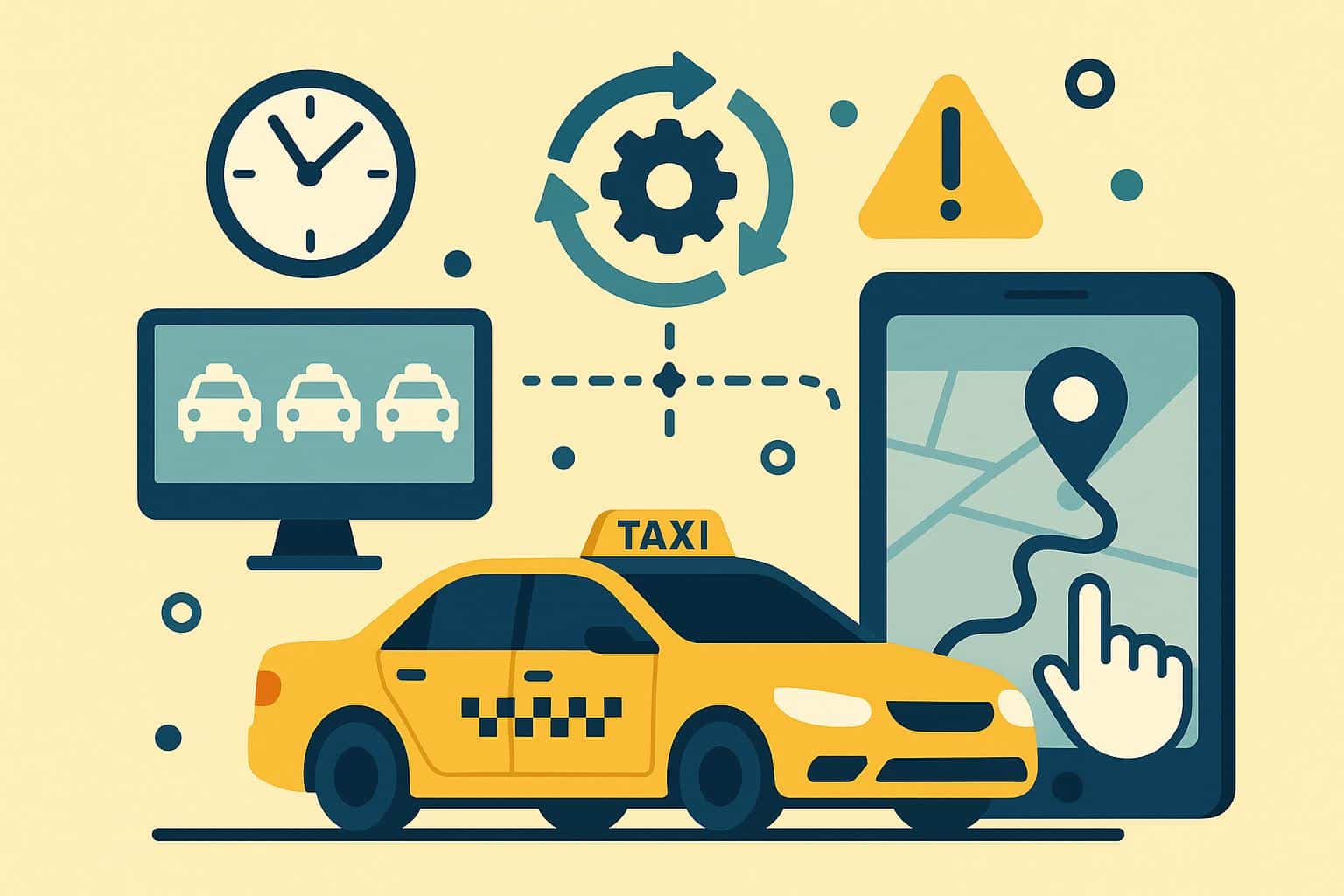
Most fleets still rely heavily on call-based booking—an outdated model that forces every ride request through a human bottleneck. And as demand rises, the bottleneck snaps.
If your operation is scaling, expanding to new service zones, or handling more corporate or airport traffic, manual intake becomes your biggest operational limitation.
In this article, we’ll break down why manual booking limits growth, why modern customers prefer omnichannel convenience, and how automated booking channels reduce chaos, speed up dispatching, and give operators the breathing room they desperately need.
Why Manual Call-Based Booking Limits Scale
At small volumes, phone bookings feel manageable. One dispatcher, two phone lines, and a notepad can handle most of the load.
But the moment volume increases—even slightly—the cracks begin to show.
A. Call congestion wipes out business
When five customers call at once:
- Three hear a busy tone
- One hangs up
- One moves on to a competitor
You lose bookings not because you lack drivers…
…but because you lack intake capacity.
B. Dispatcher workload increases exponentially
Each phone booking requires manual actions:
- Listen
- Write
- Confirm
- Reconfirm
- Re-enter into the system
- Assign a driver
- Call or message the driver
Multiply this by 100 calls during a peak hour and chaos becomes inevitable.
C. Errors become unavoidable under pressure
Wrong addresses, incorrect time entries, missing notes, duplicated bookings, forgotten cancellations—all of these issues occur when the dispatcher becomes overloaded.
D. Growth becomes impossible
If every new booking requires:
- human time
- human typing
- human coordination
…your business cannot scale.
Your dispatch team becomes the barrier standing between your fleet and your revenue.
The Rise of Omnichannel Customer Behavior
The world has changed dramatically in how people request rides.
Customers now expect to book:
- By mobile app
- Through WhatsApp
- Via website
- Using social media
- Through SMS
- By scanning QR codes
- Via corporate booking portals
When customers want convenience, forcing them into a single phone-based channel becomes a competitive disadvantage.
Today’s customer doesn’t want to call.
They want:
- Quick confirmations
- Self-service
- Live driver tracking
- No waiting on hold
- No spelling addresses repeatedly
This shift is why omnichannel booking is now the fastest-growing operational model in the taxi industry.
If your fleet still relies on phone calls, you’re competing against companies offering instant, frictionless, multi-touch experiences.
How Automated Booking Channels Eliminate Panic-Mode Dispatching
Automated booking channels don’t just replace phone calls—they fundamentally transform operational flow.
If you too are looking forward to understanding how to manage last minute bookings easily, read our latest blog. Now let’s explore the advantages.
A. They eliminate the intake bottleneck
When customers book through:
- Web portal
- App
- WhatsApp
- Chatbot
- Corporate dashboard
…the system captures details instantly—no dispatcher involvement.
No busy phone lines. No human delays. No manual entry.
All bookings reach a centralized dashboard in real time.
This alone reduces 70–80% of dispatcher stress during peak hours.
B. They reduce mistakes to nearly zero
Automated channels force customers to enter:
- Correct pickup time
- Exact address
- Vehicle type
- Special notes
No misheard information. No mistyped entries. No forgotten details.
The system becomes the single source of truth—clean, accurate, error-free.
C. They support real-time routing and faster dispatch
With multichannel booking, the system has immediate access to:
- Location of available drivers
- ETAs
- Distance
- Traffic conditions
- Vehicle categories
- Service restrictions
Automated matching can assign the nearest and best driver without dispatcher intervention.
This reduces dispatch time from minutes to seconds.
For fleets handling last-minute requests—especially airport or corporate rides—this speed can be the difference between losing and securing high-value jobs.
D. They free dispatchers from repetitive tasks
Once automation handles the intake and initial allocation, dispatchers can finally focus on:
- Exception handling
- VIP and corporate clients
- Issue resolution
- Monitoring ETAs
- Handling driver escalations
This shift turns dispatchers into overseers—not data-entry operators.
E. They allow fleets to scale without adding more staff
With automated channels:
- 200 bookings require the same staff as 50
- Surge-time volume doesn’t overwhelm the team
- New zones can be added without hiring more dispatchers
- Night operations become smoother
This is the only sustainable path for scaling a modern fleet.
Faster Routing & Dispatching: The Real Efficiency Multiplier
Routing is where automated booking channels truly shine.
When the system receives the booking instantly:
- It calculates ETAs
- Finds the nearest driver
- Checks vehicle type availability
- Evaluates trip feasibility
- Auto-assigns the job
This all happens within seconds.
Contrast that with manual dispatch:
- Dispatcher picks up the phone
- Types details
- Checks availability
- Searches for drivers
- Calls multiple drivers
- Waits for responses
Automation compresses a 3–5 minute workflow into 2–5 seconds.
And at scale, those saved seconds add up to thousands of additional bookings per month.
Your Business Can’t Scale Without Multichannel Automation
Today’s taxi industry is competitive. Margins are tight. Customer expectations are sky-high.
If your fleet still depends on call-based booking, you will experience:
- Dispatcher burnout
- Customer dissatisfaction
- SLA violations
- Cancellations
- Slow response times
- Lost bookings
- Stunted growth
Automated booking channels solve these challenges not by adding more people—but by removing unnecessary human friction.
The fleets winning today are those who:
- Accept bookings anywhere
- Process them instantly
- Dispatch them automatically
- Coordinate effortlessly
- Reduce chaos during peak hours
And for operators handling unpredictable last-minute demand, automation is no longer optional—it’s an operational necessity.
