


NASA’s Nancy Grace Roman Space Telescope launched from Kennedy Space Center in Florida at 7:26 a.m. EDT Sunday aboard a SpaceX Falcon Heavy, according to an AFP report carried by RFI. The observatory is designed to survey enormous sections of the infrared sky, providing astronomers with a new way to examine galaxies, exploding stars and worlds beyond the solar system.
The launch begins a mission intended to investigate questions surrounding dark energy, dark matter and the changing rate of cosmic expansion. It will not produce those answers immediately. Roman must first travel to its operating orbit, deploy and activate its systems, and undergo calibration and testing in a commissioning period NASA expects to last about three months.
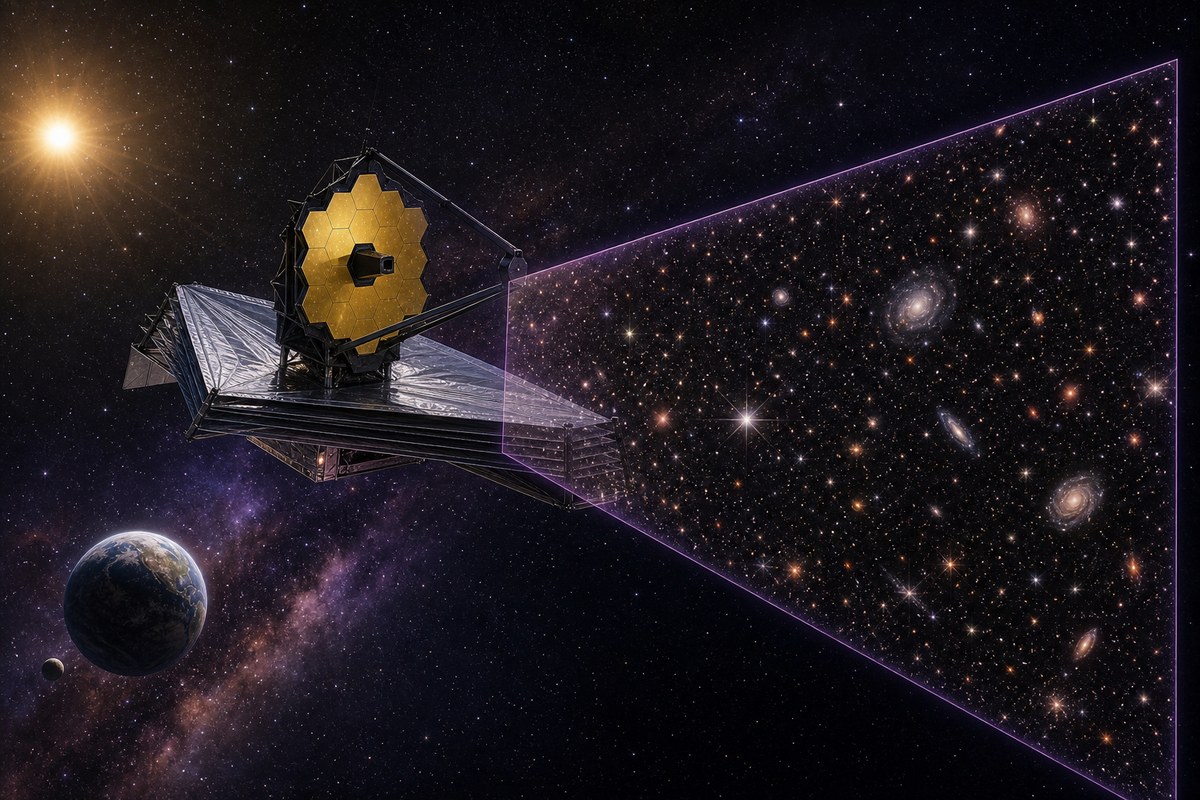
A space telescope built for broad surveys
Roman’s principal scientific tool is its Wide Field Instrument, a 288-megapixel, multi-band near-infrared camera. NASA’s mission reference says its field of view is at least 100 times larger than Hubble’s while maintaining image quality comparable to Hubble’s. In practical terms, Roman is designed to collect detailed pictures over much larger areas of sky in each observation, turning a capability often used for narrow targets into a survey-scale tool.
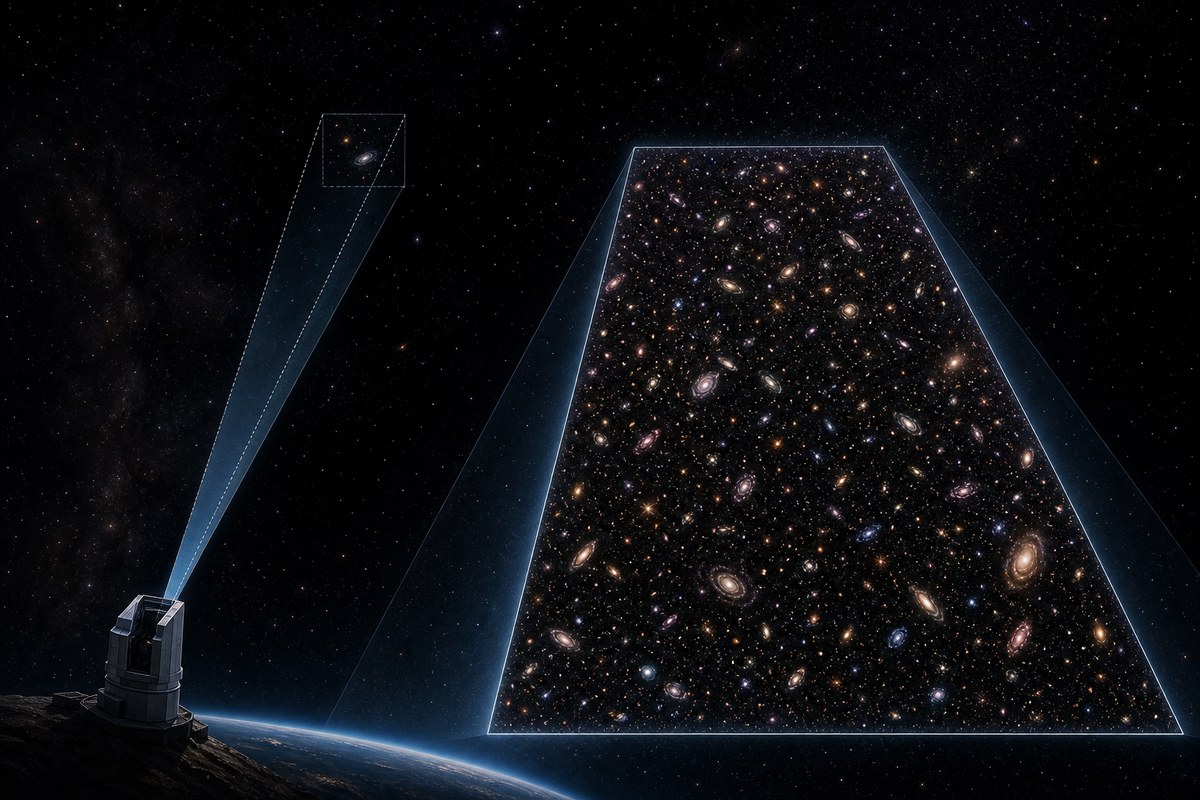
That wider view is important for research that depends on large, representative samples. A telescope studying a single distant galaxy can reveal its structure and color, but measurements of how galaxies are distributed across vast distances require observations spread across broad cosmic territory. Roman’s infrared sensitivity also allows it to observe light shifted toward longer wavelengths as the universe expands, a useful feature for studying distant galaxies and supernovae.
NASA says Roman is intended to observe more than a billion galaxies over its mission. Those observations could help researchers compare competing descriptions of the universe’s expansion history and the invisible matter inferred from its gravitational effects. They are measurements that can constrain physical models, not a guarantee that the mission will identify what dark energy or dark matter is.
The observatory is headed for a quasi-halo orbit around the second Sun-Earth Lagrange point, or L2, roughly 1 million miles from Earth. NASA selected that region for Roman’s planned observations and operations; it is also the destination described in the agency’s launch-broadcast update.
Planet census and a technology demonstration
Roman will also search for exoplanets, including through observations meant to detect the gravitational effects of a foreground object on light from a more distant star. NASA has projected that its surveys could find roughly 100,000 new exoplanets. That is a forecast based on expected survey performance and planet populations, rather than a tally of confirmed discoveries.
Its second instrument, the Coronagraph Instrument, has a different role. NASA describes it as a technology demonstration intended to advance methods for blocking starlight so that faint planets near bright stars may be observed. The instrument is not the main driver of Roman’s broad surveys, but its performance could inform the design of future missions seeking to image and characterize planets around other stars.
The two approaches reflect different astronomical problems. The wide-field camera is designed to efficiently build large catalogs and maps. The coronagraph is aimed at the much more technically difficult task of separating a planet’s faint light from the glare of its host star. Results from either program will depend on how the instruments perform after commissioning and on later scientific analysis.
Launch reporting and the next steps
NASA’s online coverage documented the final countdown Sunday morning, including a targeted 7:26 a.m. liftoff from Launch Complex 39A and a 7:19 a.m. update that Falcon Heavy engine chill had begun. AFP subsequently reported that the vehicle lifted off at the scheduled time. NASA had said before launch that Roman was flying nine months ahead of schedule.
Roman is managed by NASA’s Goddard Space Flight Center. Unlike some major observatories that reserve early data for selected investigators, NASA says Roman data will have no proprietary period and all observing time will be community directed. That policy is intended to allow researchers worldwide to work with the mission’s observations once they are processed and released.
The telescope also carries technology with ties to Hawaiʻi. A Maui Now report on University of Hawaiʻi participation said the Wide Field Instrument’s 18 infrared sensors descend from HAWAII detector technology developed by Institute for Astronomy researchers. NASA’s public mission reference specifies the camera’s 288-megapixel design but does not independently detail that detector lineage.
Roman’s first operational months will determine how closely the observatory meets its planned performance. Its scientific case rests less on any individual picture than on the scale of the resulting archive: repeated, high-resolution infrared observations that can be used to test models of the universe and broaden the search for planets long after the launch vehicle has left the scene.

