


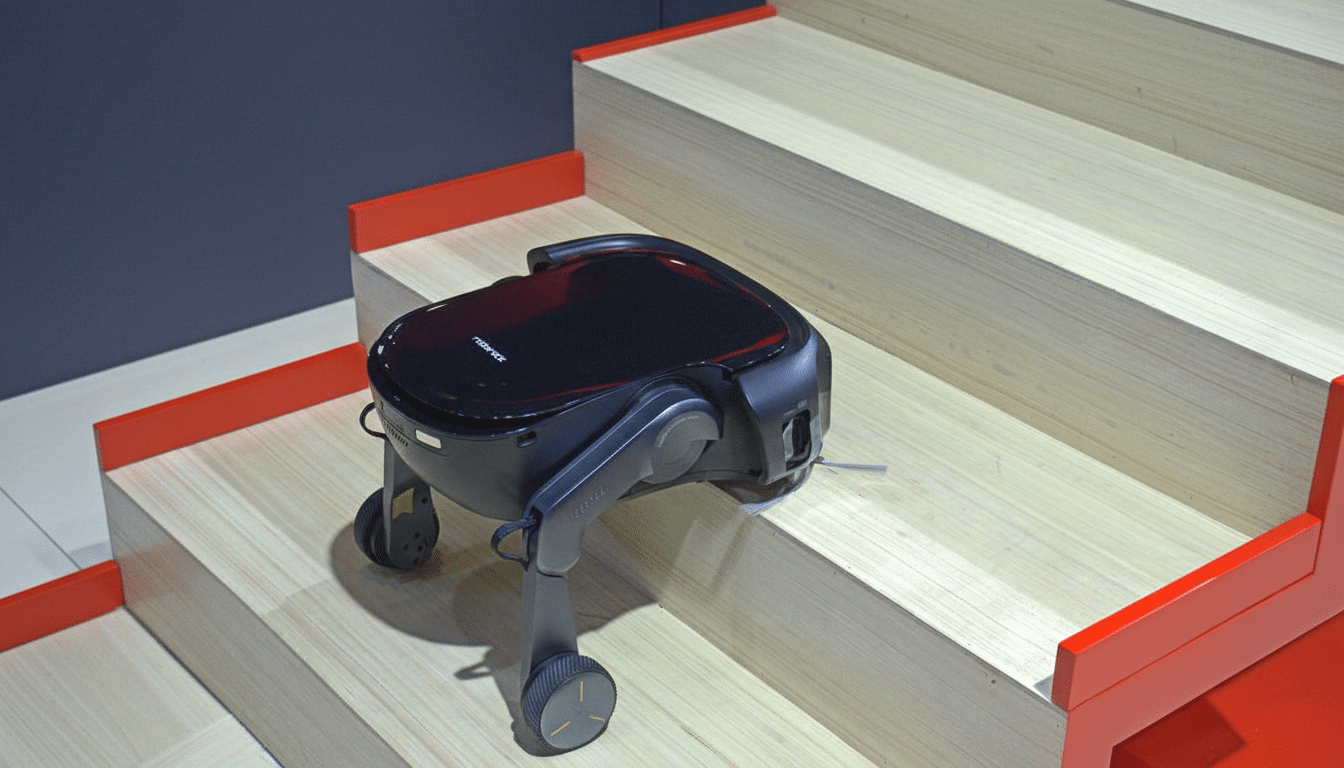
Roborock chose the global stage of CES to introduce one of the most bizarre home robots in recent memory: a self-balancing, wheel-legged vacuum that it calls the Saros Rover and which can climb stairs and navigate uneven thresholds, all while cleaning upside down on its stilt legs.
It’s a bold try at addressing the last big challenge of robot vacuums — stairs — without human intervention.
A Real Homemade Wheel-Leg Design for Stair Cleaning
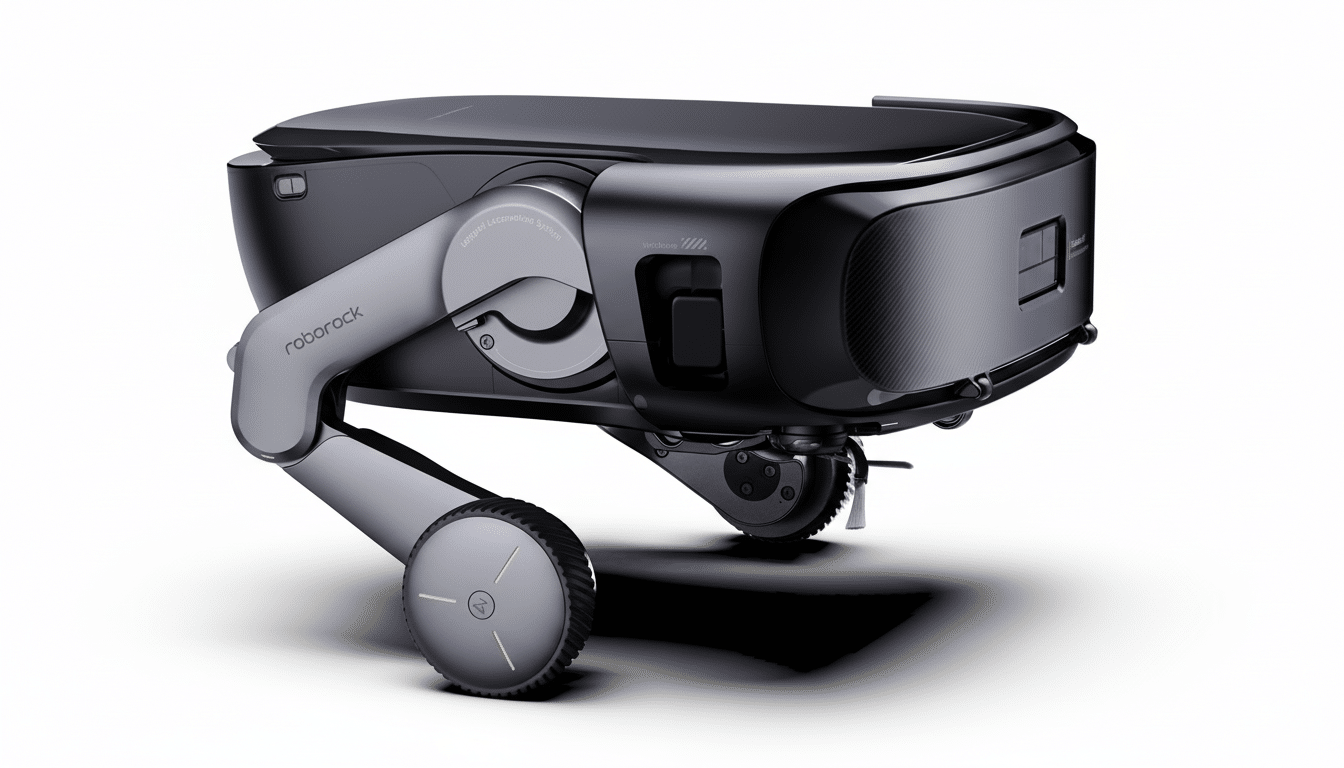
The Saros Rover travels on a pair of articulated legs, each studded with a wheel, which can be operated independently. Once lifted off the ground, onboard software shifts the body in real time to stay level even as its legs move through varied step heights or ramp inclines — not unlike how a Segway behaves. The product is a machine that not only covers the second floor — it can wipe each tread methodically on the way up.
A nifty sequence allows for that. While the Rover is rising to the next step, it deploys a single leg that remains on the lower step for stability; meanwhile, the cleaning module sweeps and vacuums the current step. Once it crosses the step, the leg withdraws and the robot steps forward to a new one. Roborock claims that the system should be able to manage curved staircases and non-stair obstacles such as ramps, a hurdle that has stumped many early prototypes.
That’s a noteworthy deviation from previous designs that send vacuums to and fro without cleaning along the way. An example product that does this is MarsWalker from eufy; it concentrates on transport. The Rover, by combining mobility and cleaning in a single routine, reflects broader advances made in robotics that marry wheels with legs — a field being pursued in academic labs at institutions like Carnegie Mellon and ETH Zurich, as well as showcased in the mobility escapades of robots like Boston Dynamics’ Spot.
Why Stair Cleaning Has Been So Difficult
Stairs offer all the worst-case variables for a household robot: gaps in surfaces, sharp corners, varying step heights, and serious consequences if it takes a spill.
Most robot vacuums sidestep the issue altogether with cliff sensors and scheduling rules. For a robot to actively clean stairs, it must put the center of gravity and slip resistance of its base in balance while also aligning its suction orifice — an inverted-pendulum balancing act while performing real work.
There’s also the cleaning science. Fines on stairs can be aerosolized if the brush and suction aren’t relatively close to the edge, and lots of stair nosings have little lips that create turbulence. The Rover’s claim is that self-balancing ensures the pickup angle remains consistent too, which reduces such losses. For a long time, robot designers commenting on IEEE forums have pointed out that wheel-leg systems trade increased mechanical complexity for real-world adaptability; the proof will come when (if) this concept approaches production, in terms of durability, battery life, and noise.
Saros 20 Series Pushes Mobility and Mopping
During development of the Rover, but not yet ready to share, Roborock also showed off two high-end additions to the Saros line, designed for mainstream floors. The Saros 20 ushers in an AdaptiLift Chassis 3.0, capable of handling room-to-room transitions as tall as 3.3 inches, one of the highest specs available for door thresholds and deep rugs. Navigation is managed by the StarSight Autonomous System 2.0, which maps homes in three dimensions and detects more than 200 types of objects to navigate around hazards like cables, shoes, and pet bowls.
Beneath the surface, meanwhile, the Saros 20 boasts 35,000 Pa of suction — far more than its premium brethren. There is a retractable FlexiArm for toe-kick recesses under cabinets, and two scrubby, dual-spinning mop heads that can generate 200 RPM with up to 12 N of reaction force to attack stuck-on spills. The high-temperature, maintenance-friendly dock with 212°F water washing and 131°F warm-air drying can minimize odor and biofilm.
The Saros 20 Sonic has the same climbing system and vacuum power, but shrinks to just 3.1 inches tall. It can also tuck its LiDAR tower away temporarily to slide under low-lying furniture and use cameras to find its way around. Its VibraRise 5.0 mopping system vibrates at up to 4,000 times a minute with just one pad, cleaning hard-to-shift dirt and increasing downforce on tough messes to 14 N. We’ll be getting pricing and availability a bit closer to when it hits retailers.
More Options for All Budgets Across Roborock’s Line
For homes where cutting-edge mobility isn’t a requirement, the Qrevo Curv 2 Flow offers 20,000 Pa of suction alongside a constantly self-cleaning SpiraFlow mop. Its 10.6-inch roller can spin up to 220 RPM with 15 N of pressure, and on-board smarts mean the vacuum can alternate between sucking dirt off your floor and mopping messes. The dock has a goal of extending maintenance intervals to beyond two months based on 167°F water cleaning and 131°F warm-air drying. Introductory pricing begins at $849, rising to $999 after the launch window.
In addition, Roborock showed off the F25 ACE Pro and a handheld wet/dry vac for quick cleanup. Suction reaches a maximum strength of 25,000 Pa, while the scrub head spins at 430 RPM with 30 N worth of pressure and is able to generate dense microbubble foam on demand. Hair-rejection scrapers head off jams, while the base dock handles maintenance with 203°F high-temp washing and 203°F hot-air drying. It starts at $549 early, and will increase to $699.
What to Watch While Rover Marches Toward Reality
Converting the Saros Rover from a crowd-pleasing demo to reliable hardware for the home will depend on a few variables: how durable actuators can be going up and down stairs daily, what kind of battery life is possible with more climbing and balancing, and whether it can navigate wet or dusty steps safely. The Consumer Technology Association, which organizes CES, has named home robotics as a growth category, though the lesson of previous breakthroughs is clear: The actual home is harsher than any test lab.
If Roborock can produce a self-balancing robot that cleans under your bed, all while making a reasonable amount of noise at a reasonable cost, it could change the way we think about premium floor care — and bring pressure to bear on competitors like iRobot, Ecovacs, eufy, and others when it comes to considering mobility. One warning for shoppers: The suction numbers recorded in Pascals aren’t standard across brands, so real-world testing will matter more than spec sheets. And so for now, the Saros Rover is CES’s most audacious swing at what has been a long-unsolved household chore.
