


A new community-built tool is igniting fresh optimism that true native PC ports of PlayStation 2 games may finally be within reach. Called PS2Recomp, the project aims to convert PS2 binaries into modern C++ that can be compiled and run as standalone applications on today’s hardware, bypassing the usual overhead and quirks of emulation.
What PS2Recomp Tries To Do: Static Recompilation Goals
Rather than interpreting console instructions at runtime, PS2Recomp pursues static recompilation. It analyzes a game’s original MIPS R5900 code, then transforms that logic into C++ that can be compiled for x86 or ARM. With a compatible renderer to handle the PS2’s Graphics Synthesizer outputs and careful handling of Vector Unit microcode, the final result could be a native executable with PC-grade performance and features.

The promise is straightforward: eliminate heavy timing emulation, reduce CPU overhead, and unlock flexible enhancements such as higher resolutions, ultrawide support, modern controller mappings, improved frame pacing, and mod hooks. It’s similar in spirit to projects like N64: Recompiled, which has delivered native PC builds of The Legend of Zelda: Majora’s Mask, Banjo-Kazooie, Star Fox 64, and Mystical Ninja Goemon.
Crucially, native ports can enable thriving mod ecosystems. After a major update last year, the N64: Recompiled toolchain enabled drag-and-drop mod support, with more than 120 mods available for Majora’s Mask alone. If PS2Recomp matures, expect a similar wave of community-driven enhancements.
Why Not Just Use Emulators Instead Of Recompilation
Emulation remains indispensable and remarkably capable—PCSX2, for instance, has seen significant gains from modern renderers and per-game patches—but it still carries overhead and timing complexities. The PS2’s architecture is notoriously idiosyncratic, making cycle-accurate behavior and perfect compatibility a moving target.
Static recompilation tackles the problem from a different angle. By converting game logic into natively compiled code, it strips away layers of translation and timing simulation. The payoffs include smoother performance on modest hardware and freedom to implement features that are tough or fragile under emulation, such as unlocked framerates without physics breakage or robust widescreen implementations.
Why The PS2 Is A Tough Nut To Crack For Recompilers
Any tool promising PS2-native ports has to wrestle with the console’s unusual design. The Emotion Engine blends a MIPS R5900 CPU with two Vector Units (VU0 and VU1), a high-bandwidth DMA subsystem, scratchpad RAM, and the Graphics Synthesizer—each with custom behaviors, edge cases, and timing assumptions that games often exploit.
That’s why PS2Recomp, like other recompilers, won’t be a one-click solution. Each game can require bespoke work: validating control flow, translating VU microcode, mapping graphics calls to modern APIs, and ensuring game-specific tricks still function. The payoff, however, is a maintainable codebase that can be optimized and improved over time.
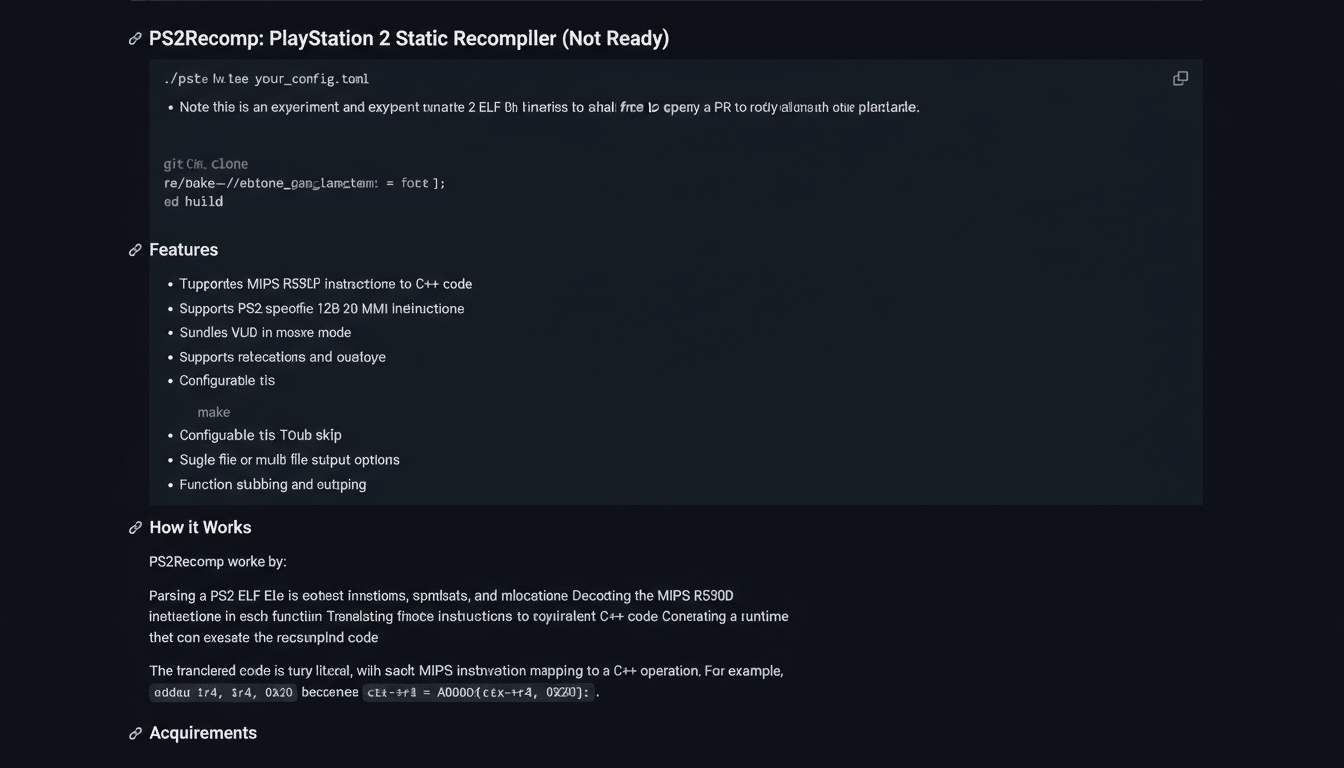
The broader trend backs this approach. Alongside N64: Recompiled, projects like XenonRecomp and XenosRecomp target the Xbox 360 era—with Sonic Unleashed as an early example—while GameCube tools have assisted efforts like the decompilation of Mario Party 4. PS2Recomp is the next ambitious step in that continuum.
Why This Matters For Preservation And Game Access
The PS2 remains the best-selling home console in history, with roughly 155 million units sold and a library exceeding 3,800 games. Yet access to that catalog is shrinking. A 2023 study by the Video Game History Foundation found that 87% of classic games in the United States are commercially unavailable, underscoring the need for robust preservation pathways.
Recompiled ports can extend the lifespan of beloved titles by running natively on current platforms, supporting higher fidelity and modern input, and enabling accessibility improvements that were impossible on original hardware. Communities typically require players to supply their own legally obtained game assets, a common approach that balances preservation goals with rights considerations.
What To Expect Next From The PS2Recomp Project
PS2Recomp is early and evolving quickly as developers offer to test, refine, and contribute. A community hub is reportedly in the works, and the initial roadmaps suggest incremental targets rather than sweeping, instant compatibility. Think months and years, not days.
Success will likely start with titles that use simpler engines or lean less on esoteric VU microcode and GS behavior. Over time, as the toolchain matures and more render backends and translation layers solidify, the door opens to higher-profile games and richer features like Vulkan or DirectX 12 renderers, 60 fps and beyond, and scalable mod frameworks.
If momentum holds, PS2Recomp could mark a turning point: not a replacement for emulators, but a complementary path that brings landmark PS2 experiences into native form with room to grow. For preservationists and players alike, that’s a compelling reason to watch this space.
