


A single, pocketable cable promising to power nearly all your daily devices just landed around the $22 mark, and it’s the rare budget buy that checks the right technical boxes. The GoCable 8-in-1 EDC cable pairs a 100W Power Delivery rating with swappable connectors and a few clever tools, aiming to replace the tangle of cords most of us still carry.
Why 100W Matters for One Cable That Does It All
Charging specs are the make-or-break feature here. At up to 100W via USB-C Power Delivery, this cable can top up phones and earbuds at modest rates, then step up to tablets and many ultraportable laptops that accept 65W–100W over USB-C. That means devices like the MacBook Air, Dell XPS 13, or Lenovo ThinkPad X1 can be supported when paired with a capable USB-C charger.
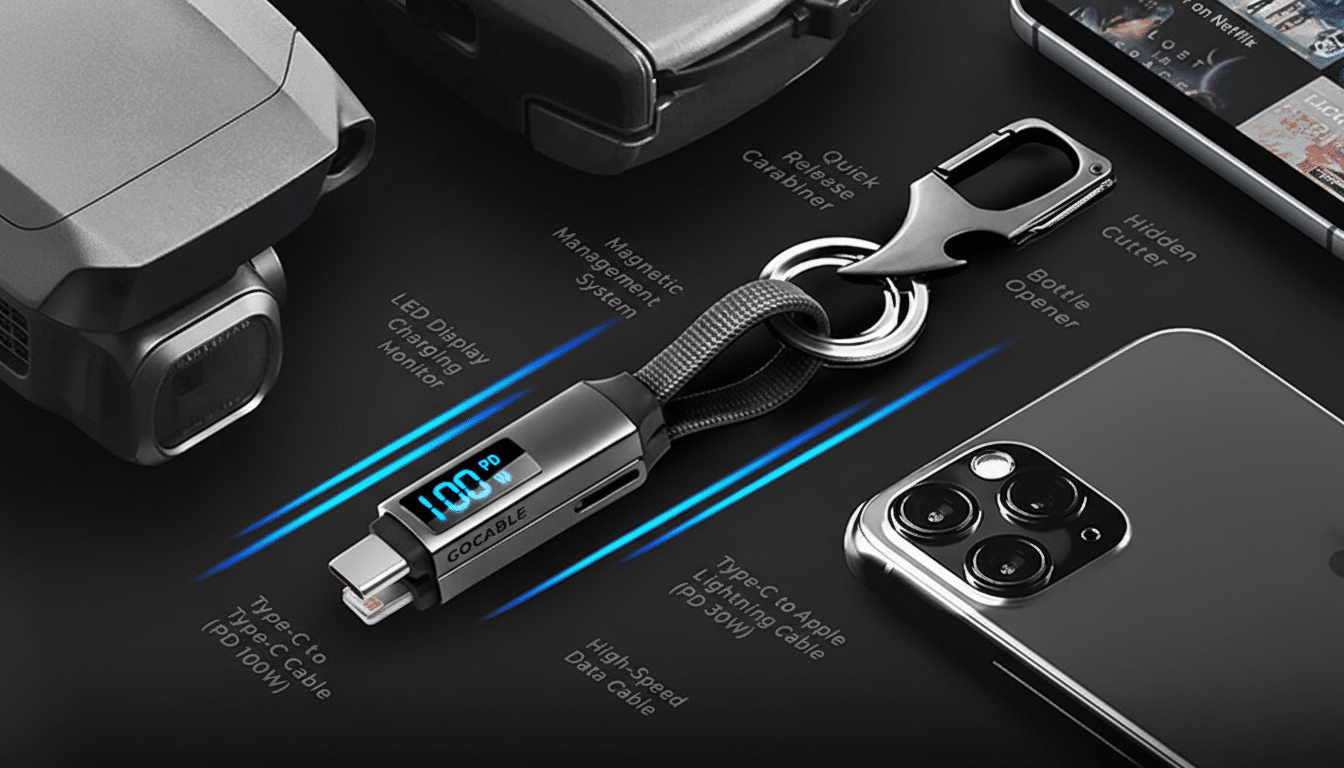
The USB Implementers Forum has pushed PD as the common language for fast charging, and 100W sits in the sweet spot before the newer Extended Power Range tier. In practice, the cable’s integrated LED readout helps demystify what’s happening: you see real-time wattage instead of guessing if your charger–cable–device trio is negotiating correctly.
Design Built for Everyday Carry and Durability
GoCable’s take on “8-in-1” blends core charging with small conveniences. Beyond the USB-C to USB-C and Apple Lightning tips, there’s a magnetic wrap to keep the short cable tidy, a carabiner to latch onto keys or a bag, and even a bottle opener and safety cutter for opening packages without mangling them. At roughly 40 grams with a braided nylon exterior and metal alloy hardware, it feels purpose-built to live on a keychain rather than at the bottom of a tech pouch.
The compact form factor is the selling point: you’re more likely to have it when you need it. In real-world travel, a short, sturdy lead that’s always on hand beats a perfect but forgotten cable every time.
Compatibility in a Transition Year for USB-C Devices
Device ecosystems are converging on USB-C. The European Commission’s common charger rules accelerated the shift, and Apple’s recent iPhone lineup now charges via USB-C. Still, Lightning remains relevant for older iPhones and accessories, which makes the included Lightning tip practical for mixed households.
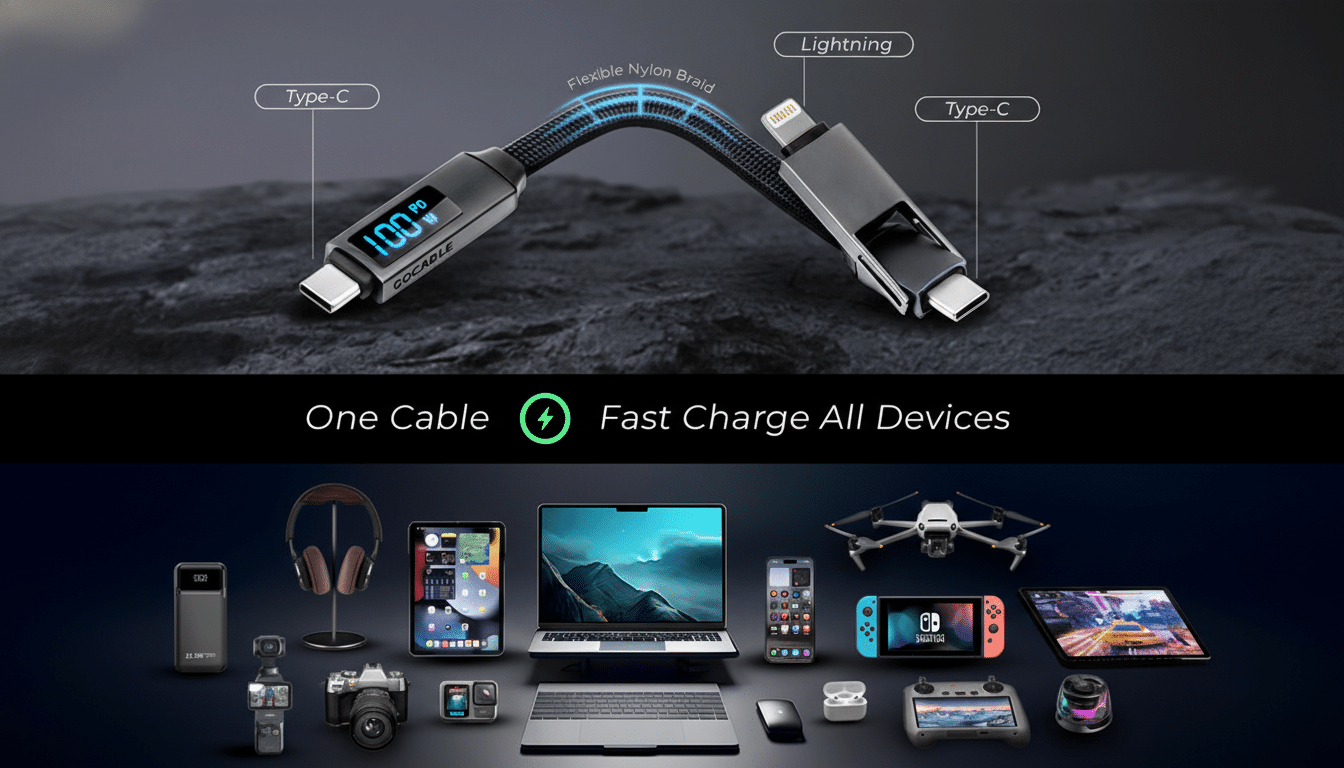
Deloitte estimates U.S. households now average more than 20 connected devices, spanning phones, tablets, laptops, wearables, and smart accessories. That diversity is why “universal” cables often come up short—either they lack the wattage for laptops or the connector for legacy gear. A 100W cable with both USB-C and Lightning coverage threads that needle for most people.
Real-World Use Cases and Limits You Should Expect
Think of common scenarios: fast charging a phone on a train, giving an iPad Pro a midday boost at a café, or topping up a work laptop during a meeting. If your power brick supports PD and the device can accept high-watt charging, this cable should step up. The LED readout is particularly helpful when diagnosing slow charge rates—if you see single-digit watts, you’ll know it’s the adapter or device limiting speed, not the cable.
As with any EDC cable, there are trade-offs. Short cables are ideal for power banks and desktops but awkward for wall outlets without a nearby surface. Some gaming laptops and high-performance workstations demand more than 100W or proprietary charging. And while the build feels robust, frequent keychain use is tough on any cable; checking for fray points over time is simply good practice.
Price and Value Against the Field of EDC Cables
At roughly $21.99, the GoCable undercuts many multi-tip chargers that hover between $25 and $40, and it’s far cheaper than premium braided USB-C 240W cables—though those lack Lightning and EDC add-ons. You are effectively paying for versatility and convenience rather than raw throughput at the cutting edge, and for most everyday gear, that’s the smarter trade.
For buyers, a simple checklist helps:
- Confirm your power adapter’s wattage.
- Verify your laptop’s USB-C PD compatibility.
- Keep a higher-watt brick handy for bigger jobs.
If those boxes are ticked, a small 100W cable with universal tips and an always-with-you design is exactly the kind of low-cost upgrade that ends cable clutter for good.
Bottom Line: A $22 100W EDC Cable Worth Carrying Daily
In a market crowded with lookalike cords, a $22 100W EDC cable that actually covers phones, tablets, and many laptops—and tells you what it’s delivering—earns a spot on your keychain. It’s not just another cable; it’s the one you’ll have when it counts.
