


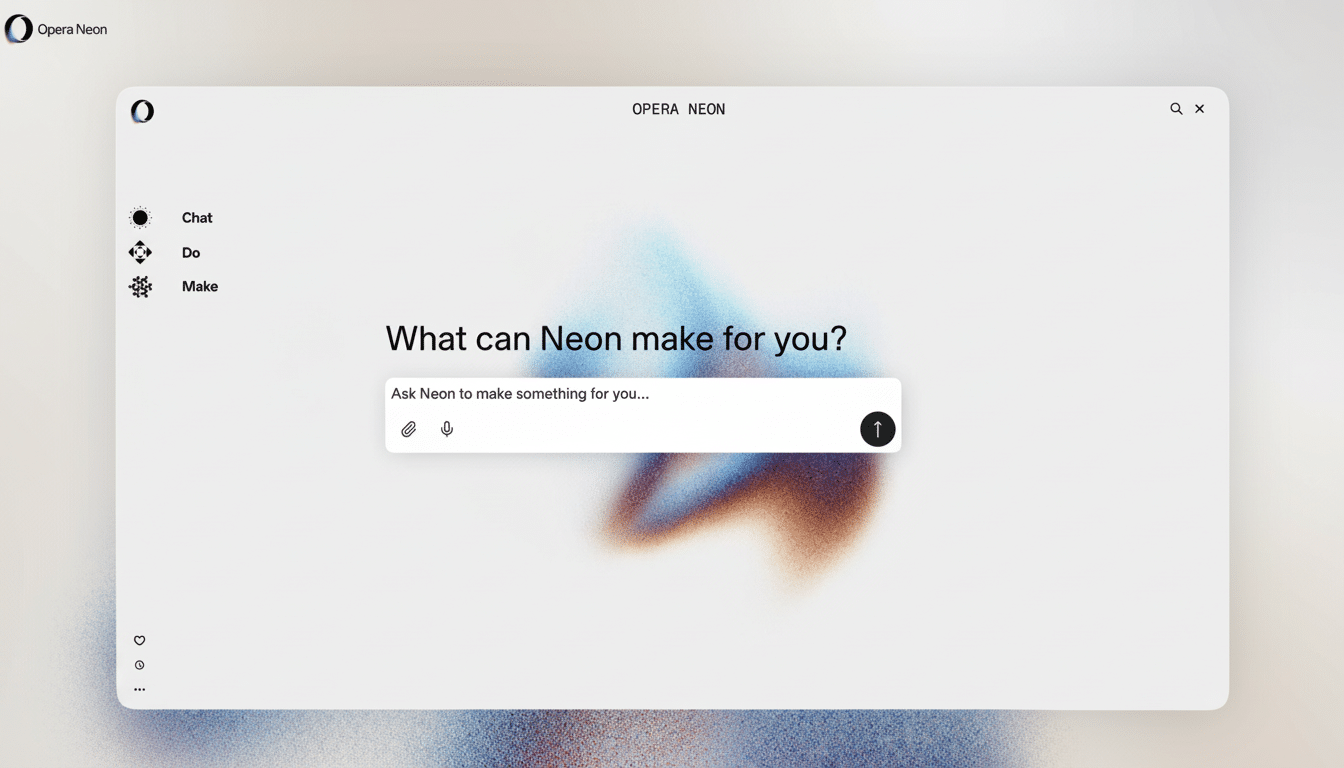
Opera is introducing Neon, an AI-powered web browser that rethinks what a browser should look and feel like today. Rather than financing the development of software with search deals and ads, Neon requires users to pay $9.90 a month for a bundle of built-in AI agents, premium models, and workflow tools meant to transform casual browsing into task-driven, automated sessions.
The company positioned Neon as a moving-fast, early-access product for enthusiasts who want all the newest AI capabilities inside their main browser, and promised: Neon will get major updates every week.
- What Neon promises for AI-assisted browsing and tasks
- The $20 pitch and access to premium AI models explained
- How Neon compares to competitors in AI-powered browsing
- Privacy and safety questions about Neon’s data policies
- Strategic stakes for Opera and its browser market share
- Availability of Neon and what’s next for Opera’s AI plans
What Neon promises for AI-assisted browsing and tasks
Neon integrates an AI chatbot right within the browser interface, making it easy to ask for information while you view pages, read summaries of long articles, and even orchestrate actions without juggling a bunch of different apps. It can use your recent browsing history as context, so you could ask for details from a YouTube video that you watched last week or surface notes from the articles you skimmed yesterday.
Neon’s workflow hinges on two concepts: Cards and Tasks. Cards are reusable prompts for recurring work — such as a product comparison or a weekly research roundup. Tasks are confined workspaces that wrap tabs and AI chats around a single project, akin to tab groups but with an agent that remembers context inside each space. Striking a more transcendental research note would yield the much fuller synthesis complex subject matter demands.
The $20 pitch and access to premium AI models explained
Outside of the browser itself, the service offers access to premium AI models such as Gemini 3 Pro, GPT-5.1, Veo 3.1, and Nano Banana Pro, as well as access to Opera’s community channels and direct lines to its developers. The company positions Neon as a living project that grows week by week — an appeal to early adopters with fat wallets rushing to gain access to frontier features and speedier iteration.
Charging a monthly fee is unusual in the category, whose core product has been free for years. A third point that the work suggests is the economics of AI: industry estimates suggest that inference costs can be a few cents per complex query, especially for multimodal models with video generation or analysis.
How Neon compares to competitors in AI-powered browsing
Neon’s pricing fits into existing popular AI tiers: Perplexity Pro is $20 per month, Google One AI Premium is $19.99, Microsoft Copilot Pro is $20, and Poe’s subscription goes for $19.99. The distinction is that Neon isn’t simply an AI app — it’s the browser itself, with the agent built into navigation, research, and tab management.
Other AI-first browsing experiences are starting to appear, but incumbents in the space appear to be moving more cautiously. Google also recently proposed a security model for “agentic” features that attempts to minimize attack surfaces, and Brave has started testing agentic workflows in a nightly build with an isolated profile so users can keep AI and non-AI sessions separate.
Privacy and safety questions about Neon’s data policies
Since Neon operates on your browsing history, it’s going to need really good data governance in order to serve as effective a trust lever. Users will want to see clear retention policies, local-versus-cloud processing options, and single on-off toggles for training and personalization. Advocacy groups including the Electronic Frontier Foundation have asked vendors to limit what they collect and ensure that consent means something when AI agents track people on sites.
In practice, the purposefulness of Neon’s privacy posture — sandboxing, memory scoping, and transparency about what data goes through which model — could determine whether it can outgrow hobbyist use to reach professional and enterprise markets.
Strategic stakes for Opera and its browser market share
Opera has a history of punching above its weight class on features, but still lags the titans. StatCounter numbers reveal that Chrome has more than 60 percent of global browser share, while Safari’s is close to 20 percent and Opera’s hovers at about 3 percent. Opera has a paid tier, though that is billed annually and continues to rely primarily on search partnerships. Opera’s expansion of its service suite could provide a recurring revenue stream and be aimed at users who use the browser as a productivity hub.
Even a small conversion could make a difference financially. Finally, if the $19.90 subscription persuades even a thin sliver of Opera’s audience to pay for AI-native workflows — research digests, content creation, data extraction, and more — the browser could serve as a gateway to continued, relatively high-margin software revenue.
Availability of Neon and what’s next for Opera’s AI plans
Neon leaves limited testing and goes into public availability as a paid-for early-access product. Opera says its other browsers — Opera One, Opera GX, and Opera Air — will remain free with AI features intact, essentially providing a no-charge on-ramp to users while making Neon the more premium choice for heavy use of AI.
The wager is obvious: if AI agents are the future of browsing, then the browser itself could be your subscription. Neon is Opera’s test case in whether the full-stack, AI-native experience — models, memory, and workflows inside the tab strip — can be demonstrated to justify a $20-a-month price.
