


OpenAI is preparing to place targeted ads inside ChatGPT, marking its first meaningful move into advertising and signaling how the $500 billion company intends to monetize a massive user base. The initial test will run in the U.S. for people on the free tier and the new $8-per-month Go plan, with ads tailored to the subject of the conversation. Premium tiers — Plus, Pro, Business, and Enterprise — are not part of the rollout.
What changes users will see inside ChatGPT ad tests
Ads will appear at the bottom of a chat thread and align with the topic you’re discussing — think cookware promos after a recipe exchange or a language app offer when practicing Spanish. OpenAI says users can dismiss ads, view an explanation of why they were shown a specific promotion, and turn off personalization entirely, which should strip targeting down to contextual basics. The company also commits to not serving ads to accounts it believes belong to people under 18.
- What changes users will see inside ChatGPT ad tests
- Who will see ads in ChatGPT and who will not during tests
- Privacy controls, user choices, and compliance commitments
- Why ads are coming to ChatGPT now and how big this could be
- Trust and user experience risks in conversational ad formats
- What to watch next as ChatGPT ad testing expands or evolves
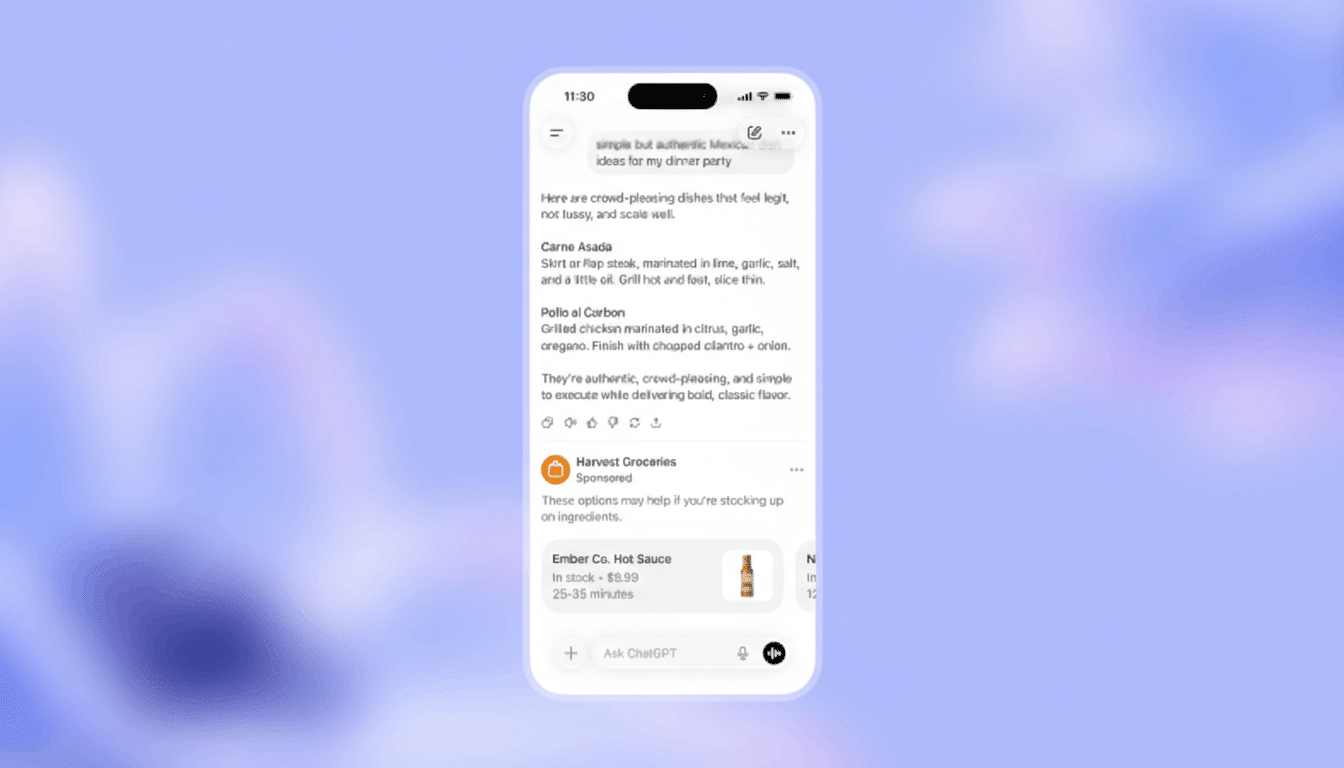
OpenAI emphasizes “answer independence,” promising that paid placements will not influence the model’s responses. It also says it won’t sell user data to advertisers. That separation is critical in a conversational setting, where the boundary between assistance and advertising can blur if labels and placement aren’t crystal clear.
Who will see ads in ChatGPT and who will not during tests
The U.S. test targets two groups: people using ChatGPT for free and those on Go, a lower-cost plan meant to bring faster access without the full feature set of higher tiers. For now, subscribers on Plus, Pro, Business, and Enterprise won’t see ads — a familiar approach in media products where advertising helps subsidize free access and nudges some users toward paid plans for an ad-free experience.
Privacy controls, user choices, and compliance commitments
OpenAI’s opt-out for personalization, under-18 exclusion, and “why this ad” transparency are designed to align with expectations shaped by mobile and web advertising norms. In the U.S., the Federal Trade Commission expects ad content to be “clear and conspicuous,” and privacy regimes such as California’s CCPA and Europe’s GDPR stress consent, data minimization, and user rights. The test will be watched for how well disclosures, consent flows, and data retention choices carry over from the browser era into AI chat.
Crucially, advertisers will want clarity on what signals are used to target ads: real-time conversational context, historical chats if personalization is on, general account attributes, or device-level metadata. OpenAI says it won’t sell user data, but brands and regulators will also scrutinize any cross-site tracking, third-party pixels, or lookalike modeling that could extend beyond the chat window.
Why ads are coming to ChatGPT now and how big this could be
Advertising is the fastest way to translate engagement into cash. U.S. digital ad revenue topped roughly $225 billion in 2023 according to the IAB/PwC, with search and retail media capturing a large share. Microsoft has shown ads in its AI chat since 2023, demonstrating that conversational inventory can be sold to brands with search-like intent. OpenAI has a compelling surface: a high-frequency utility where users reveal clear intent in natural language.

A back-of-the-envelope scenario illustrates the potential: if tens of millions of U.S. users see a couple of ads per day at eCPMs comparable to search-adjacent inventory, annual revenue could quickly reach into the hundreds of millions. Even a modest eCPM and conservative impression count would materially diversify OpenAI’s income beyond subscriptions and enterprise licensing.
Trust and user experience risks in conversational ad formats
Ads in a chat interface carry unique risks. If labels are subtle or placements feel embedded in the assistant’s voice, people may struggle to distinguish sponsored content from the model’s output. That’s more fraught than a traditional feed or search page. Clear “sponsored” tags, visual separation, and consistent disclosures are essential to avoid any perception that money influences answers, especially on sensitive topics like health or finance.
Advertisers will also expect brand safety guarantees. In practice, that means category exclusions, contextual filters, and robust reporting on where and why ads appeared. Because conversations can shift rapidly, misalignment between ad and context could create awkward juxtapositions — the sort of screenshot that travels fast on social media. Real-time controls and conservative default settings will matter in the early days.
What to watch next as ChatGPT ad testing expands or evolves
Key signals to monitor include opt-out rates for personalization, ad load (how many placements per session), advertiser categories that perform well, and whether the test expands beyond the U.S. Expect iterations on creative formats, from simple text to richer cards with images and calls to action. Also watch whether the presence of ads increases upgrades to Plus and higher tiers — a classic trade-off in freemium products.
The move positions OpenAI alongside the largest players in digital media, where advertising still funds much of the free internet. If OpenAI can balance revenue with transparency and user trust, targeted ads could become a durable part of ChatGPT’s business — and a new proving ground for how advertising works in AI-native experiences.
