


OpenAI has unveiled GPT-5.2, positioning it as its most powerful ChatGPT model developed so far for professional, skills-based work. The release has a specific target: automating routine, multi-step tasks that take a bite out of your workday, while also keeping humans in the loop for judgment calls and approvals — as well as giving things that final bit of polish.
What GPT-5.2 Is Built to Do in Workplace Automation
OpenAI says GPT-5.2 can support coding sprints, spreadsheet modeling, presentation builds, and end-to-end project sequences that cross multiple tools. Think of all those tasks in one: aggregating a quarter-end sales deck from CRM data and email threads, cross-referencing numbers on a live spreadsheet, and writing speaker notes. CEO Sam Altman noted that the system still won’t produce “polished files” on its own, which underlines the need for human oversight.
The company’s going hard in the paint on workplace automation: early tester data shows that ChatGPT’s paid customers save 40–60 minutes a day, while heavy users pocket over 10 hours per week when they delegate repetitive work tasks to GPT-5.2. OpenAI says that companies such as Shopify and Zoom have been testing the model to verify productivity gains in real-world environments.
Benchmarks and New Variants of the GPT-5.2 Model
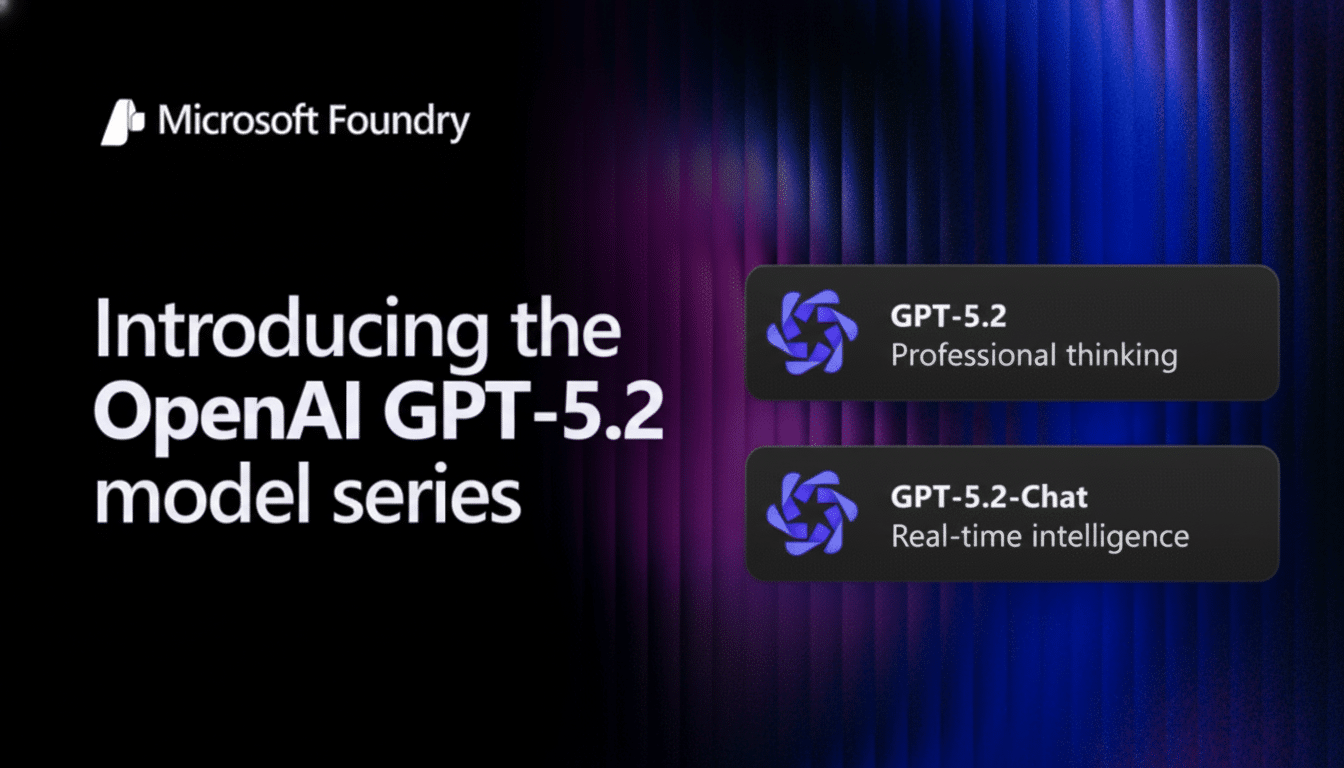
GPT-5.2 comes in three versions — Instant, Thinking, and Pro — intended to offer a speed-to-depth-of-reflection range suitable for different enterprise requirements. OpenAI says the Thinking model outperforms or ties its top human AGI professionals on 70.9 percent of a variety of knowledge-work tasks, as judged by expert reviewers. The company also says it benchmarked across 44 different occupations and well-specified tasks, outperforming state-of-the-art results on several benchmarks.
Underneath the hood, GPT-5.2 handles expert-level tasks at over 11x the speed and at less than 1% of the cost of hiring human pros in proof-of-concept projects, OpenAI says. Those numbers will change by deployment, quality of data, and standards of oversight, but they suggest an orientation: technology does the heavy lifting and people think about exceptions, context, and decisions. The launch starts with paid ChatGPT plans.
Competitive Backdrop with Gemini 3 and Industry Rivals
The launch comes in the wake of fresh competition from Google’s Gemini 3, which has yielded impressive scores on public leaderboards. Reporting from Wired indicates that OpenAI diverted more resources toward making ChatGPT cutting edge in the past few weeks, but the company insists that it didn’t speed up GPT-5.2 in reaction to Google. Internal metrics were not as impacted by Gemini as we thought, CNBC has also reported.
Strategically, OpenAI is positioning GPT-5.2 as a business-first engine, not a generic chatbot. That matters: businesses care less about flash demos and more about reducing cycle time, making work auditable, and hooking effectively into existing systems. GPT-5.2 is liberal in what its author can do with it, but also generous about what the consumer can accept from it. The pitch of GPT-5.2 is to take well-defined workflows and run them in a reliable way, fast, and at scale.
How GPT-5.2 Could Change Your Workday and Team Routines
For teams, the frictionless wins are familiar ones:
- Auto-generating reports
- Summary feedback on pipeline health
- Customer email triage
- First drafts of RFPs
- One-click code refactorings
- Spreadsheets that cull data hygiene
Over time, McKinsey has estimated that generative AI alone could automate work representing up to 60–70% of employees’ time in some jobs. GPT-5.2 is designed to pick away at those hours without completely replacing human sign-off.
The playbook is practical:
- Begin with repetitive, well-constrained tasks
- Set accuracy thresholds and escalation rules
- Monitor latency, cost, and error rates
- Maintain human accountability for final outputs
OpenAI itself recommends pairing GPT-5.2 with human review to minimize risk but still ensure quality, particularly for customer-facing documents and regulated workflows.
The Bottom Line on GPT-5.2’s Enterprise-Focused Launch
GPT-5.2, to workmanlike effect: version 5.2 is more about throughput than novelty. Unless the internal numbers don’t stand up in production, it suggests power users would be able to offload a significant chunk of their everyday duties and get back some focused time. The model still requires guardrails and human judgment, but as a force multiplier for well-scoped, repetitive work, GPT-5.2 feels like a step-change — an assistant seeking to automate the grind without removing the pilot from the cockpit.
