


New York City will impose a one-year moratorium on student-facing generative-AI software for public-school students from 2-K through eighth grade during the 2026-27 school year, while allowing tightly limited, supervised use in high schools. The policy, announced by Mayor Zohran Kwame Mamdani and Schools Chancellor Kamar H. Samuels, is expected to cover nearly 600,000 students—about two-thirds of the city’s public-school enrollment.
The move is more selective than headlines describing an outright school AI ban suggest. The city is pausing younger students’ use of generative AI, prohibiting companion chatbots at every grade level, and setting up a narrower path for older pupils. Teachers may still use AI tools for planning and administrative work if those products meet NYC Public Schools safety standards; students with disabilities, multilingual learners and some career-readiness programs also have stated exceptions.
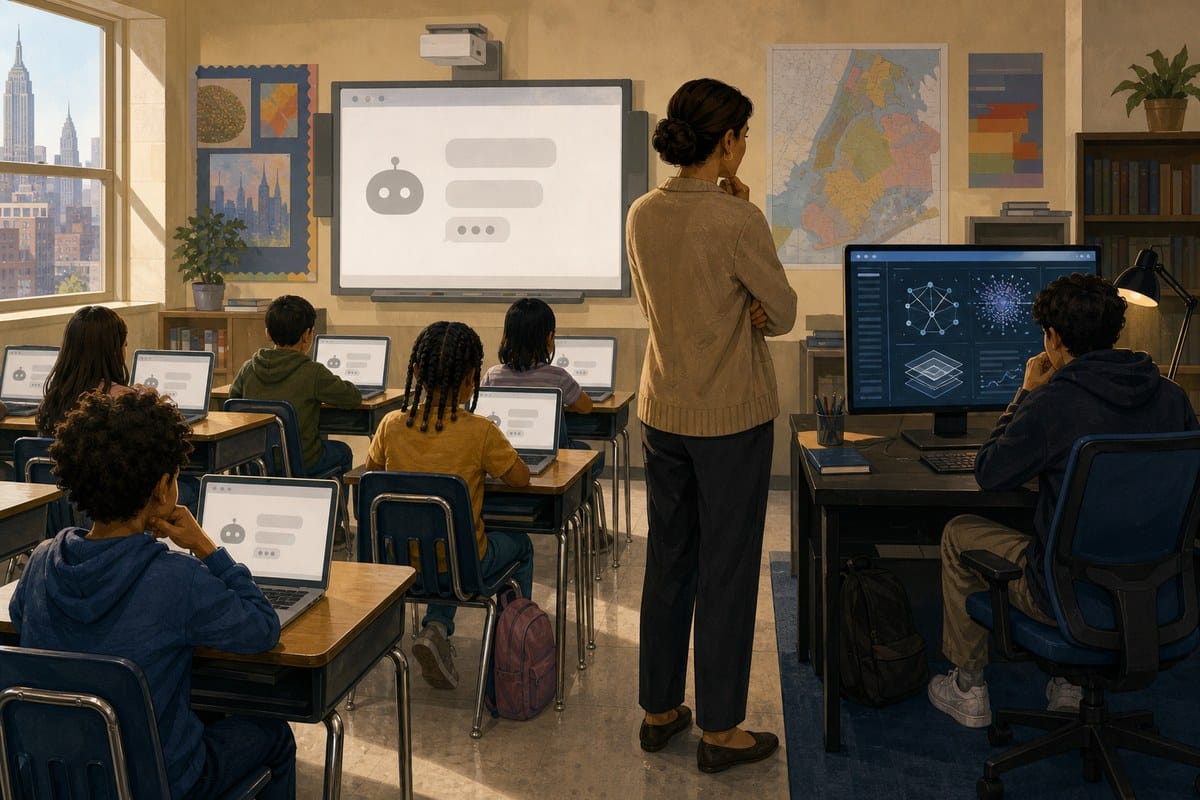
What the policy permits and prohibits
According to the city’s September 3 policy announcement, the moratorium applies to software that uses student-facing generative AI for children in 2-K through eighth grade. It does not say that all artificial intelligence, computers, tablets or classroom software have been removed from those grades. That scope is important because AI has become a catch-all label for products that range from automated translation and accessibility features to open-ended text and image generators.
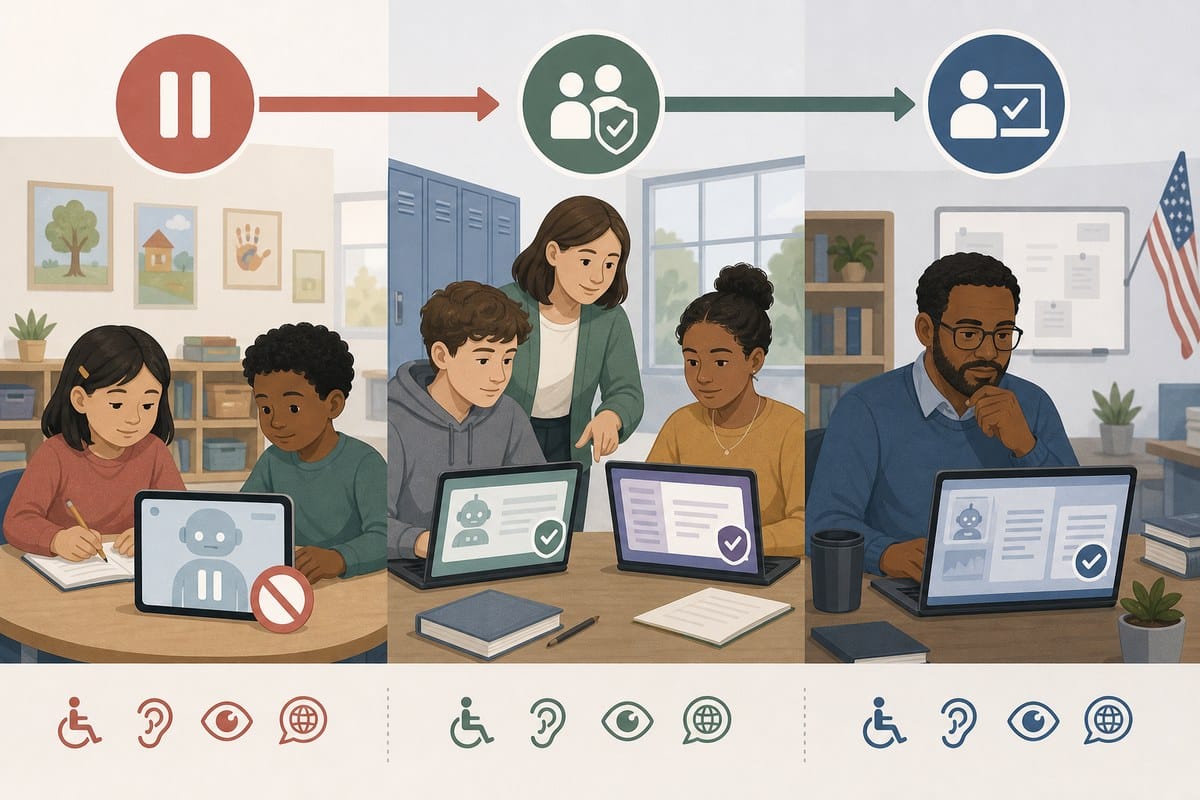
The blanket restriction is aimed specifically at companion chatbots, which will be barred across grades. The city’s release does not define every chatbot feature that could fall under that category, but the separate all-grade rule indicates that officials view conversational systems differently from permitted accommodation tools or educator-facing software.
Students who need assistive technology may continue using it under the exceptions, as may multilingual learners and students in career-readiness courses including computer science. Those carve-outs recognize that a universal prohibition could also cut off tools used for access, language support or specialized instruction. They do not amount to a general permission for younger students to use generative-AI applications.
New York City also issued recommended daily limits on one-to-one screen use: 30 minutes for grades three through five and 45 minutes for grades six through eight. These are screen-time recommendations, not evidence of a categorical laptop or tablet ban. Local reporting by FOX 5 New York described broader device restrictions, but the official policy text supports a more limited reading centered on screen time and student-facing generative AI.
High schools get literacy lessons and small pilots
High-school students are not receiving unrestricted access. The city plans two 45-minute AI critical-thinking modules each year for high-school students, covering how AI works and fails, bias, risks, ethics, career effects and future skills. The emphasis is notable: the stated instructional response is not simply teaching students to prompt a chatbot, but asking them to assess systems that may produce convincing errors, reflect biased training data or change workplace expectations.
The city also plans five high-school pilots involving no more than 50,000 general-education high-school students, a ceiling it describes as roughly 5% of the full public-school student body. A participating high school may offer a pilot in no more than five classes, using vetted tools and direct supervision by trained educators. The limits are designed to make the pilots a controlled deployment rather than a systemwide rollout.
Those guardrails leave substantial implementation questions. The release does not identify the criteria NYC Public Schools will use to vet products, what data protections each approved tool must meet, how participating schools will be selected, or what outcomes would qualify a pilot as educationally successful. The city says it will convene a Technology in Schools Coalition during the school year to assess the policy and make recommendations for later years.
A large-system test with unresolved safeguards
The city calls its measure the country’s most expansive student-facing AI moratorium, a characterization that has not been independently established in the announcement. Still, the size of the system gives the policy national weight. Rather than settle the question of AI in classrooms with a single rule, New York is separating several decisions that are often blurred together: children’s direct use of generative models, chatbot companionship, accessibility functions, teacher productivity software and older students’ supervised instruction.
That distinction has drawn both support for a cautious approach and concern that the review window is too short. Associated Press reporting cited United Federation of Teachers president Michael Mulgrew as raising unanswered questions about safeguards for products the Education Department buys. The same report quoted Fairplay executive director Josh Golin as arguing that providers should have to demonstrate safety and educational effectiveness rather than rely on a one-year evaluation.
The debate is not occurring in a policy vacuum. The Associated Press reported that at least 37 states have official AI guidance available to schools, but that there is no shared definition of AI literacy or agreement on how to teach it. New York City’s approach supplies one practical answer for the coming year: hold back broad student use among younger children, make narrowly supervised high-school use instructional rather than casual, and decide later whether the evidence justifies wider access.
For schools, the immediate operational challenge will be translating those categories into procurement and classroom rules. A teacher planning lesson materials, a student using an accessibility feature and a teenager participating in an approved pilot may all interact with AI differently under the new framework. The coalition’s eventual recommendations will determine whether that temporary distinction becomes a lasting model or simply a pause before another round of policy decisions.

