


Elon Musk has moved to recast a wave of XAI departures as a management decision, not a talent drain. After multiple high-profile exits — including two more co-founders — Musk told employees and followers that the company recently restructured to move faster and that some departures were the result of that process. The message: these were push factors from inside xAI, not pull from outside rivals.
The scale is notable. Six of the original 12 co-founders have now left, and at least 11 engineers publicly signaled their exits in the last several days. xAI still counts more than 1,000 employees, so the near-term operational hit may be limited, but the concentration of senior talent moving at once has sparked questions about culture, trajectory, and timing.
Musk Reframes The Narrative Around Fit And Speed
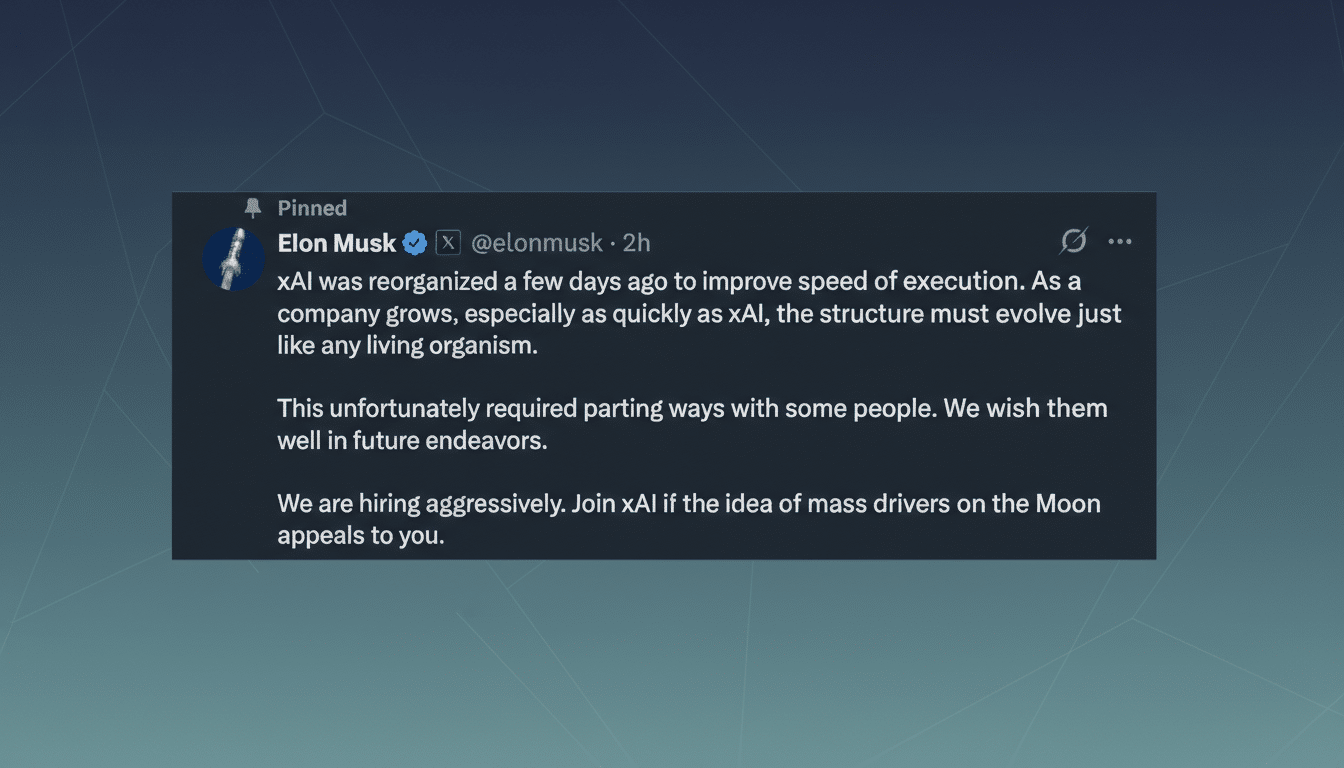
In an internal meeting reported by the New York Times, Musk positioned the changes as a shift from a startup phase to a scaled organization, saying some early-stage builders are less aligned with later-stage needs. He later posted on X that xAI’s structure had been overhauled to accelerate execution and that this “unfortunately” meant parting ways with some people. He also said the company is hiring aggressively, even punctuating the pitch with a characteristically grand vision about building off-world infrastructure.
Framing the exits as push rather than pull is a classic damage-control move in Silicon Valley, especially when founders depart in clusters. It counters the impression that xAI is losing a contest for elite talent to OpenAI, Anthropic, or Google DeepMind, and instead suggests an intentional curation of the roster for the next phase of growth.
From Co-Founders To Engineers: The Scope Of Turnover
Among those leaving are co-founders Yuhuai (Tony) Wu, who led reasoning research, and Jimmy Ba, a prominent figure in deep learning known for academic contributions to optimization and sequence models. Several senior engineers who worked on multimodal systems and Grok’s post-training behavior also exited. A handful said they will launch a new venture together; others cited a preference for small teams leveraging AI agents to iterate faster.
While any single exit can be chalked up to fit, multiple co-founder departures in quick succession raise governance and strategic alignment questions. The clustering effect matters: when early leaders go, follow-on exits often accelerate as org charts and priorities shift. Industry watchers will parse whether the new venture seeded by former xAI staff becomes a magnet for colleagues and customers, a pattern seen before when alumni pods spun out of OpenAI or DeepMind to chase narrower, high-velocity bets.
IPO Ambitions And Regulatory Headwinds Ahead
The reorganization arrives as xAI balances ambition with scrutiny. Regulators are examining how Grok-enabled tools were used to generate nonconsensual explicit deepfakes of women and children that spread on X; French authorities recently raided X offices as part of an investigation. Meanwhile, xAI is advancing toward a planned public listing after being legally acquired by SpaceX, a structural move that tightens ties between Musk’s companies and could shape disclosure, governance, and risk controls.
Reorgs ahead of an IPO are routine — boards often push for clearer lines of ownership, cost discipline, and product accountability. But AI firms face additional pressure: safety mechanisms for generative models, provenance signals for media, and incident response are now material to valuation. A tightening of responsibilities inside xAI would be consistent with that reality.
The Talent Market Test In Frontier AI Research
Competition for senior AI researchers remains ferocious. According to the Stanford AI Index and industry compensation surveys, total packages at top labs have surged, and tender offers at leading startups have provided meaningful liquidity to retain staff. Compute access, publication latitude, and the chance to ship models at scale frequently outweigh salary in recruiting conversations.
xAI’s brand has been its speed and willingness to ship aggressively, from Grok updates to experiments like Macrohard, an initiative aimed at fully automating software development via multi-agent systems. To keep that allure, the company must replace departing leaders with hires who buy into Musk’s cadence while also navigating expanding safety and compliance expectations. That balance — velocity with guardrails — is where many labs stumble.
What To Watch Next As xAI Navigates Restructuring
Three signals will indicate whether Musk’s “push, not pull” framing sticks.
- The caliber and roles of incoming hires — particularly in reasoning, reinforcement learning, and multimodal safety.
- The pace and quality of Grok releases, including visible improvements to guardrails and provenance tools.
- The shape and funding of the ex-xAI startup cluster; if it quickly lands capital and talent, it will underscore that these exits reflect philosophical divergence as much as reorganization.
xAI is large enough that short-term delivery may continue uninterrupted. The longer-term question is whether the lab can scale into public-market rigor without diluting the renegade ethos that attracted its earliest builders. Musk has made his bet on structure and speed. The market — and the next cohort of researchers — will decide if it was the right call.
