


Microsoft is moving shopping to the chat window. Using Copilot Checkout, a user can discover a product, hit Buy and then pay without ever leaving the Copilot interface. The product is being rolled out in the US and currently available upon launch is Copilot.com, with commerce handled through PayPal, Stripe and Shopify.
How Copilot Checkout Works for Seamless In-Chat Buying
If you’re searching for an item from within Copilot, supported products will display a Buy button. Tap it, and the chatbot opens its own native checkout page — no redirect to a merchant’s site. The flow is as similar to standard e-commerce checkout as possible: Your shipping details, taxes and payment confirmation are all facilitated in this efficient, chatty environment.
- How Copilot Checkout Works for Seamless In-Chat Buying
- Who Can Sell on Copilot Checkout at Launch and Beyond
- Why In-Chat Checkout Matters for Reducing Cart Abandonment
- Data Ownership and Privacy Controls for Retailers and Shoppers
- Competitive Landscape and Risks in Conversational Commerce
- Brand Agents and the Road Forward for AI-Powered Shopping
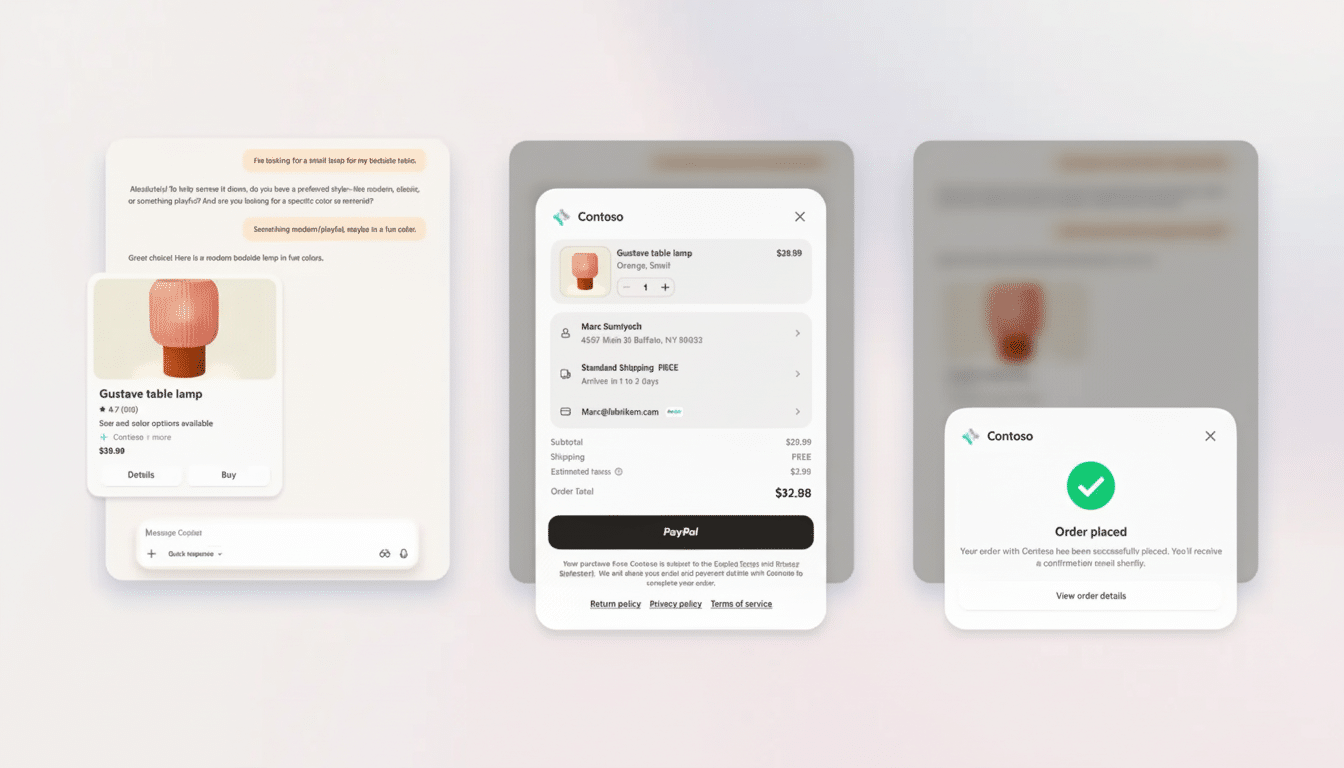
Crucially, Microsoft says the merchant continues to be the merchant of record. That means the seller retains ownership of its transaction, customer data and post-purchase relationship. Payment processing is done through standard providers. It’s a design that aims to be less friction-filled for shoppers and to navigate the politics of commerce without requiring retailers to relinquish control.
Who Can Sell on Copilot Checkout at Launch and Beyond
For now, Copilot Checkout is available for retailers such as Urban Outfitters, Anthropologie and Ashley in addition to certain Etsy sellers. Stores powered by Shopify will be automatically onboarded after a brief opt-out window, and Microsoft is now encouraging other merchants to apply using PayPal or Stripe.
They pitch speed and minimal integration lifting for sellers. The existing payment rails and fulfillment systems remain, the point of sale record continues to live where it always has — inside the merchant stack — and yet Copilot becomes a new storefront surface laid over the top.
Why In-Chat Checkout Matters for Reducing Cart Abandonment
In a shopping experience, every additional click threatens to be abandonment. The Baymard Institute, an industry research resource, has for years had average cart abandonment hovering near the 70% mark with interruptions and complex flows ranking among the leading causes. By combining discovery, evaluation and payment into a single conversational thread, Copilot is designed to eliminate those precious drop-off points.
Microsoft claims that when shopping intent is there, journeys with Copilot are 194% more likely to lead to a purchase. Though the figure is derived from Microsoft’s own data, it speaks to an increasingly common focus on “conversational commerce,” where assistance, comparison and checkout all flow from a single location — much like in-app purchasing mechanisms seen across social platforms, which will now be driven by an AI assistant.
Data Ownership and Privacy Controls for Retailers and Shoppers
Retailers concerned about losing customer relationships receive an explicit guarantee: they remain the merchant of record and retain their first-party data. Payments are funneled through PCI-compliant processors such as PayPal and Stripe, minimizing exposure without sacrificing visibility into orders, refunds, and support interactions. That balance — less friction for buyers, control remaining with sellers — will be key to adoption.
For shoppers, the appeal is convenience with familiar protections. Working with major processors should help attenuate any trust issues here, though it’s still difficult to beat having the same, Copilot-hosted flow on your second purchase as you did first — rather than hopping from store checkout to store checkout.
Competitive Landscape and Risks in Conversational Commerce
Microsoft is not alone. OpenAI’s ChatGPT and Perplexity have provided commerce integrations that have included Shopify, connecting consumers with the ability to go from product discovery to purchase. But the space is contentious: Amazon has gone to court to challenge one such shopping assistant, arguing that it led to a degraded shopping and service experience — pointing also perhaps at potential hazards if AI summaries or recommendations prove ill-informed when up against buyers.
Amazon has also been pushing shopping via chat, with its expanded Alexa bot able to research items and adding it to a cart; however, checkout is still handed off to Amazon’s traditional flow.
Microsoft’s in-chat payment is a bigger gamble that end-to-end transactions all within an assistant can be both reliable and trusted at scale.
Brand Agents and the Road Forward for AI-Powered Shopping
Microsoft is previewing Brand Agents — AI shopping assistants that will speak in a retailer’s voice and walk customers through the process of discovering and buying products inside Copilot. If done well, that could provide brands with a programmable salesperson integrated across Microsoft’s surfaces.
The short-term questions are practical: how soon will other forms of coverage appear outside Copilot.com, just how strong order support and returns will be in chat, and whether Microsoft can continue to hold a line of accuracy and truthfulness around its recommendations. And if Copilot Checkout proves it significantly reduces abandonment without sacrificing trust, it could serve as a template for AI-native storefronts — and another sales channel for merchants hungry for more-incremental, higher-intent conversions.
