


Lego is adding intelligence to the humble brick. Introduced at CES, the company’s new Smart Play system incorporates reactive lights, sounds and behavior that are activated as you build and play with it, providing an immersive screen-free experience — keeping the magic in the model, not on a phone.
To Build a Brick That Listens and Learns
Zaha Hadid Architects Needed a Little Help
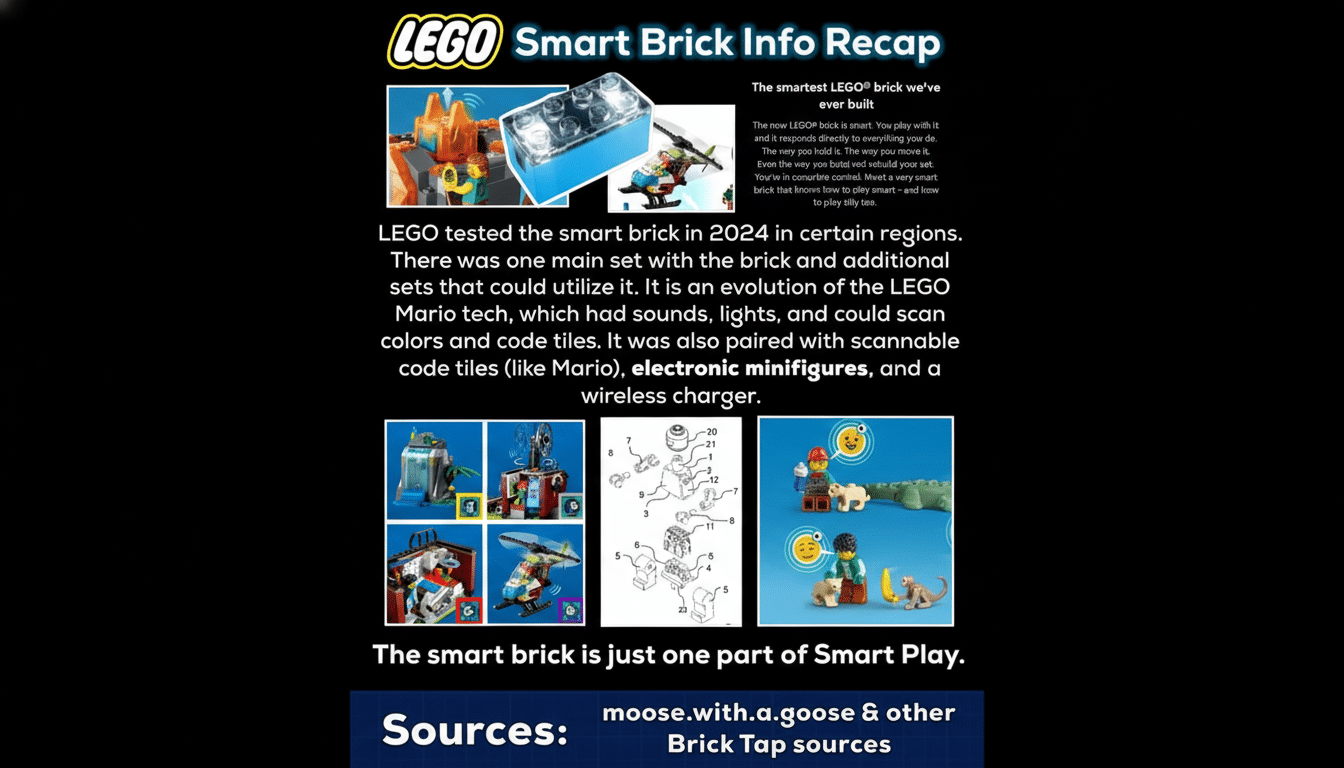
The Smart Play system revolves around three components that click into place within regular builds: Smart Bricks, Smart Minifigures and Smart Tags. Lego says the pieces keep to the same familiar sizes and clutch power (how firmly they stick together) of old-school parts, but are packed with all-new guts: a custom microchip, a tiny speaker and its own software driven by an onboard synthesizer that can play back sound files, along with a lengthy suite of new sensors including accelerometers for detecting motion and speed; a gyroscope for sensing position so it knows how you’re moving it; and sensors that respond to both light and various colors in case you wanted your creation to do things when you shine different kinds of light on it. It’s all wireless power and charging, so no removable batteries or spoiled finish once you have it done.

The company says in its press materials that the system includes more than 20 newly patented innovations, among them a chip architecture small enough to fit within the footprint of a single stud. That’s a big deal: Previous connected-play initiatives in the Lego ecosystem — Mindstorms, Boost, Powered Up and the education-targeted Spike kits — have all used external hubs, cables and apps. In this instance, interactivity is baked right down to the brick and won’t rely on a required companion screen.
Star Wars Unleashes the Launch Wave of Sets
The first wave comes in the form of three Star Wars sets that illustrate how models can feel alive in your grip. Luke Skywalker X-wing kits come with two Smart Minifigures and one Smart Brick that can trigger cockpit chatter and flight effects as you bank or land. A Darth Vader TIE Fighter collectible building set offers hours of highly imaginative Star Wars fun, featuring large engine exhausts, red detailing, and the dark side ship’s iconic black wings with dagger-shaped tips. A larger Throne Room Duel with an A-wing involves duel cues, character reactions and Smart Tag-triggered moments in Emperor Palpatine’s chamber.
Lego stresses that all Smart elements will remain compatible with the overall system of play. Builders can transplant the responsive parts into original works (tagging custom locations to provide a trigger mechanism for their effects), and remix scenes without beginning afresh with an app. In short, the logic is alive in both the model and the rules you write around it.
Why This Matters For Playing And Learning
Smart toys typically drift toward screens; Lego’s approach nudges back in the other direction. By transforming real-world actions like tilting a starfighter, dimming the lights in a room and tapping on a hull into immediate feedback, the system reinforces cause and effect, sequencing and spatial reasoning. For years, research funded by the LEGO Foundation and conducted out of MIT’s Lifelong Kindergarten group has also specifically linked hands-on, iterative tinkering with broader problem-solving skills. The American Academy of Pediatrics, for example, encourages active physical play as a way to offset time spent in front of passive screens.
There’s a logistical boon for families and teachers too: fewer devices to plug in and manage. By not connecting to tablets, Smart Play wants players to stay focused on the build table. For classroom makerspaces that are already full of heaps of standard bricks, drop-in interactive parts could extend lesson plans without a complete workflow reboot.
How It Compares To Previous Connected Kits
Mindstorms blazed the trail for Lego robotics a decade ago, but it also included a programmable brick, motors and a coding interface. Boost and Powered Up downsized the hardware and brought Bluetooth control to consumer sets, while Spike became the classroom workhorse. Smart Play is betting on something else: make the brick be the computer. That adjustment lowers the barrier to entry and extends interactivity to younger builders who might not be old enough to code but innately understand that by rolling, shaking or pressing a camera-tagged area on their model they can make it do something.
It also places Lego in contrast with a wave of “phygital” toys from companies like Nintendo and Sphero, which blend physical play and sensors. What makes a stage, what’s a trigger map? The differentiator here is continuity with more than six decades of Lego geometry: any brick can be a stage, any model may be a trigger map.
Availability Ecosystem And What To Watch
Preorders for the debut sets will launch in certain markets before being extended to other territories, Lego says. While the company is not providing specifics on a third-party program, Smart Tags suggest an ecosystem-type approach in which designers can place down interaction points much like they might lay down markers on a game board — landing pads that can trigger your thrusters, say, or hidden chambers that whisper hints when you discover them.
Longevity and scalability are now the big questions. Can battery life and wireless charging keep pace with school (and playroom) demands? Can the updating of firmware also add sounds and behaviors without any friction? Early impressions imply Lego has tried to learn from the Mindstorms retirement and is reaching for a platform as timeless-feeling as a 2×4 brick, only smarter.
What is obvious is the goal: to return wonder to the table, have models talk back and keep the creativity loop tightly wound between imager and response. If Smart Play lives up to the promise, though, the best type of upgrade might be the simplest — relevant instruction exactly where kids are already building.
