


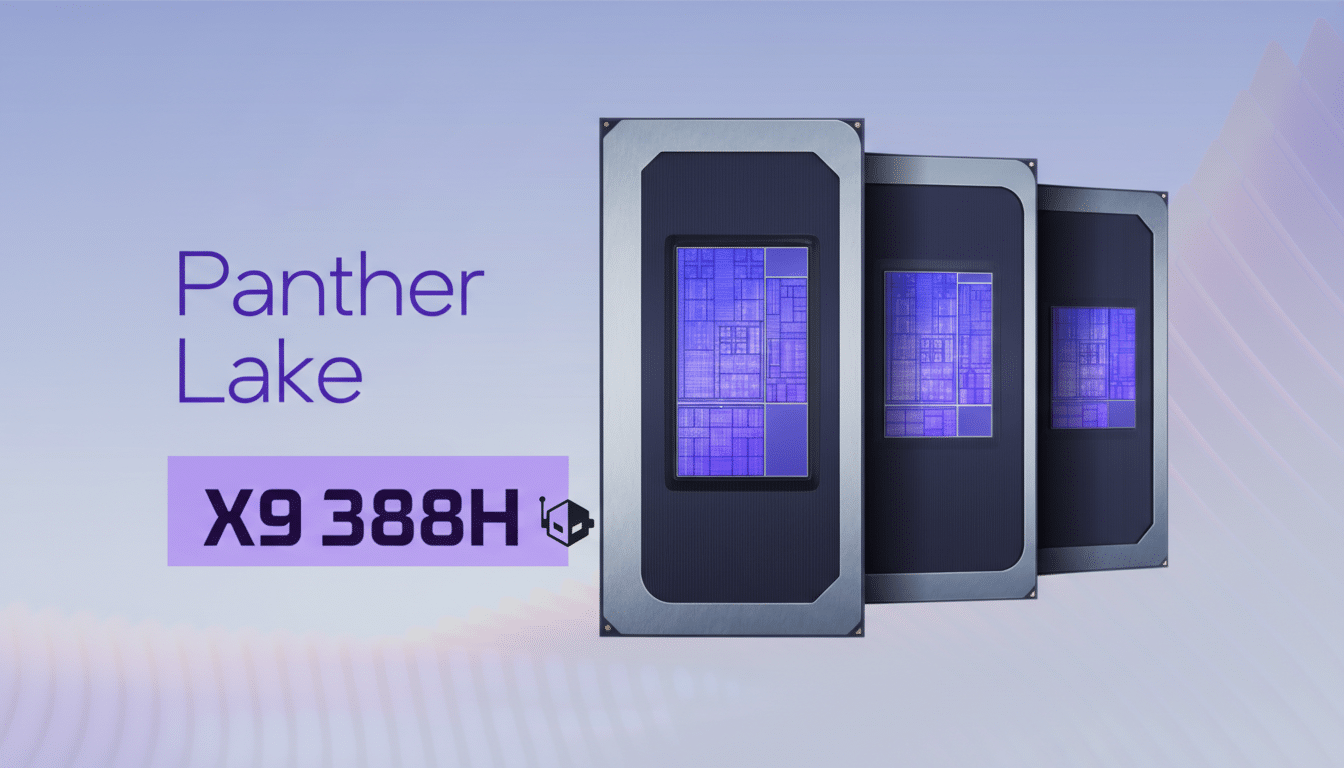
I spent the past week stress-testing Intel’s flagship Core Ultra X9 388H from the new Panther Lake family, and the verdict is clear: the CPU holds serve, but the integrated graphics is the story. With its Arc B390 tile based on Xe3 “Battlemage,” this chip makes thin-and-light laptops legitimately game-capable—provided you use Intel’s XeSS upscaling where available.
Test setup: hardware configuration and benchmarks used
The test system was an Asus Zenbook Duo configured with the Core Ultra X9 388H (4 P-cores, 8 E-cores, 4 LPE-cores; up to 5.1GHz; 18MB L3) and Arc B390 integrated graphics with 12 Xe3 cores. The 14-inch 16:10 panel runs at 2,880×1,800 (1800p); I tested both at native and at the 1,920×1,200 (1200p) full-HD equivalent. Memory was 32GB, typical for premium ultraportables.
- Test setup: hardware configuration and benchmarks used
- CPU performance is solid, not surprising
- Arc Xe3 Graphics Change The Laptop Baseline
- Real game benchmarks: real gains with XeSS upscaling
- The Fine Print On Compatibility And Naming
- Why this matters for thin-and-light gaming laptops
- Bottom line: a meaningful leap for integrated graphics
Benchmarks spanned UL’s PCMark 10 for overall productivity, Maxon Cinebench 2024, Primate Labs Geekbench 6.3, HandBrake video transcoding, and Puget Systems’ PugetBench for Photoshop. For graphics, I used UL 3DMark’s Wild Life, Steel Nomad, and Solar Bay ray tracing, followed by game testing in F1 2024, Call of Duty: Modern Warfare 3, and Cyberpunk 2077.
CPU performance is solid, not surprising
On the CPU side, Panther Lake behaves like a seasoned pro: steady, efficient, and comfortably competitive with late-cycle Core Ultra 200 and AMD Ryzen AI 300-class parts in our runs. PCMark 10, Cinebench, and Geekbench scores tracked closely with those peers, while HandBrake and PugetBench results confirmed that media and content workloads are handled with ease. This is not a generational barnburner for CPU throughput, but it doesn’t need to be—the platform’s focus shifts to graphics and on-chip efficiency under Intel’s 18A-era design.
Arc Xe3 Graphics Change The Laptop Baseline
3DMark runs underscored how far Intel’s integrated graphics has come. Against prior-gen Intel and AMD IGPs, the Arc B390 consistently landed well ahead in Wild Life and Steel Nomad, and posted credible Solar Bay numbers for an iGPU. In one comparison, it even edged a thin-and-light implementation of a GeForce RTX 5050—context that matters, because tuning and power budgets vary. Still, the takeaway stands: this iGPU narrows the gap in ways that weren’t realistic a generation ago.
Intel has informally framed Arc B390’s target as brushing up against GeForce RTX 4050 territory in some workloads. Raw raster performance is rarely there, but the right mix of settings and upscaling can make the experience surprisingly close.
Real game benchmarks: real gains with XeSS upscaling
F1 2024 at 1200p Ultra managed 34 fps without help and just 15 fps at 1800p—borderline. Flip on XeSS with frame generation and the picture changes: 111 fps at 1200p and 72 fps at 1800p. That’s the difference between “it runs” and “it screams,” and it mirrors what we’ve seen with DLSS on discrete GPUs.
Call of Duty: Modern Warfare 3, a fast-twitch title where many players prefer low settings, hit 80 fps at 1200p on the minimum preset without any upscaling. Push visual settings and higher resolutions and you’ll need to compromise, but for competitive play, the results are more than serviceable.
Cyberpunk 2077 remains a stress test. On Ultra at 1200p without upscaling, the Zenbook Duo delivered 35 fps. Move to a High preset at 1200p with XeSS on Quality (no frame generation), and it climbed to 58 fps. Engaging XeSS 3.0 with 2x frame generation pushed the same scene to 96 fps. Higher frame-gen ratios can exceed triple digits, though you’ll trade some image stability for speed—exactly the calculus PC gamers now know well.
The Fine Print On Compatibility And Naming
Two practical notes. First, XeSS support varies by title and version. In-game XeSS (2.0 or 3.0 depending on the game) is the smoothest path today. Intel’s driver-level XeSS 3.0 override showed promise in my testing but was finicky and not universally available, so consider it a bonus rather than a guarantee.
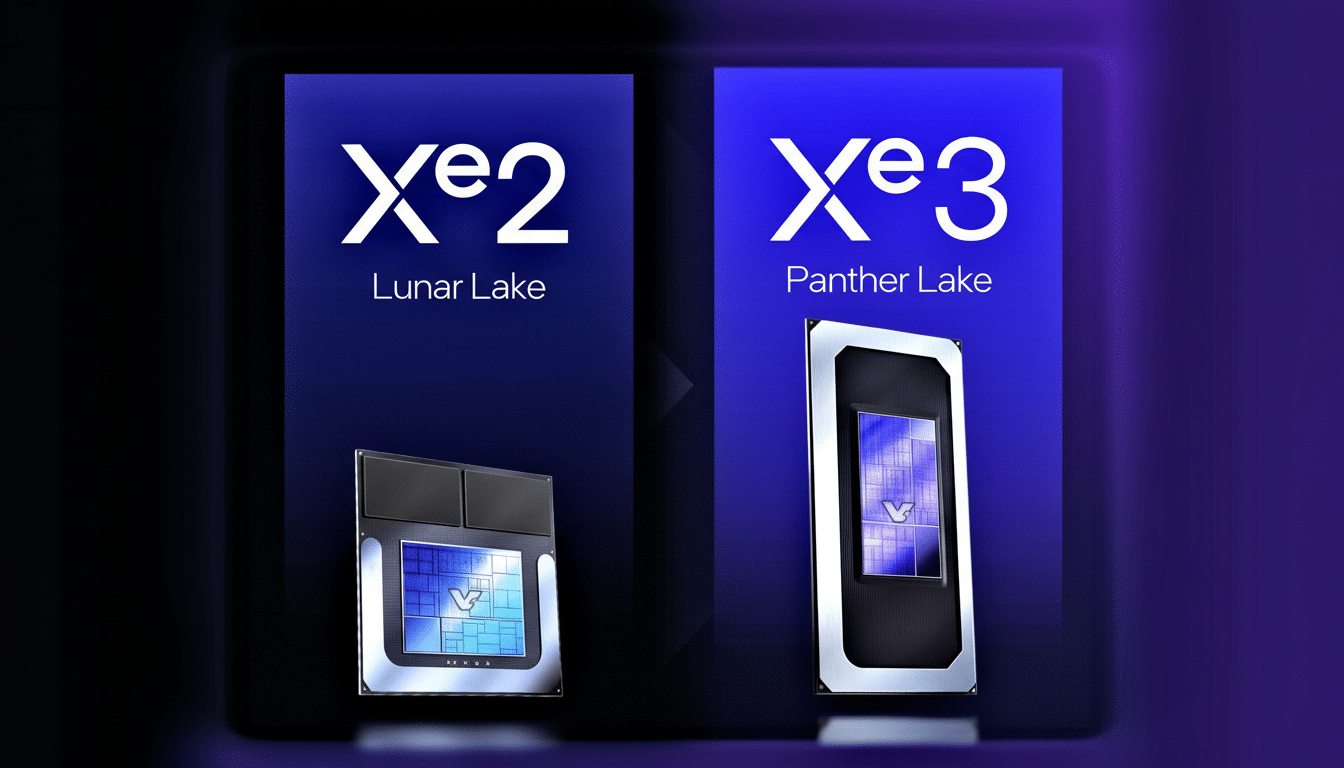
Second, not all Panther Lake chips are created equal. The “X” in X7 and X9 denotes an Arc IGP with a denser Xe3 core count. The Core Ultra X9 388H I tested carries the 12-core Arc B390 tile; some non-X models rely on a leaner four-core Intel Graphics IGP. Expect a clear spread in gaming results across that stack.
Why this matters for thin-and-light gaming laptops
For years, integrated graphics meant “good enough for indie titles and esports.” Panther Lake disrupts that assumption. With XeSS doing the heavy lifting—just as DLSS and FSR have reshaped expectations on discrete GPUs—ultraportables can credibly handle modern games at 1200p, and sometimes higher. For creators and students who don’t want the size, heat, or cost of a discrete GPU, this is a meaningful shift.
Bottom line: a meaningful leap for integrated graphics
Intel’s Core Ultra X9 388H doesn’t rewrite the CPU record books, but its Arc B390 graphics tile is a genuine leap for iGPUs. In the right titles with XeSS enabled, frame rates jump by well over 100% versus native rendering, turning “almost playable” into “smooth.” As more laptops with X7 and X9 variants arrive, this could become the new default for gaming on mainstream notebooks—no discrete GPU required.
