


I didn’t plan to spend $10,000 on Instagram ads. Like most small business owners, I started out believing organic would be enough. Post consistently, show up in Stories, engage with comments, and build slowly. And for a while, that worked.
Until it didn’t.
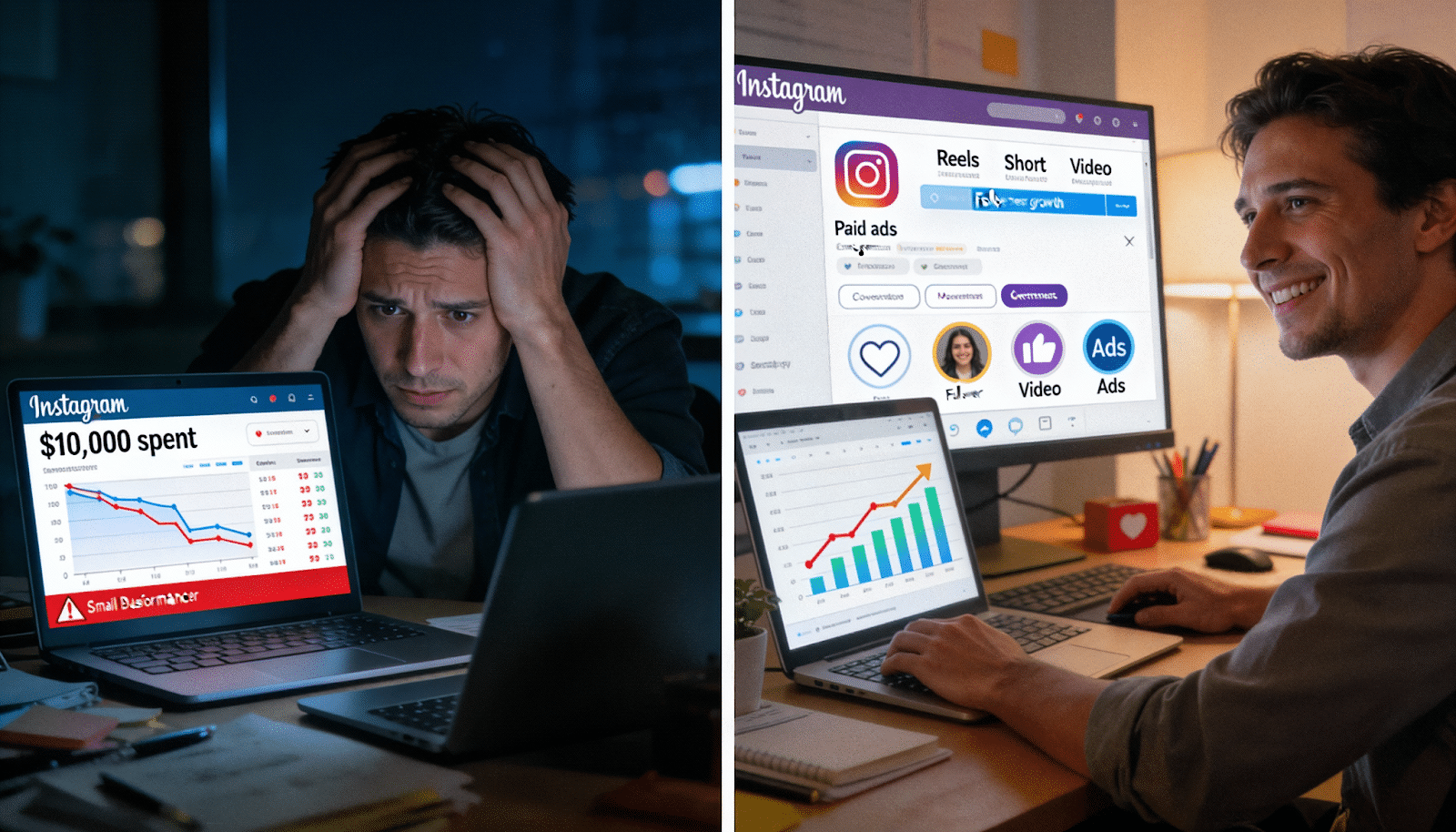
As reach started slipping, competition increased, and good posts barely moved the needle, I did the thing I’d been avoiding. I set aside $10,000 and decided to actually test Instagram ads properly, not one boosted post here and there, but structured experiments over several months. Some of it worked. A lot of it didn’t.
Here’s what I learned the hard way.
Why Instagram at all?
Instagram is not just a “social” platform anymore. It’s a distribution engine. As of 2025, Instagram’s ad audience sits at around 1.47 billion users globally. Formats like Reels now drive significantly higher engagement than static posts.
What that means in practice is, if your customers are online, they’re probably on Instagram, and organic reach alone won’t reliably get you in front of them anymore.
The biggest mistake I almost made
Early on, I was tempted to put a big chunk of the budget behind one “strong” campaign and hope for results. I’m glad I didn’t. Instead, I broke the spend into small tests:
- Different creatives
- Different placements
- Different audiences
It felt slow at first. But it worked.
Industry data shows carousel and video ads consistently outperform single-image ads, sometimes by double-digit margins in ROI. My results followed the same pattern. Some creatives just didn’t land. Others quietly kept converting.
Without small tests, I would’ve never known which was which.
Video was table stakes
This surprised me less than it probably should have.
Static image ads struggled. Short videos (rough ones) performed better. Clips that showed the product being used, a quick behind-the-scenes moment, and a customer reaction that wasn’t perfectly framed brought more engagement.
Instagram clearly favors motion. Reels, Stories, vertical video. And users respond to it too. Reels ads tend to generate noticeably higher engagement and lower scroll-away rates than traditional feed ads.
My takeaway: if you’re still relying mostly on static creatives, you’re making this harder than it needs to be.
I obsessed over targeting. That was a mistake
At first, I spent an unhealthy amount of time refining interests, like narrowing audiences. I was trying to be clever. Performance was… okay.
Then I loosened things up.
Broader targeting plus stronger creative consistently worked better. Instagram’s algorithm needs room to learn. When you choke the audience too tightly, costs go up, and results flatten.
This lines up with how Meta’s ad system is designed. The machine is better at finding patterns at scale than we are at manually stacking interests. Once I accepted that, results improved.
Retargeting did the heavy lifting
If there’s one thing I’d do again immediately, it’s retargeting.
Audiences who:
- Watched most of a video
- Clicked but didn’t convert
- Engaged with posts
converted far better than cold traffic; sometimes double, sometimes more. That makes sense. They already knew the brand, so the ads didn’t need to convince, just remind.
Platforms like QRCodeChimp QR Code Generator can make that next step seamless. Users who engage with an ad can instantly scan a QR code to access a landing page, claim an offer, or connect with your business, reducing friction between interest and action. Across platforms, retargeting consistently delivers lower acquisition costs because familiarity does part of the work for you.
What clearly didn’t work
Polished ads that looked like ads
Anything overly designed or overly clever underperformed. Instagram users spot marketing instantly. When something feels engineered, they scroll.
One-step “buy now” thinking
Trying to convert cold audiences immediately burned money. What worked better was a loose funnel generating awareness, engagement, and conversion.
Boring but effective.
Ignoring the landing page
Clicks mean nothing if the page doesn’t deliver. Instagram conversion benchmarks often sit between 1–3.5%, depending on the funnel. My worst-performing campaigns weren’t bad ads. They were mismatched landing experiences.
The uncomfortable truth about costs
Costs varied wildly. CPCs bounced between roughly $0.70 and $2.00, which is well within normal Instagram ranges. Chasing the cheapest clicks was pointless, as cheap traffic didn’t convert. The only metric that really mattered was cost per actual result.
Instagram can drive sales. But it doesn’t forgive weak positioning or unclear value.
What $10,000 actually taught me
This wasn’t about “cracking” Instagram ads. It was about understanding how people behave when they’re scrolling.
Here’s what stuck:
- Test before you scale
- Use video, even if it’s imperfect
- Let the algorithm do its job
- Build familiarity before asking for conversion
- Treat ads as part of a system, not a shortcut
Instagram ads didn’t magically grow the business. But they did something just as valuable. They removed guesswork.
And that alone was worth the spend.
My takeaway
Instagram ads don’t reward perfection. They reward clarity. If your message is clear, your story makes sense, and your offer feels human, the platform will amplify it. If not, no amount of budget will save you.
The real lesson from spending $10,000 wasn’t about ads at all. It was about learning how your business sounds when no one owes you attention. And that’s a lesson every small business eventually has to pay for, one way or another.

