


Sloped yards are known to be difficult to work with when it comes to deck construction, but if the deck is built by an expert deck builder, it can actually turn into one of the best outdoor spaces. In this post we will talk about how to build a deck in a sloped yard and what you should in expect in terms of complexities and cost.
Slopes usually require a more complex structure and permitting, and can also open the door to elevated deck, multi-level designs, and some really impressive views. Let’s get into more details to see why a sloped yard can turn into an amazing space.
- 1. Evaluate the Slope and Site Conditions
- 2. Choose the Right Deck Design for a Sloped Yard
- 3. Permits, Codes, and Engineering Requirements
- 4. Footings and Foundation: The Most Critical Step
- 5. Framing for Strength and Stability
- 6. Stairs and Access
- 7. Decking Materials and Maintenance Considerations
- 8. Drainage and Erosion Control
- Cost Comparison: Sloped Yard vs. Flat Yard Deck Construction
- Cost Comparison Summary
- How to Control the Cost
- Final Ideas
1. Evaluate the Slope and Site Conditions
The first step is the site assessment. Your contractor will check the steepness and direction of the slope. For instance, specialized deck builders in Naperville, IL often look for specific soil density issues common in Northern Illinois before even pulling a permit. This will influence everything from deck height to foot depth.
Key factors to evaluate:
- Slope severity: Mild (under ~10%), moderate, or steep slopes require different structures.
- Soil conditions: Clay, sandy soil, or fill dirt affect the footing design and load capacity.
- Drainage patterns: Water must flow away from footings and the home’s foundation.
- Access and setbacks: Property lines, easements, and utility locations may limit design options.
For moderate to steep slopes, you might want to invest into a professional survey or soil report. This will give you a better idea on what’s going on.
2. Choose the Right Deck Design for a Sloped Yard
inclined terrains allow for several effective deck configurations:
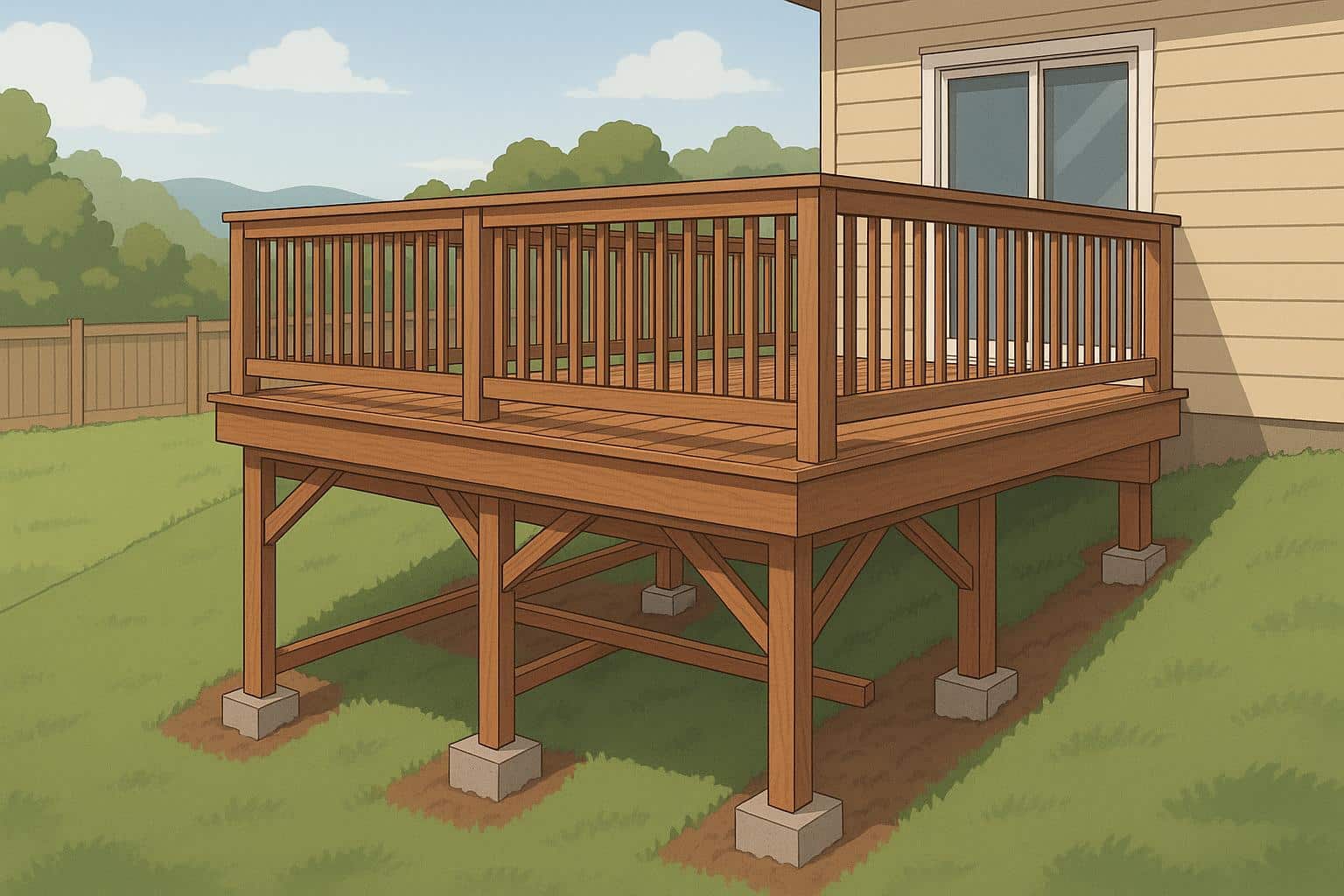
Elevated (Stilted) Deck
- Uses tall posts and deep footings
- Ideal when the slope drops quickly away from the house
- Creates usable space beneath the deck for storage or patios
Stepped or Multi-Level Deck
- Follows the natural grade of the yard
- Reduces railing height and visual mass
- Often more expensive but visually integrated with the landscape
Walkout-Level Deck
- Common when the home has a basement walkout
- Deck height is lower, reducing structural complexity
Design choice should balance aesthetics, budget, and long-term maintenance.
3. Permits, Codes, and Engineering Requirements
Almost any type of decks requires permits and inspection, especially the ones on slopes. Your deck builder might take care of this, if not you’ll have to be aware of this step.
Common code considerations include:
- Deeper footings to reach frost depth on the downhill side
- Lateral bracing to resist racking forces
- Guardrail height and spacing, especially on elevated decks
- Stair geometry for long stair runs down a slope
Because most of the decks built on slopes turn out to be either elevated or tall, they will require stamped engineering drawings. If you try to skip this, you’ll end up with failed inspections and costly rebuilds.
4. Footings and Foundation: The Most Critical Step
Footings are the backbone of a sloped-yard deck.
Best practices:
- Dig footings vertically plumb, not perpendicular to the slope
- Use sonotubes or formed concrete piers sized for load and height
- Extend footings to or below frost line on all sides
- Consider helical piers for very steep slopes or poor soil
Pro-Tip: If your slope is steeper than 15 degrees, choose steel deck framing. It will cost a little more, but it provides the structural rigidity wood often lacks at great heights.
5. Framing for Strength and Stability
The frame must be built with additional lateral forces in mind. If you are building a tall deck on a slope, the stiffness is as important as the load capacity.
Here are other important things to keep in mind:
- Use pressure-treated lumber rated for ground contact where required
- Install diagonal bracing between posts and beams
- Oversize beams and posts when deck height exceeds typical limits
- Keep spans conservative to minimize bounce and deflection
6. Stairs and Access
Stairs often become the most complex part of a sloped-yard deck.
Tips for safe, code-compliant stairs:
- Break long stair runs with intermediate landings
- Maintain consistent riser height despite changing grade
- Use wider staircases for comfort and safety
- Install graspable handrails and proper lighting
Well-designed stairs improve usability and reduce fall risk, especially in wet or icy conditions.
7. Decking Materials and Maintenance Considerations
Material choice matters more on elevated decks.
Popular options:
- Composite decking: Low maintenance, stable, ideal for exposed conditions
- PVC decking: Excellent moisture resistance, higher cost
- Pressure-treated wood: Budget-friendly but requires ongoing maintenance
For framing connectors and fasteners, always use corrosion-resistant hardware rated for treated lumber.
8. Drainage and Erosion Control
Improper drainage can undermine footings over time.
Effective strategies include:
- Gravel backfill around footings
- Swales or French drains uphill from the deck
- Retaining walls or terracing below the structure
Managing water flow is essential for long-term stability on sloped sites.
Cost Comparison: Sloped Yard vs. Flat Yard Deck Construction
One of the biggest questions homeowners have is how much more it costs to build a deck on a uneven grade compared to a flat yard. While exact pricing varies by region, materials, and labor rates, the table below shows realistic national average ranges for professionally built decks.
Assumptions: 300–350 sq. ft. deck, pressure-treated framing, mid-range composite decking, code-compliant railings, and standard stairs.
Cost Category | Flat Yard Deck (Avg.) | Sloped Yard Deck (Avg.) | Why Sloped Yards Cost More |
Site Prep & Excavation | $500 – $1,200 | $1,500 – $4,000 | Hand excavation, limited equipment access, soil stabilization |
Footings & Foundation | $1,500 – $3,000 | $3,500 – $8,000 | Deeper footings, tall piers, engineering requirements |
Framing Labor | $2,500 – $4,000 | $4,500 – $7,500 | Elevated framing, bracing, longer install time |
Decking & Materials | $5,500 – $7,500 | $5,500 – $7,500 | Material costs are typically similar |
Railings | $2,000 – $3,500 | $3,000 – $5,500 | Taller railings, more linear footage |
Stairs & Landings | $1,000 – $2,000 | $3,000 – $7,000 | Long stair runs, landings, complex geometry |
Permits & Engineering | $300 – $800 | $1,000 – $3,000 | Structural engineering and additional inspections |
Estimated Total Cost | $14,000 – $22,000 | $22,000 – $42,000+ | — |
Cost Comparison Summary
On average, building a deck on a inclined terrain costs 30%–90% more than building the same deck on a flat yard. The primary cost drivers are not materials, but labor, engineering, stairs, and foundation complexity.
Where costs increase the most:
- Footings and vertical load support
- Stair construction
- Labor hours and safety requirements
- Engineering and inspections
In contrast, decking boards and surface materials usually remain consistent regardless of yard slope.
How to Control the Cost
If budget is a concern, homeowners can reduce costs by:
If the estimate you got is out of your budget, there are a few things you do to reduce the cost:
- Choose a single-level elevated deck instead of multi-level designs
- Minimize the stair length where it’s possible
- Use pressure-treated decking instead of premium composites
- Incorporate the deck design into the natural grade rather than cutting and retaining soil
Final Ideas
Sloped yards decks might be a little more expensive to build than a deck on a flat yard, but if you work with a specialist—like the team at Wolf Spirit Deck—you can unlock design opportunities like usable under-deck storage or multi-level ‘walkout’ patios that a standard flat-land build simply can’t offer. On top of all these, a structure like that will increase your property’s value, especially if you choose the best materials for your deck like composite boards and steel deck framing.
