


Google is widening access to Ask Gemini in Meet, its AI assistant that summarizes meetings, surfaces action items, and helps late joiners catch up. The feature, previously limited to Workspace Business Plus, will begin reaching Workspace Business Standard customers in late January, with mobile availability following in February. Google is also adding support for French, German, Italian, Japanese, Korean, Portuguese, and Spanish in early February.
What Ask Gemini in Meet does for participants and teams
Ask Gemini in Meet acts as an in-call aide. Participants can prompt it for the meeting’s goals, a quick recap of what’s been discussed, key takeaways, and next steps. For anyone who joins late, it provides a concise digest without interrupting the flow of conversation. It’s essentially a meeting-aware copilot designed to reduce the cognitive load of tracking threads, decisions, and assignments.
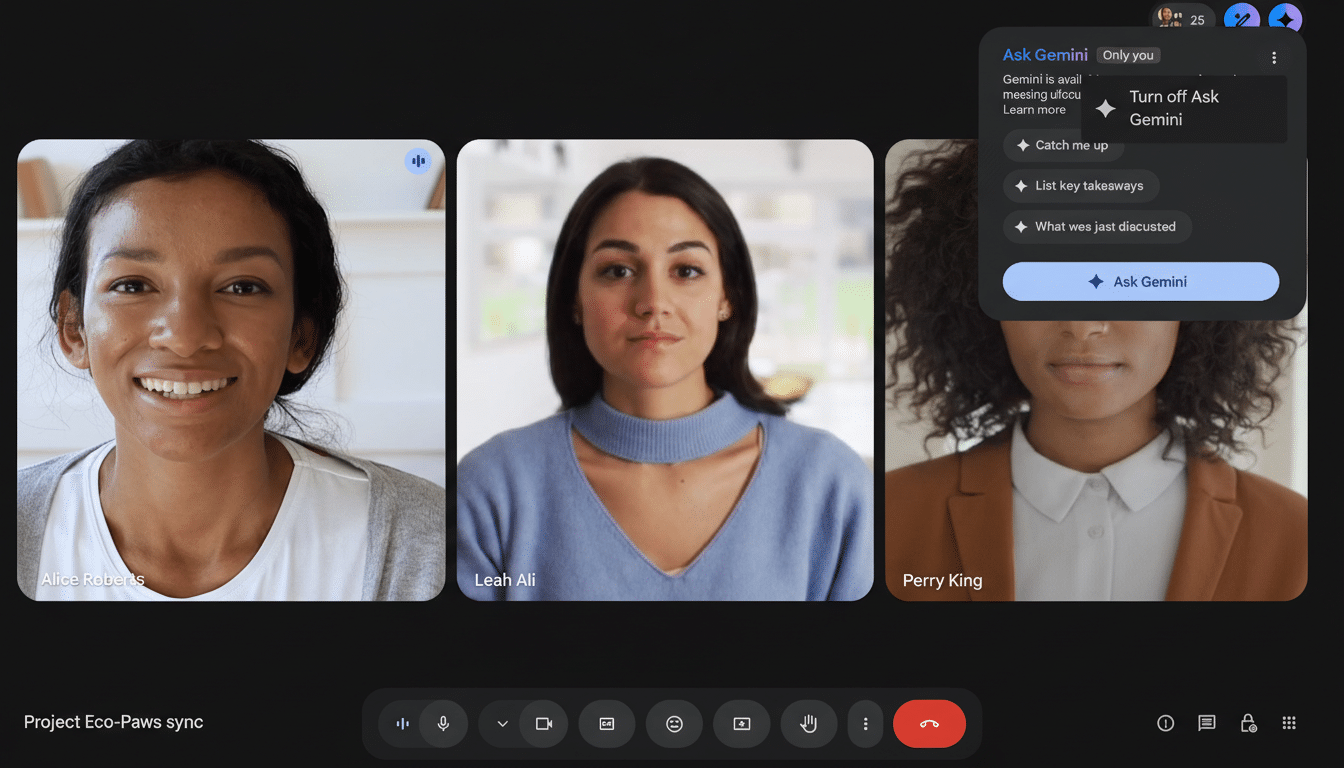
The tool builds on Google’s broader Gemini for Workspace strategy, which aims to weave generative AI into everyday productivity tasks. In Meet, that means turning real-time dialogue into actionable context—something teams often struggle to do consistently in fast-moving discussions.
Rollout timeline and availability for Business Standard users
Access is expanding in two waves. Workspace Business Standard customers will start seeing Ask Gemini in Meet from late January. A mobile rollout is slated for February, extending the feature to participants on phones and tablets. Google hasn’t provided exact dates for either phase, which suggests a gradual, region-by-region enablement typical of Workspace releases.
This shift notably lowers the entry point from the Business Plus tier, signaling that Google sees AI summaries and catch-up prompts as core collaboration features rather than premium add-ons. For organizations that standardized on Business Standard, it removes a licensing barrier that previously put AI meeting helpers out of reach for many teams.
New language support and limits for Ask Gemini in Meet
Beyond English, Ask Gemini in Meet is gaining support for French, German, Italian, Japanese, Korean, Portuguese, and Spanish in early February. There is an important caveat: the tool works with one language at a time. In multilingual meetings, it will operate in the selected language rather than mixing inputs across languages. That’s a practical limitation for global teams, but it’s also a sensible first step toward more robust multilingual processing.
For international deployments, this opens the door to more consistent AI summaries in regional offices and cross-border projects. A sales team in Tokyo, for instance, could keep discussions in Japanese while still generating clear action items and quick recaps for internal stakeholders.
Why this matters in the AI meeting tools race
The expansion lands amid intense competition around AI in conferencing tools. Microsoft is pushing Copilot in Teams, which can summarize meetings and extract tasks but requires a separate Copilot for Microsoft 365 license. Zoom offers AI Companion, which the company has positioned at no additional cost for paid Zoom plans. By bringing Ask Gemini in Meet to Business Standard and to mobile, Google is closing a distribution gap and making AI assistance feel default, not deluxe.
The timing also aligns with broader workplace trends. Microsoft’s 2023 Work Trend Index found that employees spend more than half their time communicating—meetings, email, and chat—creating demand for tools that reclaim focus. AI-generated summaries and action items don’t just save minutes; they reduce the friction of switching between discussion and documentation, a hidden productivity tax in hybrid work.
Practical use cases and admin notes for deployment
Imagine joining a product review ten minutes late and asking, “What decisions have been made and who owns the follow-ups?” Or wrapping a quarterly planning call by prompting, “Summarize risks, dependencies, and deadlines.” Ask Gemini in Meet is built for those scenarios. On mobile, the value is even clearer: commuters or field teams can stay contextually aligned without digging through chat logs.
From an IT perspective, expect familiar Workspace controls. Feature availability typically follows admin-managed settings, and Google has emphasized that Gemini for Workspace respects existing data protections and organizational policies. As with any AI rollout, change management matters: setting expectations on accuracy, clarifying when to double-check summaries, and educating teams on effective prompts will drive better outcomes.
Bottom line: by broadening access, adding key languages, and reaching phones, Google is turning Ask Gemini in Meet into a mainstream capability. For many organizations, that will translate into faster alignment, clearer action items, and fewer “what did I miss?” interruptions—small wins that compound over every meeting on the calendar.
