


Gmail is inching from smart suggestions to something bolder: an inbox that behaves like an AI agent. Recent signals from Google’s product leadership point to a future where Gmail doesn’t just sort and summarize, it interprets relationships, remembers goals, and quietly works on your behalf.
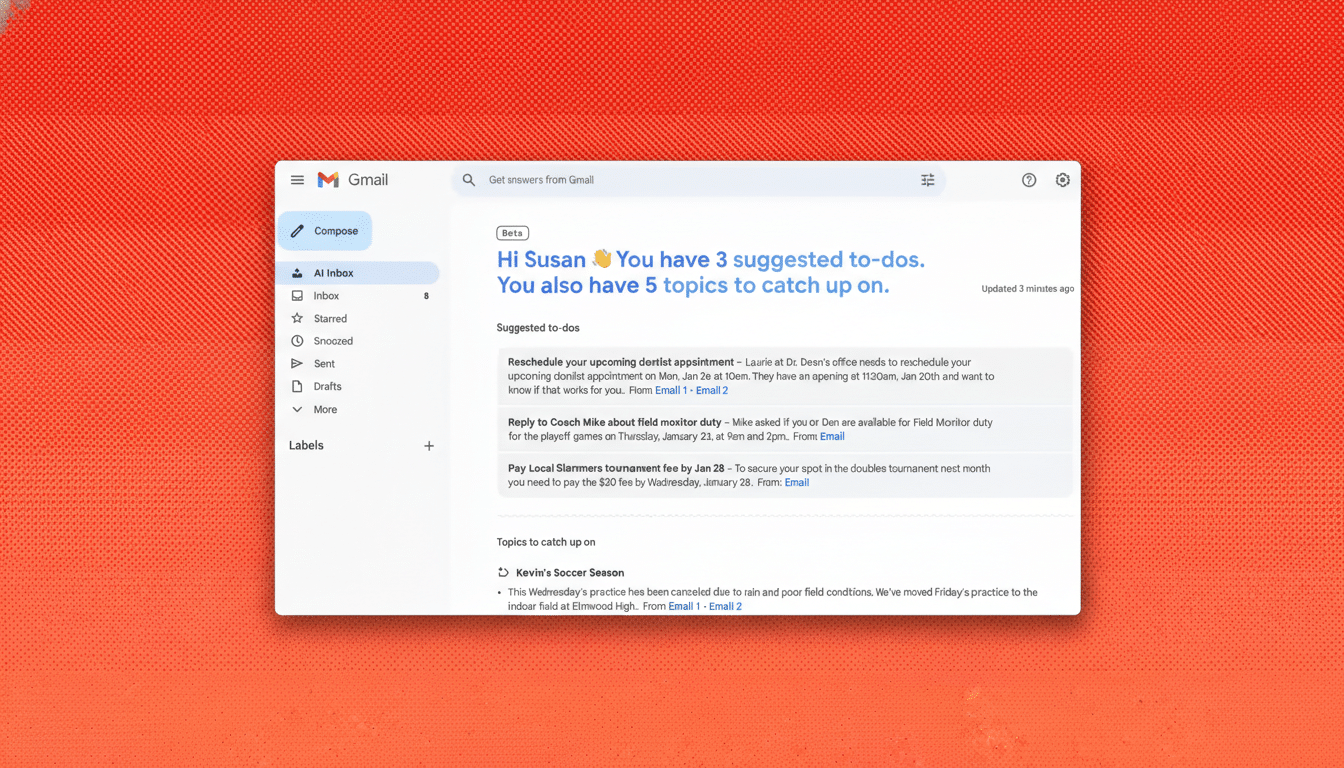
That shift explains why Google is rolling out a separate AI Inbox view rather than reshaping the classic inbox overnight. The direction is clear, though. Instead of treating email as a stream of messages, Gmail is beginning to treat it as a stream of tasks, commitments, and events that can be modeled and managed.
- Why Gmail is uniquely ripe for AI-powered email agents
- From simple email rules to context-rich relationships
- How an AI-driven Gmail inbox could operate day to day
- Privacy guardrails could make or break Gmail’s AI inbox
- Competitive pressure is rising across email and AI
- What to watch next as Gmail tests its AI inbox
Why Gmail is uniquely ripe for AI-powered email agents
Email remains the operating system of modern work. McKinsey has estimated that knowledge workers spend roughly 28% of their week on email, a drag on focus and energy that automation rarely fixes. The Radicati Group pegs global email traffic at well over 300 billion messages per day, underscoring the scale of the overload.
Google has said its Workspace apps now serve more than 3 billion users, with Gmail alone previously surpassing 1.5 billion accounts. That ubiquity gives Google a rare chance to deploy agentic AI where people already live their professional and personal lives—travel itineraries, invoices, school notes, contracts, and everything in between.
From simple email rules to context-rich relationships
Filters and labels work like plumbing—routing messages without understanding their meaning. An agentic Gmail aims to recognize that the same sender can occupy different roles: a vendor today, a marketer tomorrow, a partner next quarter. Context, not just keywords, becomes the organizing principle.
Think of clusters such as “Q4 contract renewals,” “family travel next month,” or “open design approvals.” Rather than merely tagging messages, an AI Inbox could group them by user-defined goals, summarize status, highlight blockers, and surface the next action. Summaries and reply drafts are table stakes; the differentiator is judgment about what matters now.
How an AI-driven Gmail inbox could operate day to day
Google’s vision hints at natural-language control. You tell Gmail, “Prioritize messages from finance about the budget reforecast, flag anything from the hiring committee, and keep me posted on neighborhood alerts.” The system then watches for updates, clusters related threads, proposes triage, and drafts responses for review.
Trust hinges on transparency and reversibility. Users will expect visible rationale for prioritization, the ability to undo actions, and clear controls that keep the classic inbox intact. Compared to drafting text, reliably deciding what you see—and what you don’t—demands consistent performance and conservative defaults.
Privacy guardrails could make or break Gmail’s AI inbox
Agentic behavior requires a model of your relationships, history, and intent. That raises obvious questions about data boundaries, retention, and human oversight. Enterprise customers will ask how models learn, what stays within a tenant, and how auditing works. Individual users will want simple opt-in flows, quick off switches, and clarity about where computation happens.
Expect Google to lean on established frameworks such as the NIST AI Risk Management Framework and to align with regional privacy regimes like GDPR. On-device inference for sensitive tasks, red-team testing, and activity logs that explain automated actions are likely to be part of the playbook if Gmail is to earn day-to-day reliance.
Competitive pressure is rising across email and AI
Microsoft is weaving Copilot into Outlook to summarize threads and propose replies. Productivity startups like Superhuman have added AI triage and instant responses. Even messaging platforms are layering in summarization. Gmail’s advantage is not features per se, but the depth of context across Calendar, Drive, Docs, and Android—raw material an agent can use to act with nuance.
If Google executes, the inbox could become a mission control that notices conflicts, books time, tracks approvals, and nudges stakeholders—without the user hunting through threads. If it stumbles, users will see hallucinations, missed priorities, and opaque sorting that erodes trust.
What to watch next as Gmail tests its AI inbox
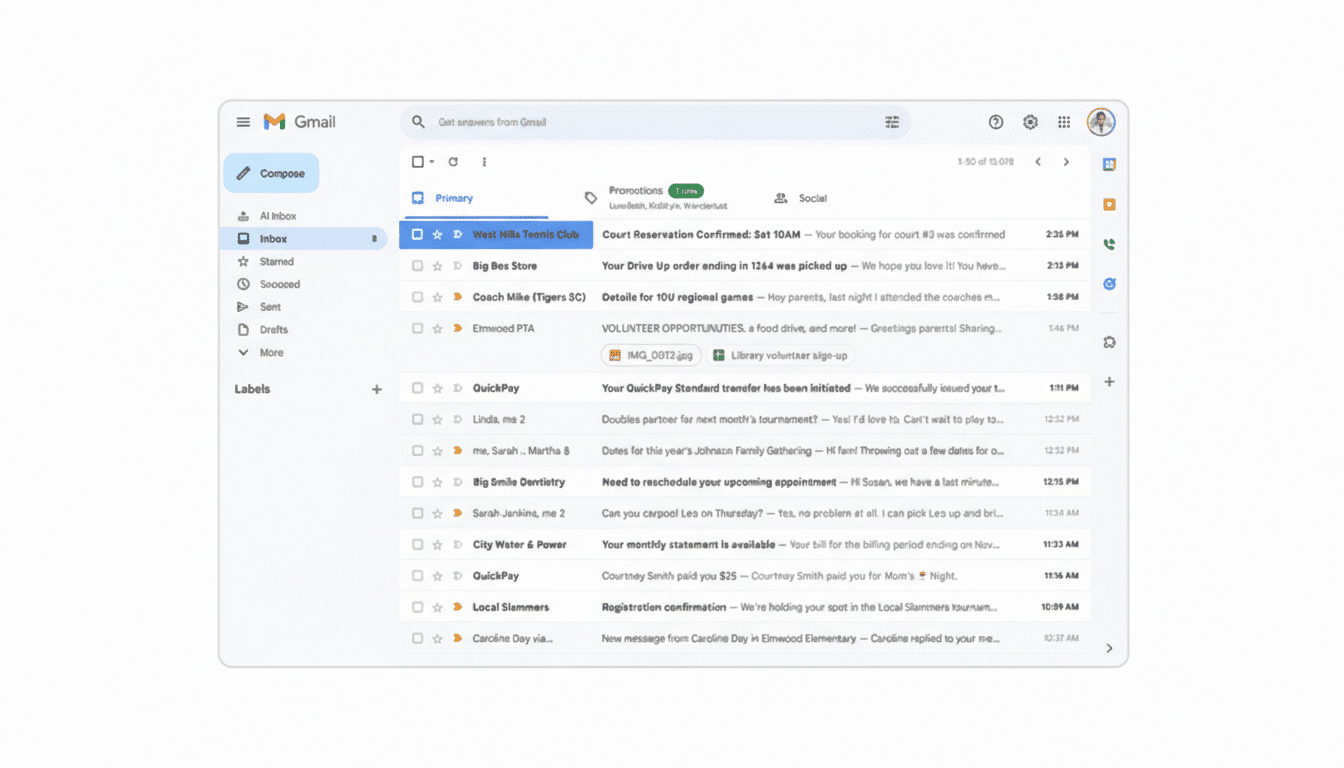
The separate AI Inbox tab is a telling design choice, signaling respect for entrenched workflows while creating room to experiment. Watch for gradual expansions: richer clustering, user-taught categories in plain language, safer auto-triage, and scenario-specific skills such as travel, billing, or recruiting that prove value quickly.
The endgame is not an inbox that is cleaner, but one that is quieter—because it understands what you are trying to accomplish and handles the rest. If Gmail can deliver that reliably, email might finally feel less like a chore and more like an assistant that thinks ahead.
