


El Niño events during the past four decades were nearly 40% stronger than those of the pre-industrial era, according to a coral-based reconstruction from the Galápagos Islands described by the University of California, Santa Barbara. The findings, reported Aug. 28 by UC Santa Barbara as published in Science, extend the record of eastern tropical Pacific conditions back roughly 1,000 years beyond the period covered by modern instruments.
The result is consequential because El Niño can shift rainfall, heat and atmospheric circulation well beyond the Pacific, affecting fisheries and increasing the likelihood of weather disruptions in some regions. But the reconstruction does not establish that human-caused climate change caused individual El Niño events, or directly prove why the longer-term intensification occurred. It offers evidence of an unusual recent change and narrows some alternative explanations.
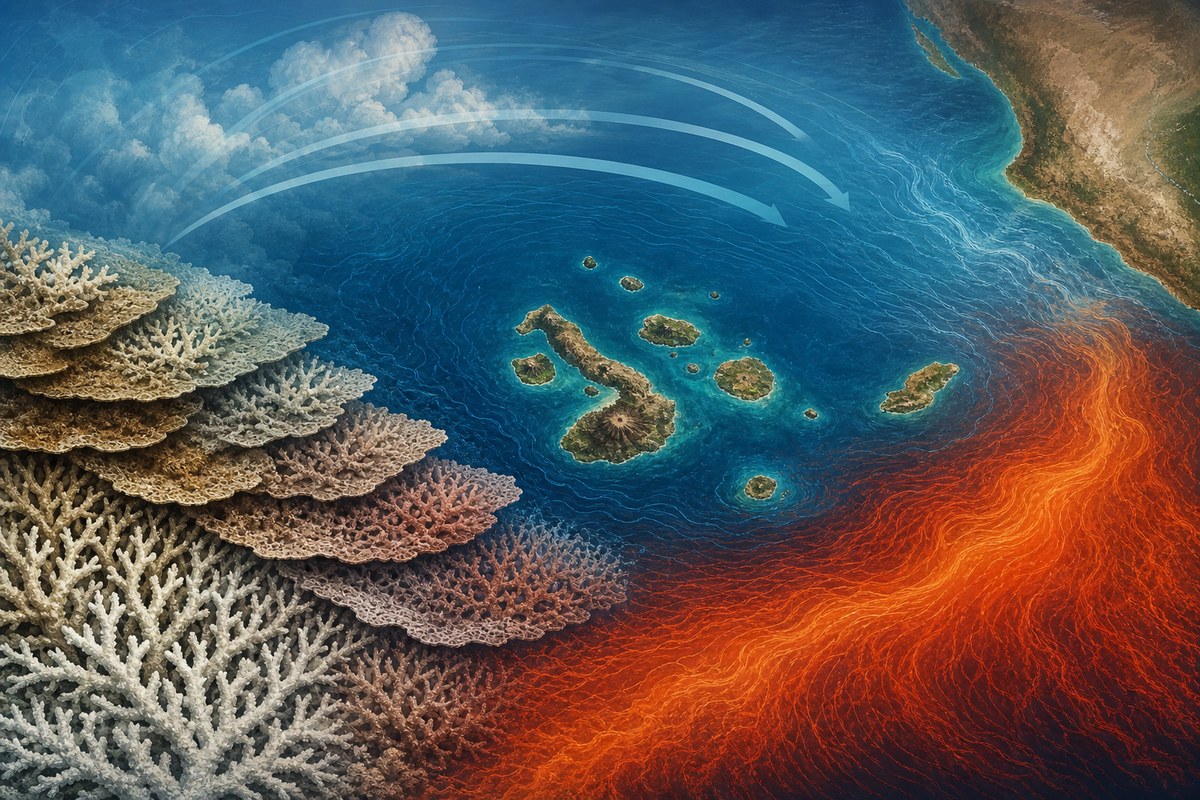
Corals offer a longer view of Pacific variability
The research team examined 13 coral samples, including cores from living corals and ancient coral boulders in the Galápagos. The islands sit in a part of the eastern tropical Pacific that is strongly influenced by El Niño, making their corals a potential archive of changing ocean conditions.
Corals build skeletons in layers. The researchers measured strontium-to-calcium ratios and oxygen-isotope ratios within those layers, both chemical signals used as indicators of seawater temperature. By assembling records across modern and older material, they reconstructed the historical variability associated with El Niño rather than relying only on the relatively brief instrumental record.
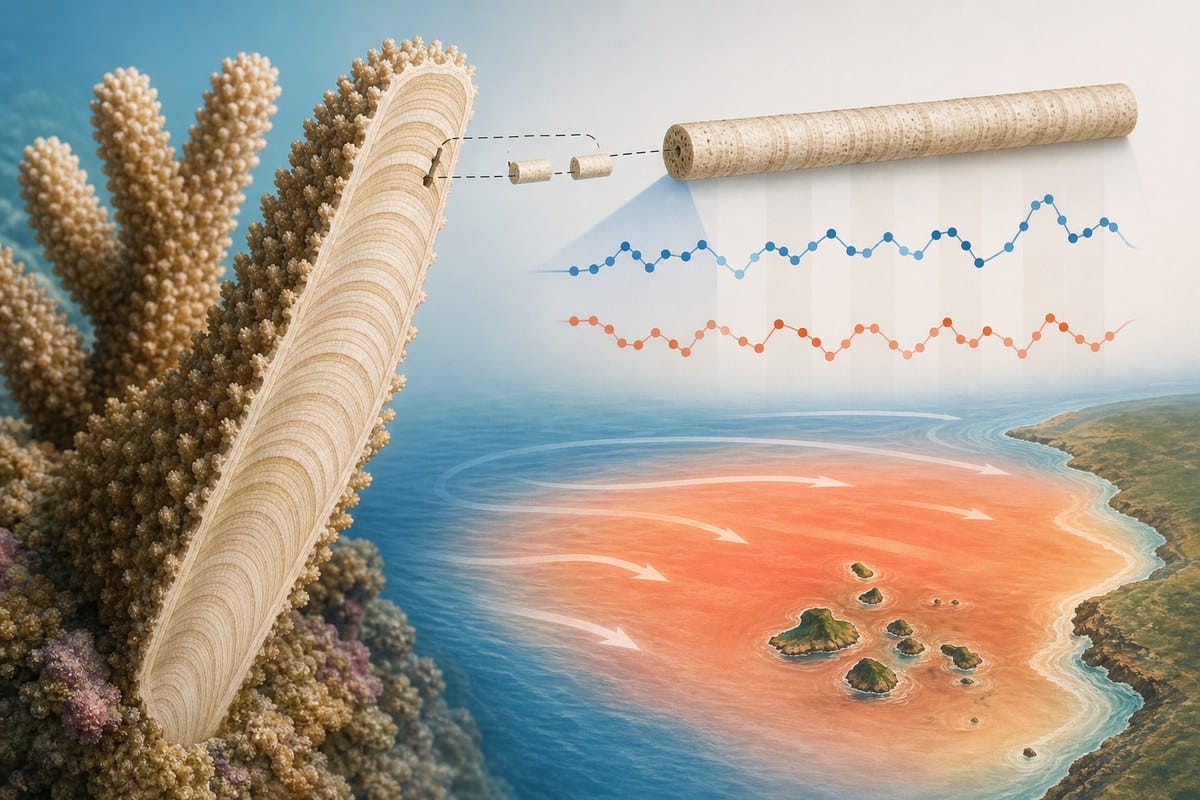
According to the university’s account, the millennium before about 1850 showed a lower, comparatively consistent pattern of El Niño intensity. The largest events in the last 40 years exceeded that earlier range. The reported nearly 40% increase is a comparison of reconstructed recent intensity with the pre-industrial era; expressed plainly, it means the recent measure was about 1.4 times the earlier benchmark. It is not a measurement of conditions in 2026 or a forecast for the next El Niño.
NASA’s overview of El Niño describes the phenomenon as a coupled ocean-atmosphere pattern in which surface waters in the central and eastern tropical Pacific become warmer than usual. The pattern can alter weather around the world and disrupt marine fisheries. NASA also makes an important distinction: El Niño is a naturally occurring climate pattern, not something caused by climate change, although it can contribute to exceptionally warm global years.
What the study tests — and what it does not settle
The study’s lead author, Julia Cole of the University of Michigan, said the reconstructed changes in El Niño strength tracked global warming and that the largest recent events were outside the range seen in the previous millennium. That interpretation is consistent with a possible climate-warming influence, but the available account does not provide direct attribution of the change to greenhouse gases.
The team also used climate-model experiments incorporating histories of volcanic eruptions and solar variability. Those experiments, UC Santa Barbara reported, did not find that volcanic and solar changes could account for a shift as large as the one reconstructed from the corals. That result addresses two natural influences on climate; it is narrower than saying that models could not reproduce the recent change or that every other explanation has been eliminated.
There are other limits to what can be concluded from the information available. Coral chemistry records local seawater conditions near the Galápagos, while a conclusion about El Niño intensity across the Pacific depends on how those local signals were reconstructed and checked against the broader climate pattern. The public account identifies the samples and chemical measures but does not provide the underlying paper’s title or DOI, uncertainty ranges, proxy calibration details, dating information for individual corals, or statistical tests. Those details would be needed to independently assess the precision and geographic reach of the estimate.
A signal with global stakes
Scientists have long sought to understand how a warming climate may affect the El Niño-Southern Oscillation, the broader Pacific system of which El Niño is the warm phase. The question is not whether El Niño will suddenly become an artificial phenomenon. It is whether the intensity, frequency or effects of a natural oscillation may change as the background climate warms.
In the UC Santa Barbara account, co-author Samantha Stevenson said the coral result suggests current climate models may be missing part of El Niño’s response to climate change. The model comparison in the study was designed to examine volcanic and solar influences, however, not to provide a complete explanation for the reconstructed shift. Resolving the discrepancy will require fuller analysis of the coral record and further model work.
If the reported intensification persists, stronger El Niño episodes could heighten risks associated with drought, flooding, wildfire, food security, infrastructure and some disease threats in vulnerable places, the researchers said. The reconstruction’s immediate contribution is historical: it places the recent four decades against a far longer baseline and finds them unusually strong within it.

