


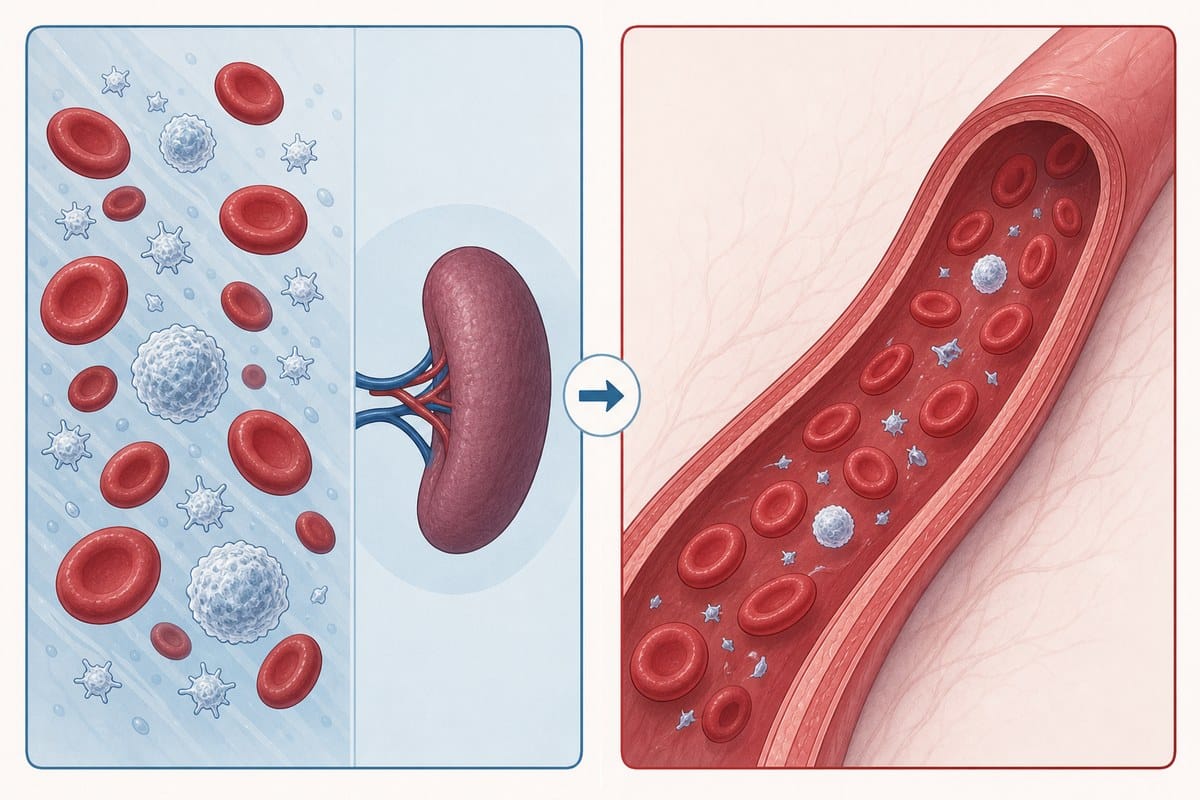
The Food and Drug Administration has approved Besremi, an injectable interferon medicine also known as ropeginterferon alfa-2b-njft, for adults with essential thrombocythemia, a rare chronic blood disorder marked by excess platelet production. The Aug. 31 decision adds a labeled treatment option for a disease in which too many platelets can increase the risk of blood clots and, at very high counts, bleeding.
The approval was based principally on a randomized study in patients whose disease had not responded adequately to hydroxyurea or who could not tolerate it. In that trial, 37.4% of patients assigned to Besremi achieved a durable composite response at both months 9 and 12, compared with 3.6% of those assigned to anagrelide, according to the FDA approval announcement. The 33.8-percentage-point difference is substantial, but the result should not be read as proof that the drug prevents clots, extends life or cures the disorder; those were not the outcomes reported in the announcement.

What the pivotal trial measured
The SURPASS ET trial enrolled 174 adults with essential thrombocythemia at multiple sites. It was open-label, meaning both participants and investigators knew whether a patient had been assigned to Besremi or anagrelide. Ninety-one patients received Besremi and 83 received anagrelide. Unless aspirin was medically unsuitable, patients in both groups also received low-dose aspirin.
The study’s primary assessment was not simply whether a platelet count fell. It used a durable modified European Leukemia Net response measured at two separate points, months 9 and 12. To count as a response, a patient had to meet blood-count remission criteria, show improvement or no progression of spleen enlargement, and have no bleeding or clotting events during the assessed period.
That composite endpoint offers a broader picture than platelet counts alone, incorporating clinical events and spleen findings. But it also means the FDA’s topline result does not separate how much of the difference came from each component. The announcement does not provide independently detailed rates of clots or bleeding, nor does it report survival outcomes or a longer-term comparison of complications.
Because the study randomly assigned participants to the two treatments, it can support a causal comparison for this defined composite outcome in the population studied. Its open-label design is still relevant when interpreting outcomes that may be influenced by clinical assessment or treatment decisions. And the trial population was specific: people with an inadequate response to, or intolerance of, hydroxyurea. It does not by itself establish equally strong evidence for every adult newly diagnosed with the condition.
Approval scope is broader than the trial population
Specialist oncology reporting says the approved indication covers adults with essential thrombocythemia regardless of genotype or disease status, including people who are newly diagnosed and have not previously received cytoreductive therapy. The ASCO Post reported that breadth, which is wider than the hydroxyurea-experienced or hydroxyurea-intolerant group described in the FDA’s summary of SURPASS ET.
The distinction is important for reading the evidence rather than a reason to question the approval. Regulators can approve a medicine for a population broader than a single pivotal trial’s enrollment criteria after reviewing the full application, including supporting data, drug class knowledge and other evidence. Still, the public FDA announcement does not spell out the full basis for applying the indication to treatment-naive patients. Patients and clinicians considering the medicine will need to rely on the prescribing information and individualized clinical judgment for questions about eligibility and sequencing.
Besremi was already approved in the United States for adults with polycythemia vera, another myeloproliferative neoplasm. The new indication is notable historically: the ASCO Post and the patient publication HealthTree describe anagrelide’s 1997 approval as the previous new U.S. approval for essential thrombocythemia, making Besremi the first newly approved treatment for the condition in nearly three decades.
Dosing and safety require monitoring
FDA recommended that treatment begin with a 250-microgram subcutaneous injection, increase to 350 micrograms after two weeks and to 500 micrograms after four weeks. The recommended maintenance dose is 500 micrograms every two weeks, unless tolerability requires changes. Those are regulatory dosing instructions, not a substitute for an individual treatment plan.
The FDA listed elevated liver enzymes, anemia, fever, bacterial infection, itching and weight loss among the most common adverse reactions. The agency’s announcement does not provide enough detail to compare the full safety profiles of Besremi and anagrelide, or to describe every warning, contraindication or monitoring requirement. Those details belong in the full prescribing information and in discussions with a hematology clinician.
Essential thrombocythemia is generally managed over many years, so the months 9 and 12 response findings answer only part of the clinical question. The approval establishes that Besremi met the FDA’s standard for use in adults with the disease. How it performs over longer periods, including its effect on major thrombotic and bleeding events and how it is used across different patient groups, will depend on continued clinical evidence and real-world experience.

