


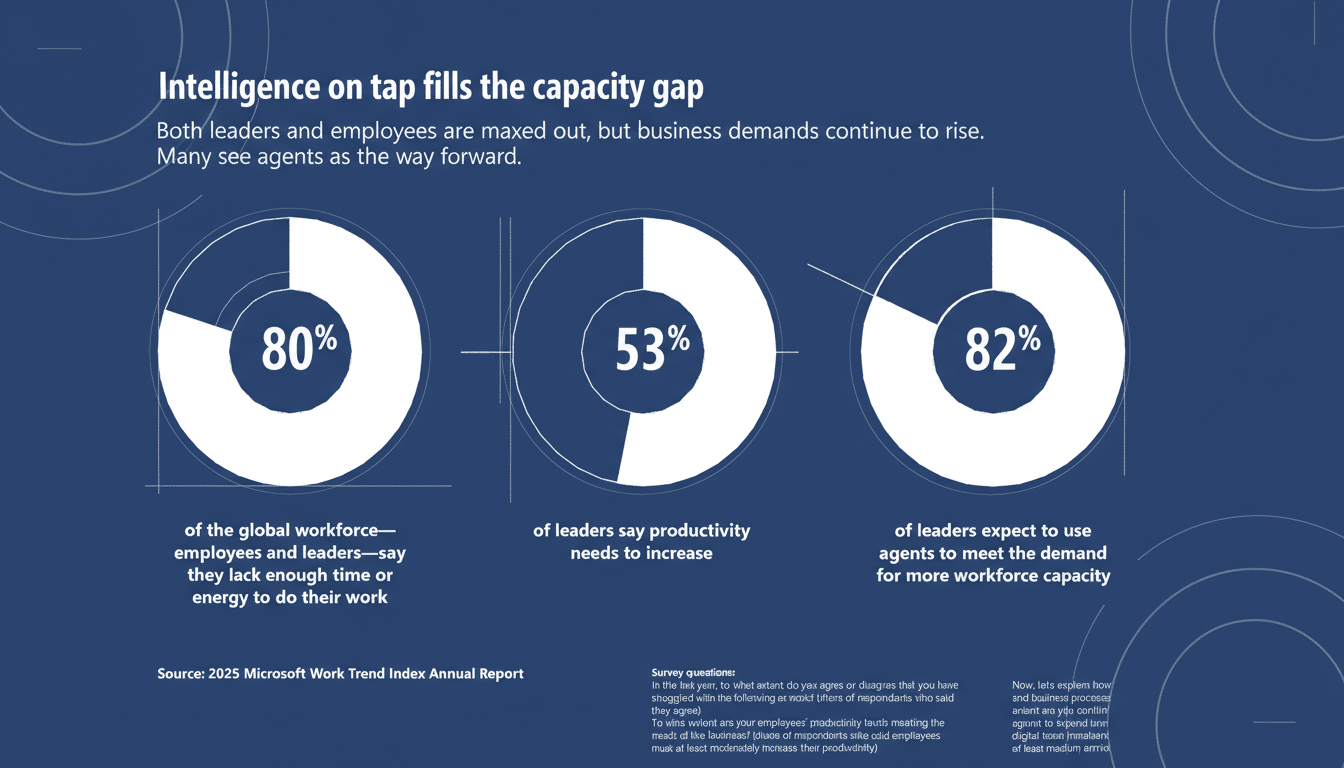
AI anxiety is real, but freezing up is the wrong move. The workers who keep their edge aren’t waiting for perfect playbooks; they’re pivoting inside their current roles. Global data backs the urgency: the World Economic Forum projects 44% of workers’ skills will be disrupted by 2027, with a net loss of 14 million roles and millions more created in data, AI, and sustainability. IBM’s Institute for Business Value says about 40% of the workforce will need reskilling within three years due to AI. Meanwhile, Microsoft’s latest Work Trend Index reports most knowledge workers already use AI and many are bringing their own tools to work. The direction is set. Your move is to adapt fast where you stand.
Here’s the playbook experts and early adopters are using to swap stress for traction—and translate AI into job security.
- Stop Fretting, Start Piloting at Work Now
- Find the AI That Fits the Job, Not the Hype
- Shift from Producer to Editor and Raise Quality
- Quantify Value and Make It Visible to Leaders
- Strengthen the Skills That AI Amplifies Most
- Mind the Guardrails to Build Trust and Safety
- Real-World Pivots Already Underway Across Sectors
- Your 30-Day Pivot Plan to Build AI Job Security

Stop Fretting, Start Piloting at Work Now
Pick one high-friction task you repeat weekly, such as drafting proposals, reconciling data, triaging emails, or documenting meetings. Baseline a metric that matters—cycle time, error rate, or customer response time—then run a two-week pilot with a safe, compliant tool. Think: a trusted copilot for writing, a low-code automation for routine steps, or a search assistant over approved documents.
The key is speed with guardrails. Use non-sensitive data, log what the AI did, and compare results to your baseline. One small, measured win beats a dozen abstract AI ideas.
Find the AI That Fits the Job, Not the Hype
Not every problem needs a large language model. Natural language tools shine for drafting and summarizing, classic machine learning for predictions, robotic process automation for repetitive clicks, and sometimes a simple rule-based workflow is enough. Clinicians at leading UK hospitals, for example, are testing ambient voice systems to generate clinical notes automatically—freeing time for care rather than paperwork. The lesson: match method to mission, not hype.
Shift from Producer to Editor and Raise Quality
AI raises the ceiling for output, but the human advantage moves to oversight and judgment. Act as the editor-in-chief: set the brief, provide examples, check sources, and refine outputs. In regulated fields, keep a clear human-in-the-loop record—who approved what and why. Your value compounds when you own quality and accountability.
Quantify Value and Make It Visible to Leaders
Turn experiments into evidence. Track time saved, accuracy gains, fewer handoffs, or faster cycle times. Roll up small wins into a personal “AI portfolio” you can show managers and teams. This is how individual pilots scale into team playbooks—and how you become the person colleagues call when they want results, not rhetoric.
Strengthen the Skills That AI Amplifies Most
Double down on skills that compound with AI: domain expertise, client empathy, problem framing, data hygiene, and clear writing. Add lightweight tech muscles—structured prompting, spreadsheet automation, basic SQL, and no-code workflows. Gartner advises avoiding the trap of treating AI as “digital labor.” The winners treat it as a force multiplier for human strengths.
Mind the Guardrails to Build Trust and Safety
Ask three questions before you start:
- What data leaves the organization?
- How is it retained and audited?
- Where is human review required?
Align your pilots with company policy and frameworks like NIST’s AI Risk Management Framework. Don’t paste sensitive or client-identifiable data into public tools. Document assumptions, sources, and final decisions. Trust is the new currency; guard yours carefully.
Real-World Pivots Already Underway Across Sectors
Insurance brokers at firms such as Howden are leaning on generative tools to draft proposals quickly so they can spend more time with clients—the human connection that closes deals. At Imperial College Healthcare NHS Trust, leaders highlight how voice-enabled systems can auto-generate documentation and letters, shifting staff from late-night admin to patient care. Property specialists like Segro report many “AI” wins are actually smart combinations of automation and machine learning—proof that incremental change delivers real results.
Process-mining leaders note the culture shift is as important as the tech: managers are less interested in who knows every answer and more in who can use the tools to find the best one. That mindset rewards problem solvers and integrators.
Your 30-Day Pivot Plan to Build AI Job Security
- Week 1: Map your top three repetitive tasks and choose one with clear metrics and low risk. Align on goals with your manager.
- Week 2: Pilot a tool on a small sample, keep a human reviewer, and document outcomes.
- Week 3: Expand the sample, tighten prompts or rules, and capture before-and-after data.
- Week 4: Package results, propose a lightweight standard, and train one colleague—then start the next pilot.
The takeaway is simple and actionable. AI will keep accelerating, and so can you. Pivot inside your current role, stack visible wins, and make yourself indispensable in the workflows that matter. Instead of stressing about replacement, become the person who shows everyone how to work smarter—starting now.
