


A restaurant menu once acted as a contract. The customer saw a price, decided whether the meal was worth it, and expected that figure to remain stable until the restaurant printed a new menu. Digital ordering has weakened that convention. Prices can now change across websites, delivery platforms, self-service kiosks, apps, and digital menu boards without anyone replacing a sheet of paper.
Dynamic pricing takes that capability further. Instead of reviewing prices every few months, a restaurant can adjust them according to demand, time, weather, inventory, local events, delivery volume, or kitchen capacity. A burger might cost less at 3:00 p.m. than at 7:00 p.m. A delivery order may carry a higher menu price during a storm. A café could discount iced drinks on a cold afternoon while promoting hot drinks at their regular prices.
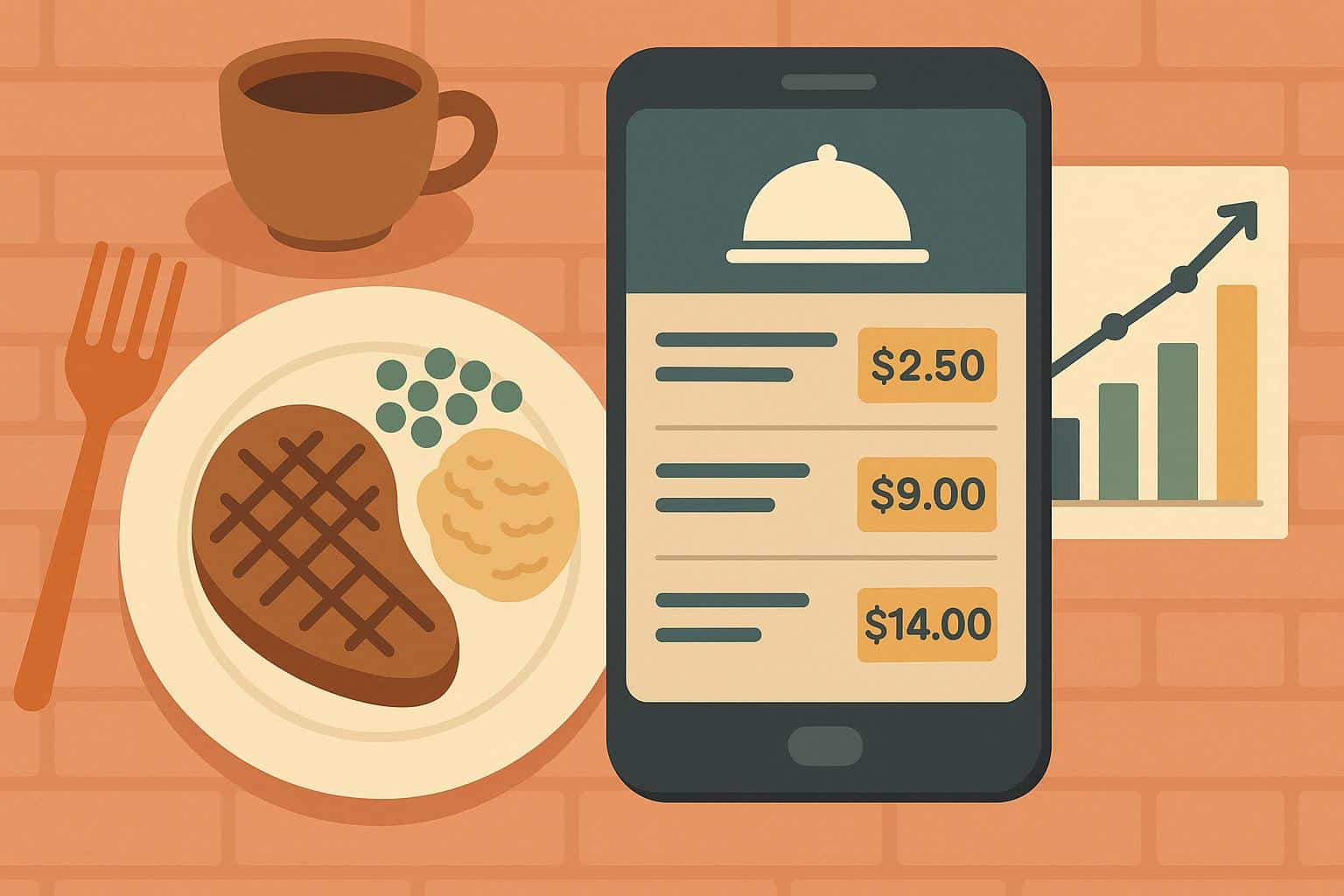
Restaurants have always used limited forms of variable pricing. Lunch menus, happy hours, early-bird offers, weekday specials, seasonal dishes, and weekend packages all charge different prices under different conditions. The difference lies in speed, scale, and automation. Traditional promotions follow a published schedule. AI-driven systems can analyse changing conditions and recommend or apply a new price almost immediately.
The comparison with Uber comes from the relationship between demand and available capacity. Ride-hailing platforms raise prices when many passengers request a limited number of cars. Restaurants also operate with limited capacity: a fixed number of seats, cooks, ovens, delivery drivers, and order slots. When demand exceeds that capacity, a pricing system may raise selected prices or remove discounts. When demand falls, it may lower prices to attract orders.
The comparison also explains the controversy. Most diners accept that a hotel room costs more during a festival or that a flight costs more before a holiday. They do not necessarily accept paying more for the same plate of food because they arrived during the dinner rush. Eating out carries strong expectations about hospitality, consistency, and equal treatment. A guest who discovers that another table paid less for the same meal may feel cheated even when the difference amounts to only a few dollars.
Wendy’s demonstrated how sensitive the subject had become in 2024. After its chief executive discussed dynamic pricing, daypart offers, AI-assisted menu changes, and digital menu boards, reports framed the plan as fast-food surge pricing. The company then clarified that it did not plan to raise prices during busy periods and emphasized the ability to offer discounts during slower hours. The reaction showed that terminology can shape public opinion before a restaurant changes a single price.
Dynamic pricing therefore presents restaurants with two separate challenges. The first involves calculating a profitable price. The second involves convincing customers that the price is legitimate. AI can help with the calculation, but it cannot settle the question of fairness on its own.
What Decides the Price of Dinner?
A dynamic pricing system begins with the restaurant’s transaction history. Point-of-sale data shows how many units of each item sold, at what time, on which day, through which channel, and at what price. The system can connect those sales to discounts, holidays, staffing levels, table occupancy, delivery times, cancellations, ingredient costs, and local events.
Time provides the most straightforward signal. A quick-service restaurant may experience a concentrated lunch rush between noon and 1:30 p.m., followed by several quiet hours. A bar may fill after 8:00 p.m. but struggle to attract early customers. A pricing model can identify those recurring patterns and offer lower prices when unused capacity is predictable.
Demand adds a real-time layer. A restaurant may have 80 percent of its tables booked, a long digital-order queue, or a sudden increase in app traffic. Those signals tell the system that the business does not need an additional discount to generate orders. The software may return an item to its standard price, reduce the visibility of promotions, or recommend a modest increase within limits chosen by management.
Weather can change both demand and product preference. High temperatures may increase orders for cold drinks, salads, and ice cream. Heavy rain may reduce walk-in traffic while increasing delivery orders. A forecast of snow could prompt customers to order earlier than usual. Research into restaurant demand forecasting has examined how sales and meteorological data can improve item-level predictions because weather, holidays, and other external factors often produce nonlinear changes that simpler forecasts miss.
Local activity creates another useful signal. A concert ending nearby can generate a sharp increase in late-night orders. A football match may raise demand for sharing dishes and delivery bundles. A convention can fill restaurants that are normally quiet on weekdays. A system connected to event calendars can anticipate the increase instead of responding only after orders begin arriving.
Inventory gives dynamic pricing a different purpose. A kitchen holding excess mushrooms, berries, seafood, or baked goods faces a deadline. Once the ingredients spoil, their value falls to zero and disposal creates another cost. A restaurant can discount dishes that use those ingredients, feature them prominently on digital menus, or include them in bundles. In this case, the changing price supports waste reduction rather than charging more during a rush.
Ingredient shortages can produce the opposite response. If a popular seafood dish is close to selling out, the restaurant may raise its price, remove it from delivery channels, or reserve it for dine-in customers. However, higher prices are not always the best answer. A temporary shortage may justify removing the item rather than making customers feel punished for ordering it.
Kitchen capacity may matter more than table occupancy. A dining room can contain empty restaurant chairs while the kitchen struggles with delivery orders. A system that reads only reservations could interpret the restaurant as quiet and release a discount, adding pressure at the worst moment. A stronger model considers preparation times, order backlog, staffing, equipment limits, and the complexity of each dish.
Digital infrastructure turns those signals into action. The pricing engine receives data from the point-of-sale platform, reservation system, inventory software, delivery channels, loyalty program, and external feeds. It forecasts demand, estimates how customers may react to different prices, and selects an action within predefined boundaries. That action might change a price, launch a discount, recommend a bundle, alter menu placement, or pause a promotion.
Human control remains essential because predictions can fail. A street closure may make historical traffic patterns irrelevant. A sudden kitchen problem may reduce capacity without appearing in the system. Incorrect inventory records could trigger a discount on an ingredient that is already scarce. Managers need the power to approve, reject, pause, or reverse automated decisions before a pricing error reaches hundreds of customers.
The Revenue Case for Responsive Menu Prices
Restaurant operators see dynamic pricing as a way to make more money from capacity they already possess. Rent, core staffing, equipment, insurance, and many utility costs remain payable whether a restaurant serves 40 customers or 140. Attracting additional orders during quiet periods can improve the return on those fixed costs without opening another location.
Off-peak discounts provide the least confrontational starting point. A restaurant might reduce selected prices between 2:00 and 5:00 p.m., when employees and kitchen equipment would otherwise sit underused. Customers gain a clear benefit for changing their behaviour, while the restaurant spreads demand across a longer period.
Digital menus allow operators to target those reductions. A blanket 20 percent discount may reduce the price of items that customers would have purchased anyway. A pricing system can instead discount dishes with high contribution margins, short preparation times, or excess inventory. It can leave low-margin items unchanged and test combinations designed for specific periods.
Peak pricing follows a different logic. If a restaurant regularly reaches full capacity on Friday evening, additional promotion does not create useful demand. A modest increase could raise the average transaction value and direct price-sensitive guests towards quieter periods. The operator earns more from a scarce time slot without adding tables or rushing service.
However, raising prices does not automatically raise profit. A higher price may reduce order volume, change what guests buy, or discourage future visits. Customers may skip drinks and desserts after noticing a more expensive main course. They may also accept the price once, leave a negative review, and choose another restaurant next time. The immediate transaction can appear successful while the customer relationship deteriorates.
Price elasticity determines whether an adjustment works. An item has high price sensitivity when a small increase causes a large decline in demand. It has lower sensitivity when customers continue ordering despite the increase. Signature dishes, convenience-led delivery orders, and products with few substitutes may tolerate moderate changes. Familiar items with obvious alternatives often do not.
AI can estimate elasticity by studying past behaviour, but restaurant data contains complications. A dish may sell poorly because of weak menu placement rather than price. A temporary promotion may attract customers who behave differently from regular guests. A price increase may coincide with a recipe change, bad weather, or reduced opening hours. The model must separate those influences before it recommends a decision.
Contribution margin offers a better target than revenue alone. A £20 dish with expensive ingredients and heavy labour may generate less profit than a £14 dish that is quick to prepare. Raising the first dish’s sales could increase kitchen pressure without producing much additional income. A useful pricing system accounts for ingredient cost, preparation time, packaging, delivery commission, waste, and discount expense.
Order composition also matters. A low-priced starter may lead customers to purchase drinks and desserts with stronger margins. Increasing its price could reduce the value of the entire order. Conversely, discounting a main course may attract customers who buy nothing else. Item-level optimization can therefore produce poor results unless the system understands baskets and dining patterns.
Demand management can create operational value even when prices remain unchanged. A restaurant can use targeted discounts to move delivery orders away from the busiest dine-in period. It can promote quick dishes when the kitchen has a backlog or encourage advance orders before a major event. These adjustments reduce late orders, cancellations, refunds, and staff stress.
Food waste presents another business case. A restaurant can lower the price of a dish when its ingredients approach the end of their usable life. The discount may generate less margin than a standard-price sale, but it still performs better than disposal. The restaurant also gains information about the size and timing of discounts needed to clear specific stock.
Dynamic pricing works best as a controlled revenue-management programme rather than a constant auction. Managers should establish minimum and maximum prices, limit how often prices can change, and protect core value items. They should measure repeat visits, customer complaints, preparation times, waste, average order value, and profit alongside revenue.
Testing should begin with a narrow question. A restaurant could ask whether a 10 percent weekday discount increases traffic between 3:00 and 5:00 p.m. without taking sales from lunch or dinner. Another test might examine whether a weather-triggered delivery bundle raises order value during rain. Specific tests produce clearer answers than allowing an algorithm to change dozens of prices simultaneously.
The strongest strategy may involve dynamic offers rather than visibly changing base prices. A restaurant can keep its regular menu stable while releasing time-limited bundles, loyalty rewards, or inventory-based specials. The operator still manages demand, but the customer sees an opportunity instead of a penalty.
Why Surge Pricing Feels Unfair
Customers judge a price through comparison, not only through affordability. They compare it with the price they paid last week, the price shown in an advertisement, the amount charged by competitors, and the amount another customer paid. These comparisons create a reference price for the meal.
Dynamic pricing disrupts that reference point. A customer who usually pays $12 for a sandwich may view $14 as a loss, even if the new price remains competitive. The restaurant has not added ingredients, improved service, or increased the portion. From the customer’s perspective, the business is demanding more while offering the same product.
Demand-based increases can appear especially unfair because the reason benefits the seller. Customers often accept higher prices when a restaurant faces a visible cost increase, such as a sharp rise in seafood prices. They respond less positively when the restaurant raises prices simply because many people want to buy at that moment. Research on restaurant pricing has long found that customers can accept variable prices when the structure appears fair, but presentation and the conditions attached to the price strongly influence that judgment.
Loss aversion deepens the reaction. People generally feel the pain of losing a benefit more strongly than the pleasure of receiving an equivalent gain. A $2 peak surcharge can therefore provoke more anger than a $2 off-peak discount creates satisfaction. Both produce the same numerical difference, yet customers interpret one as a penalty and the other as a reward.
Language changes the frame. “Peak surcharge” tells diners that the restaurant will charge extra when they most want to visit. “Early dining discount” tells them they can save money by choosing a quieter time. The underlying price schedule may be identical, but the second version preserves the standard price as the reference point.
Timing also shapes fairness. Customers may accept separate lunch and dinner menus because the categories are familiar and published. They may reject a price that changes while they travel to the restaurant or wait in a digital queue. Rapid changes make the transaction feel unstable and can create pressure to buy before the price rises again.
Group dining makes inconsistency more visible. Friends comparing receipts may discover that they paid different prices for the same dish on different days. Two app users may see different offers based on loyalty status, location, or ordering history. Even when the restaurant has a logical reason, unequal outcomes can create suspicion.
Personalized pricing carries the greatest risk. Demand-based pricing changes the price for everyone under the same conditions. Personalized pricing uses information about an individual customer to estimate how much that person may be willing to pay. A restaurant might theoretically use purchasing history, device data, location, loyalty activity, or response to earlier promotions.
Customers may tolerate targeted discounts but object to targeted increases. Offering a coupon to a customer who has not visited recently feels different from charging a loyal customer more because the system predicts that person is unlikely to leave. The second approach treats loyalty as an opportunity for extraction rather than a relationship worth protecting.
Algorithmic decisions can also hide forms of discrimination. Location-based pricing may produce systematically higher prices in certain neighbourhoods. Delivery demand may correlate with income, disability, working hours, or access to transport. A model does not need to use a protected characteristic directly to create unequal outcomes associated with that characteristic.
Suspicion alone can damage the business. Research involving restaurant customers found that greater suspicion about price increases was associated with lower perceptions of fairness and value, reduced satisfaction, and weaker intentions to return during peak-demand periods. A restaurant cannot solve that problem by insisting that its algorithm made a mathematically correct decision.
Transparency helps, but too much complexity can confuse customers. A notice stating that “prices may vary based on market conditions” provides little useful information. Diners need to know the price before ordering, how long it remains valid, and whether another fee will appear at checkout. They do not need the restaurant’s entire model.
Consistency provides another form of transparency. Published time bands, such as weekday lunch prices or late-night discounts, give customers a rule they can understand. A price that changes every few minutes according to an invisible demand score offers no comparable sense of control.
Restaurants should also recognise differences between channels. Customers already expect delivery prices to differ because packaging, commissions, and fulfilment costs are visible parts of the service. They may react more strongly when dine-in prices fluctuate inside the same location. A strategy acceptable in an app may feel inappropriate at the table.
Where Revenue Management Crosses the Line
A restaurant crosses the line when customers cannot make an informed choice. The displayed price should remain valid after the customer begins ordering. Changing it in the basket, during payment, or after a queue forms turns demand management into a bait-and-switch experience.
Clear price boundaries protect both sides. Restaurants should define the lowest and highest possible price for each participating item. They should also restrict the size and frequency of changes. A dish moving between $18 and $20 according to a published schedule will attract less concern than one jumping from $16 to $25 within an hour.
Personal data requires stricter rules than general demand data. Restaurants should not set higher prices according to a customer’s perceived income, device, urgency, disability, age, or previous willingness to pay. Sensitive characteristics and close proxies should remain outside the pricing model.
Managers should document every factor the system uses. They should know whether the price changed because of time, capacity, inventory, weather, ingredient cost, or customer behaviour. If nobody at the restaurant can explain a decision, the business has surrendered too much control to the software.
Audits should look for unequal outcomes, not only prohibited inputs. A model may never receive demographic data yet still charge certain communities more because it uses postcodes, ordering channels, or local demand patterns. Regular reviews can identify those effects before they become entrenched.
Human review becomes especially important during emergencies. Storms, transport disruptions, power failures, and public events can produce sudden demand. An automated system may interpret that demand as a profit opportunity and raise prices. Customers may interpret the same decision as exploitation. Restaurants need rules that suspend increases during situations in which people have limited alternatives.
Consumer protection law still applies when AI selects the price. Restaurants remain responsible for accurate displays, truthful promotions, disclosed fees, and compliance with rules governing discrimination and personal data. Calling a decision “algorithmic” does not transfer accountability to the software provider.
Contracts with pricing vendors deserve equal attention. Operators should confirm who owns the data, how the model uses customer information, how quickly prices can be reversed, and whether the vendor trains other systems on restaurant data. They should also demand logs that record each change and the reason behind it.
Staff need practical guidance because they face customer reactions. Servers and cashiers should not have to defend a mysterious algorithm. They need a short explanation of the pricing policy, authority to correct obvious errors, and a process for escalating complaints. A pricing strategy that employees cannot explain will rarely feel credible to diners.
Dynamic Discounts Offer a Safer Route
Dynamic pricing does not have to mean charging the highest amount that a customer will tolerate. Restaurants can use the same technology to release discounts during quiet periods, move surplus inventory, reduce waiting times, and direct customers towards dishes the kitchen can prepare quickly.
A discount-led approach aligns the restaurant’s objective with a visible customer benefit. The restaurant gains demand when it needs it, while the customer receives a lower price for changing the time, channel, or contents of the order. The exchange remains easy to understand.
Stable base prices should anchor the programme. A restaurant can publish its regular menu and layer temporary offers around it. Customers retain a reliable reference price, while management gains tools for handling slow periods and excess stock.
Limited trials can reveal whether the idea suits the business. Operators should start with one channel, a small group of items, and a defined time window. They should compare profit, customer retention, complaints, waste, service speed, and order composition against a control period.
Restaurants should stop a test when the customer cost exceeds the financial gain. A slight increase in short-term revenue does not justify damaged trust, confused staff, poor reviews, or falling repeat business. The model must serve the restaurant’s long-term position, not merely improve tonight’s numbers.
AI will make menu changes faster and more precise, but speed is not the same as sound judgment. The central decision remains human: whether a restaurant wants customers to experience changing prices as a useful choice or an unpredictable charge. Businesses that use responsive discounts, clear rules, and firm ethical limits can manage demand without turning dinner into an auction.

