


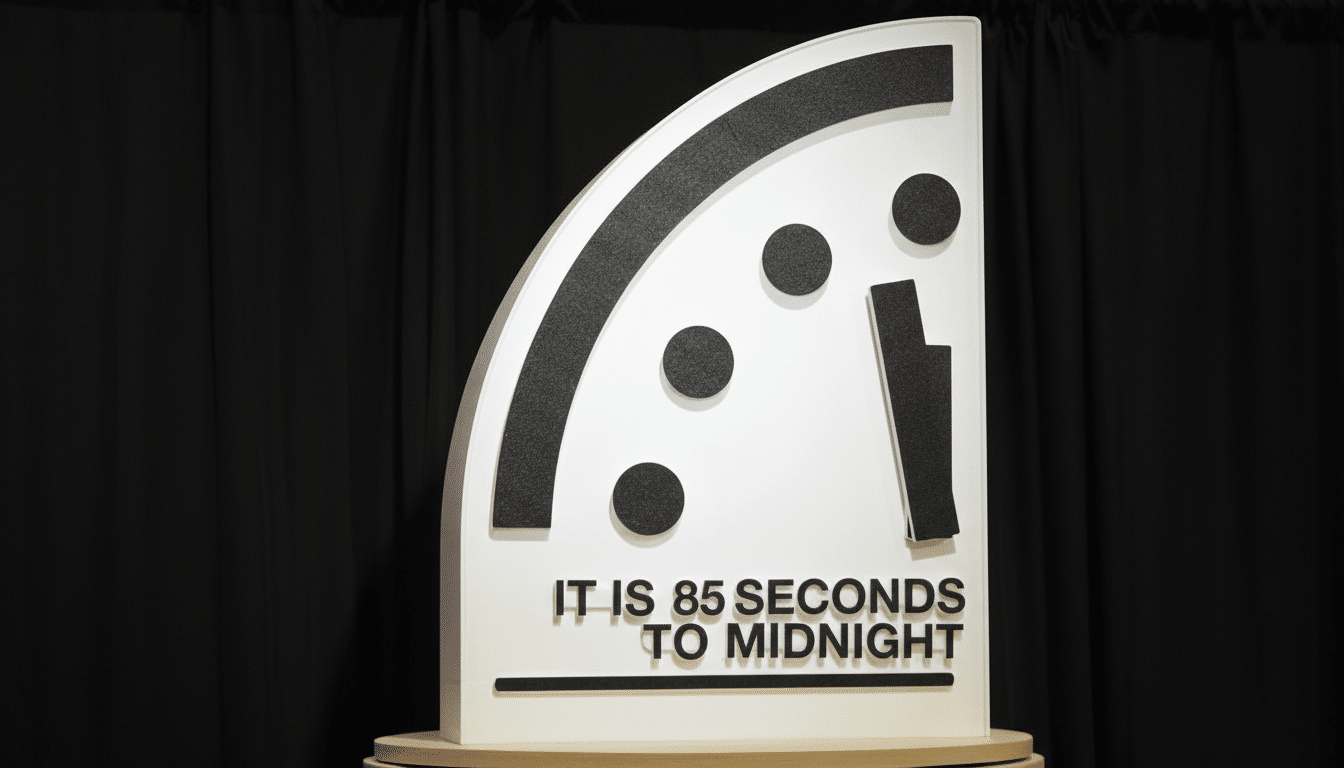
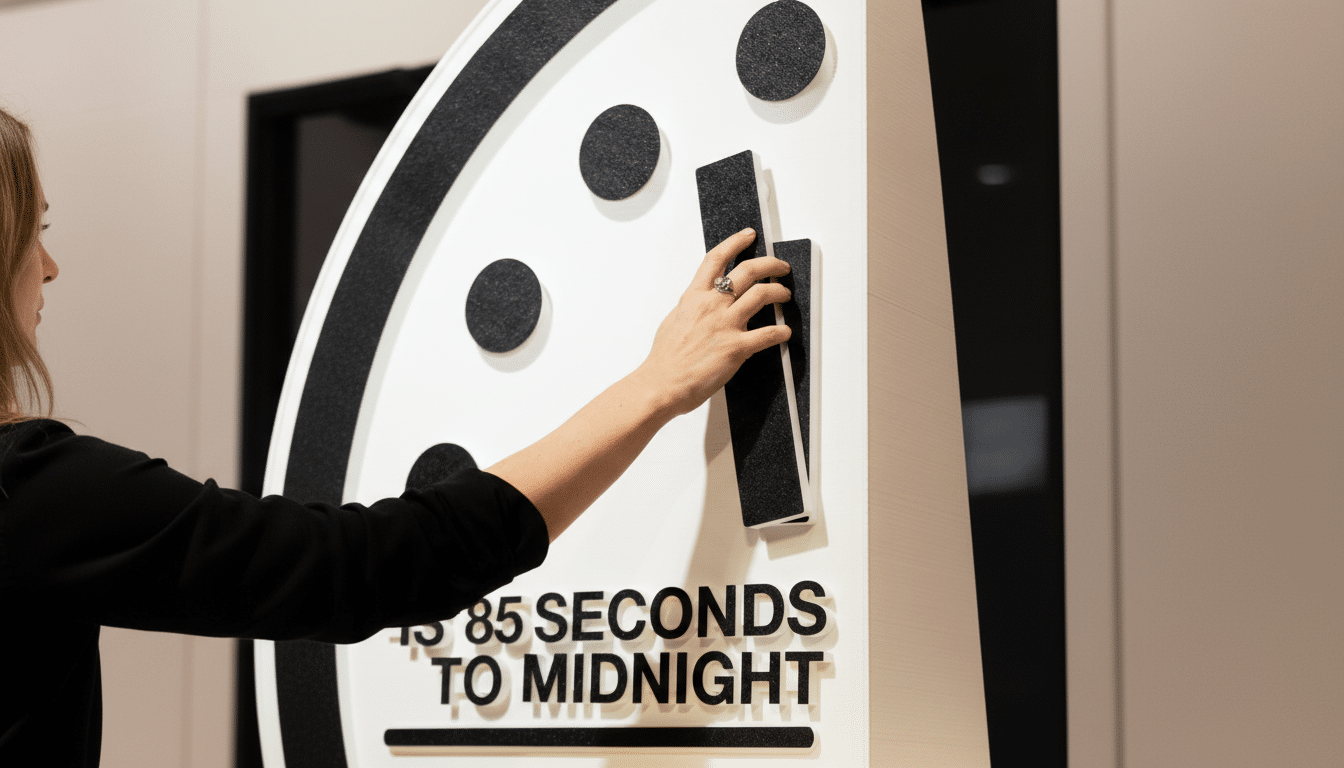
The Doomsday Clock has been moved to 85 seconds to midnight, the closest it has ever come to symbolizing human-caused global catastrophe. Set by the Bulletin of the Atomic Scientists, the new time underscores converging risks from nuclear weapons, climate change, biological threats, and rapidly advancing artificial intelligence.
Members of the Bulletin’s Science and Security Board said the hands are inching forward because major powers are dismantling guardrails faster than they are building new ones. This is not a prediction but a warning: the risk landscape is worsening, and the norms and agreements designed to contain it are fraying.
- Why the Doomsday Clock’s Hands Moved Closer to Midnight
- Nuclear Risks Resurface Amid Eroding Global Guardrails
- Climate and Biological Threats Intensify Worldwide
- Artificial Intelligence Emerges as a Global Risk Multiplier
- What Could Turn the Doomsday Clock’s Hands Back Again
- What the Doomsday Clock Is—and What It Is Not
Why the Doomsday Clock’s Hands Moved Closer to Midnight
The new setting reflects an accumulation of dangers rather than a single trigger. Escalatory rhetoric around nuclear use has normalized once-taboo scenarios. Global greenhouse gas emissions and atmospheric concentrations continue to hit new highs, while extreme weather punishes infrastructure and budgets. Public health capacity remains uneven, with eroding trust and underinvestment. And AI now accelerates crises by supercharging disinformation, lowering barriers to dangerous research, and creeping into sensitive military and decision systems without robust safeguards.
The move to 85 seconds follows a previous setting at 89 seconds, a sign that the risk curve has not flattened. The Board’s judgment is informed by outside research and its Board of Sponsors, which includes Nobel laureates and leading scientists.
Nuclear Risks Resurface Amid Eroding Global Guardrails
Strategic stability is under strain. The Stockholm International Peace Research Institute estimates the world holds more than 12,000 nuclear warheads, with the U.S. and Russia accounting for roughly 90%. Several nuclear-armed states are expanding or modernizing arsenals, testing new delivery systems, and rehearsing scenarios that blur the lines between conventional and nuclear conflict. With key arms-control accords expired or dormant, channels for verification, deconfliction, and crisis communication are thinner than they should be.
Experts warn that miscalculation is the most plausible path to disaster. False alarms, cyber interference with command-and-control, or attacks on early-warning satellites could compress leaders’ decision time to minutes, raising the risk of irreversible mistakes.
Climate and Biological Threats Intensify Worldwide
The Intergovernmental Panel on Climate Change reports that planetary warming is already around 1.2°C above preindustrial levels, amplifying heatwaves, floods, and wildfire seasons. The Global Carbon Project and NOAA have documented record-high emissions and methane concentrations, with energy and land-use systems not yet bending the curve quickly enough. Every fraction of a degree locked in now multiplies future risk and cost.
On the biological front, the World Health Organization has flagged persistent gaps in surveillance, laboratory safety, and vaccine equity. Advances in biotechnology are a double-edged sword: they can speed countermeasures but also lower the technical hurdles for creating or modifying pathogens. Erosion of public trust in health institutions further undermines response capacity when speed matters most.
Artificial Intelligence Emerges as a Global Risk Multiplier
Artificial intelligence compounds other threats by amplifying speed, scale, and opacity. Large language and generative models can fabricate convincing deepfakes, flood information ecosystems, and overwhelm social consensus, complicating crisis management and election integrity. In defense contexts, AI-enabled targeting and decision support raise concerns about automation bias and unpredictable failure modes. In bioscience, algorithmic design tools can accelerate benign research—but also, without guardrails, enable harmful capabilities.
Despite constructive steps from standard-setters like NIST and voluntary industry commitments, binding global norms remain sparse. Model evaluations, provenance signals for AI-generated media, and compute governance are emerging, but adoption is uneven and accountability mechanisms are still forming.
What Could Turn the Doomsday Clock’s Hands Back Again
The Bulletin’s recommendations align with longstanding expert guidance. Major powers should restart strategic stability talks, revive verification and data exchanges, restore military-to-military hotlines, and pursue measures such as de-alerting, no-first-use declarations, and limits on tactical nuclear deployments. Expanding constraints on fissile material production and reaffirming testing moratoria would add crucial friction to escalation.
On climate, commitments mean little without execution: accelerating clean power buildout, grid modernization, methane abatement, and climate finance for resilience can deliver near-term gains. In biosafety, universal gene-synthesis screening, tiered lab standards, and rapid-response platforms can reduce misuse risk. For AI, content provenance, independent model audits, incident reporting, and clear liability rules would curb harms while preserving innovation. Addressing information disorder—through transparency, media literacy, and platform accountability—restores the trust needed for collective action.
What the Doomsday Clock Is—and What It Is Not
The Doomsday Clock is a communications tool, not a countdown. It distills a wide body of evidence into a single, memorable signal about systemic risk. The hands have moved backward before—most notably after the Cold War’s thaw when major arms agreements took hold—reminding us that policy choices matter. Today’s record-setting is meant to galvanize, not paralyze.
The message is stark but empowering: catastrophe is not inevitable. Restoring guardrails, rebuilding trust, and investing in resilience can push the hands back. The distance to midnight is measured as much by political will as by physics and code.
