


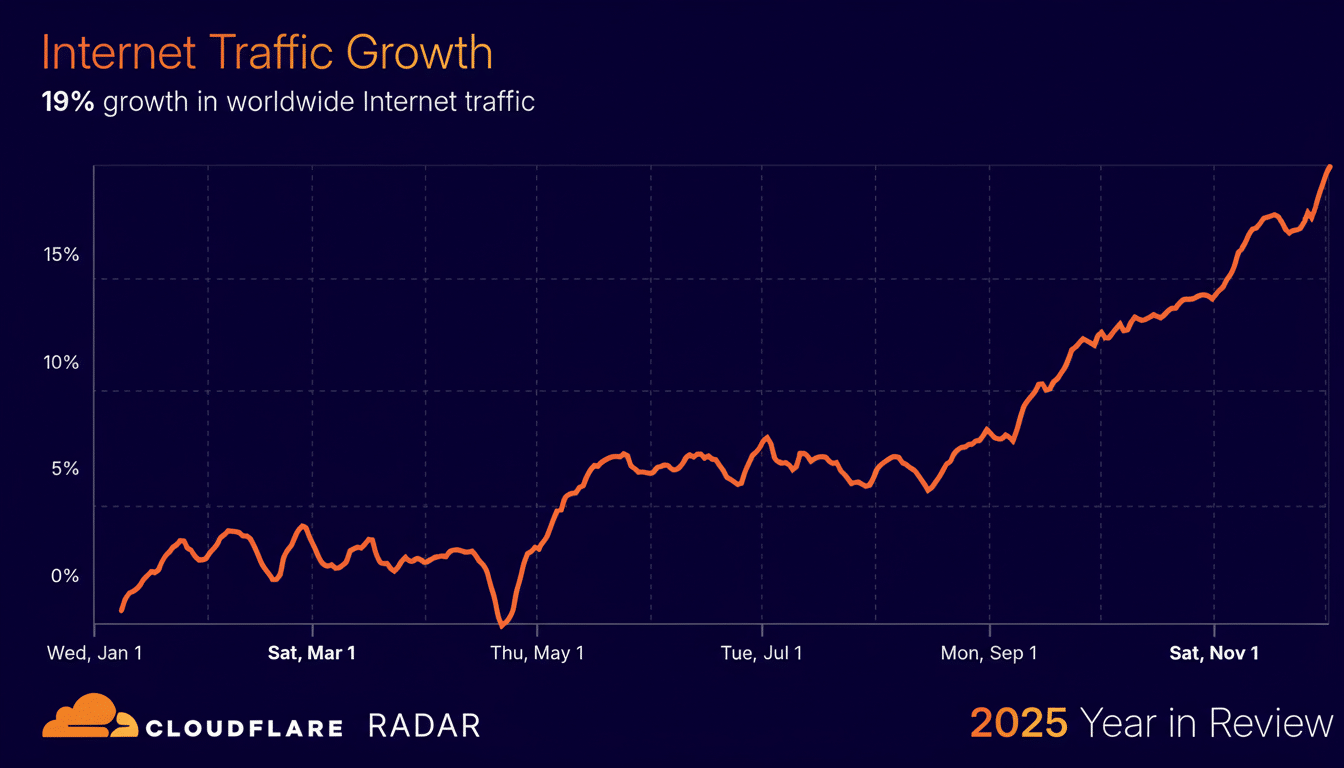
Global internet use continued to increase in 2025, with total traffic increasing by 19% according to the annual Cloudflare Radar Year in Review. Compiled from one of the world’s largest edge networks, the report indicates a year characterized by early and sustained activity, a late period of intense growth, a significant increase in AI bot traffic, and continued Google domination across several key categories of the web stack.
The headline number obscures important changes under its surface: AI crawlers picked up an obvious step, mobile use tilted yet more toward Android on a global scale, and satellite connectivity reached for the sky itself—shifting who can be online and when. Here are some of the crucial conclusions and why they matter for businesses, developers, and policymakers.

Traffic Increases Are Weighted in the Second Half
Activity settled around the new year, according to Cloudflare, and was mostly flat from January through July before spiking again in the second half. That pacing aligns with hardware launch cycles, major entertainment and sports streams, and the ramp of new AI-powered services that increase background traffic. In other words, 2025 wasn’t a one peak — it was end-of-year structural lift.
What’s more encouraging is the bigger picture: even though we could say the internet as we know it has grown up, there is still a growing total demand brought on by richer media, cloud Tower of Babel collaboration, and machine-to-machine workloads. For network planners, an end-of-the-year bulge means capacity and caching strategies that now need to accommodate holiday- and event-induced surges as well as traditional peaks for retail.
AI Bots Now Account for 4.2% of HTML Requests
AI crawlers and bots made up some 4.2 percent of all HTML requests observed, according to Cloudflare. That’s a significant proportion of traffic for publishers and APIs, most of whom have seen increased scraping activity de facto connected to model training and retrieval updates. ‘Soup’ of verified bots from the main providers are sitting next to a growing long tail, meaning companies have to tweak their allowlists, robots rules, and bot mitigation tactics.
From an operational perspective, the impact is clear: an undesired bot load can lead to blown bandwidth bills, corrupt analytics, and poor user experience. Teams are, more and more often, combining WAF and bot management tools with rate limiting, token-based access, and model-specific directives to find that balance between discoverability and shelter.
Google Retains Web Supremacy Across Core Services
AI battles notwithstanding, Cloudflare still counts Google as the most popular internet service in the world, larger than Facebook, bigger even than Apple and Microsoft. Googlebot is the dominant crawler among those that have been verified, Chrome is still the browser of choice, and Google’s ecosystem remains at the heart of everyday web activity. ChatGPT, interestingly enough, did not make its way into the top 10 internet services by traffic share.
Looking at the AI category, it is interesting to note that in this case Cloudflare notes ChatGPT as the most popular service, Claude/Anthropic and Perplexity beat Google Gemini, coming 4th. The lesson here is nuanced: AI is gaining ground—yet traditional search and browser behavior continues to frame where traffic goes and how content gets found.
Mobile Usage Split Shows Android Advantage
Android devices created 65% of mobile traffic tracked by Cloudflare, and iOS made up the rest. That share does, however, tend to vary a lot: one country has iOS adoption hit nearly 70%, and iOS accounts for 56% of mobile traffic in the US.
For product teams, it’s a practical rather than ideological shift: optimize for a fragmented Android hardware base while not overplaying your hand in iOS-heavy markets. Lean pages, performant media formats, and graceful degradation on low-end browsers are important considerations for conversion and retention in bandwidth- or device-constrained environments.
Satellites Push Networks Into Remote Markets
In 2025, satellite broadband’s footprint grew quickly. Cloudflare notes that Starlink’s growth year-over-year is a healthy 2.3x, and SpaceX’s launch total now numbers around 10,000 satellites. For the traffic map that means more visits from rural and remote parts of the world which never had any or only limited access to broadband.
With the increase of satellite connections we start to have a higher variance in latency and throughput on edge networks. And providers of content can mitigate that with regional caching, adaptive bitrate streaming, and transport protocols tailored for high-latency paths—techniques that help keep experiences usable as the internet’s geography becomes more exotic.
Continued Infrastructure Centrality Shapes Reliability
This year also illustrated how a small number of infrastructure providers support much of the web’s day-to-day reliability. A recent outage at a large edge and security provider briefly affected popular services including Spotify, Google, Snapchat, Discord, and Nintendo, among others—reminding operators to build for graceful failover and test multi-CDN and multi-region strategies.
Overall, the 19 percent traffic surge and ascent of AI bots themselves, among other newly broadening access channels, paint a pretty simple story: the internet is getting busier and more automated yet also ever more distributed. Those companies that invest in performance budgets, the governance of bots, and resilient architectures will be better positioned for that next wave of demand outlined in Cloudflare’s Radar 2025 Year in Review.
