


China has moved to outlaw the fully hidden, electronically actuated exterior door handles popularized by high-end EVs, requiring every passenger door to include a direct mechanical release that works even when a car’s low-voltage system fails. The policy, issued by the Ministry of Industry and Information Technology, positions China as the first major market to draw a bright safety line on a design trend that spread rapidly with the rise of electric vehicles.
The decision targets a sleek styling cue that helped reduce drag and signal modernity, but has been implicated in real-world extrication problems after crashes and power losses. Regulators say the new standard addresses a simple question with life-or-death consequences: can you always open the door?

What the new rule requires for exterior door handles
Under the Safety Technical Requirements for Automobile Door Handles, each passenger door must have an exterior handle that mechanically actuates the latch, along with a mechanical interior release. Tailgates are exempt. In practice, that means automakers cannot rely solely on pop-out or flush handles driven by electronic actuators without a direct mechanical fallback.
The standard was shaped through a multi-stakeholder process led by Chinese authorities, with input from more than 40 manufacturers, suppliers, and testing bodies, according to China’s national standards agency. Participants included BYD, Geely, SAIC, and Xiaomi, as well as foreign brands such as General Motors, Ford, Hyundai, Nissan, Porsche, Toyota, and Volkswagen. Tesla was not listed among the official drafters.
Why regulators are acting to mandate mechanical releases
Safety officials cite high-profile crashes in which occupants or first responders struggled to open doors after a collision or battery failure. An investigation by Bloomberg detailed incidents involving concealed Tesla handles and highlighted scenarios where low-voltage power loss left exterior releases inoperable. In the United States, the National Highway Traffic Safety Administration has an open defect investigation into certain Tesla Model 3 and Model Y door handles. While those models include manual interior pulls, investigators noted some owners were unaware of them and that access can be challenging for children.
Chinese regulators also referenced fatal crashes inside the country, including one involving a Xiaomi SU7, as catalysts for tightening requirements. Firefighters and paramedics globally have urged clearer, fail-safe egress in EVs, where 12-volt systems can be compromised after an impact or thermal event. The new rule aligns with broader safety engineering principles, including ISO 26262 functional safety guidance, emphasizing predictable human-machine interaction when electronics falter.
Design tradeoffs and industry impact of new handle rule
Hidden handles promised modest aerodynamic gains—often measured in small reductions to a vehicle’s drag coefficient—along with a minimalist aesthetic. But those benefits become difficult to defend when they complicate emergency egress. Automakers now face a design and engineering pivot: retain clean surfaces while integrating a mechanical linkage that is intuitive, clearly labeled, and operable with gloved or impaired hands.
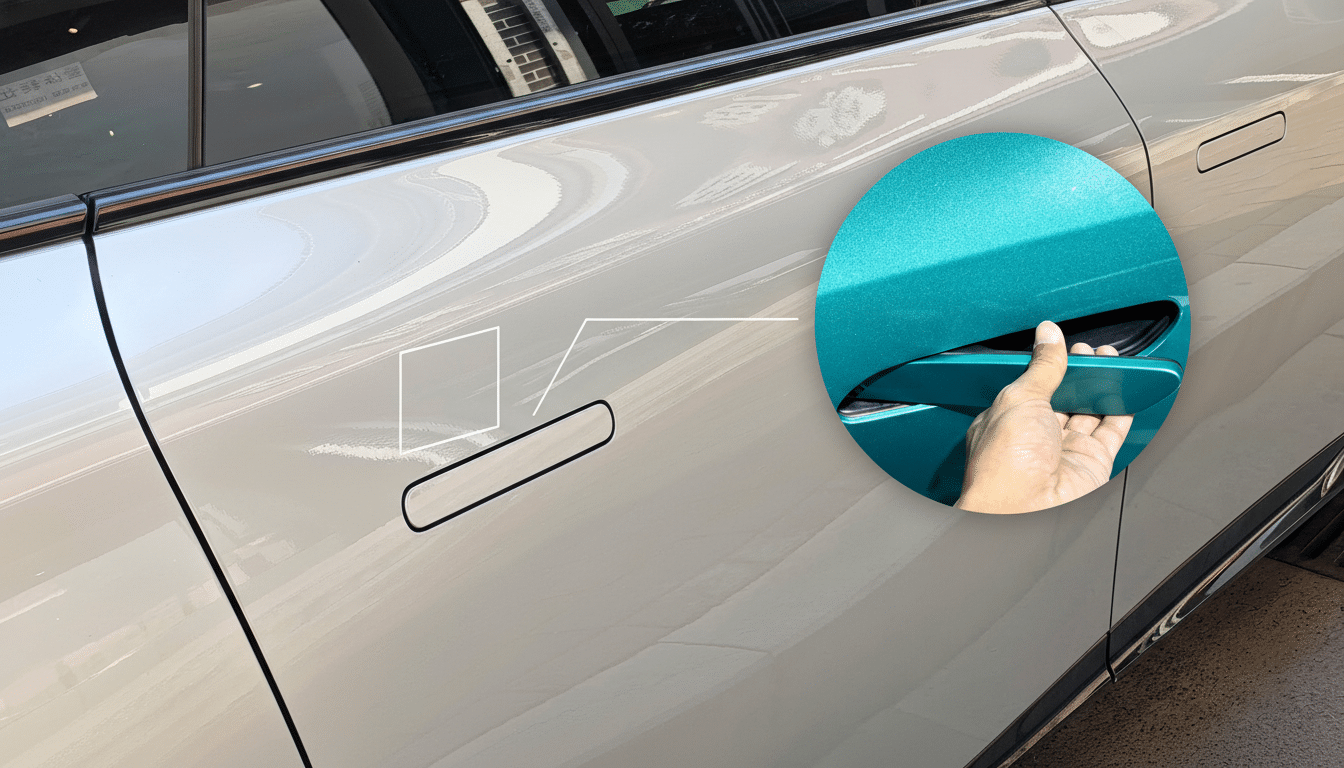
The shift is unlikely to add substantial cost or mass, but it will reshape exterior hardware on many Chinese-market models. Brands that currently use pop-out handles, common across domestic EVs, will need to redesign. For global platforms, manufacturers may either standardize mechanical exterior releases worldwide or maintain market-specific handle assemblies, adding complexity to supply chains and validation testing.
There is also a consumer-education angle. Even when manual pulls exist inside vehicles, many drivers do not know where they are or how they function. Clearer labeling and consistent placement—along with tactile feedback that signals “this is the mechanical release”—could reduce confusion in emergencies.
Could other markets follow China’s door handle mandate?
China’s move will reverberate beyond its borders. With more than one-third of new vehicles sold domestically now classified as new energy vehicles, according to the China Association of Automobile Manufacturers, standards adopted there quickly shape global design language. U.S. lawmakers have floated bills to mandate manual releases in new cars, and NHTSA’s ongoing probe keeps pressure on manufacturers. European regulators and testing bodies, including UNECE working groups and Euro NCAP, have also emphasized post-crash rescue and egress, though they have not drawn the same line on exterior handle design.
Automakers often welcome clear, performance-based rules, and this one is straightforward: any occupant or responder should be able to open a door without power. Expect suppliers to roll out new families of latches and handles that blend low drag with reliable mechanical linkages, along with standardized markings to guide users quickly.
The bigger picture for EV safety and door handle design
EV innovation has delivered breathtaking acceleration, battery advances, and software-rich cabins. But safety regulations tend to spotlight the basic interactions that matter in the worst moments. China’s crackdown on hidden door handles is a reminder that progress in mobility still hinges on fundamentals: when seconds count, the simplest mechanism is often the most advanced.
