


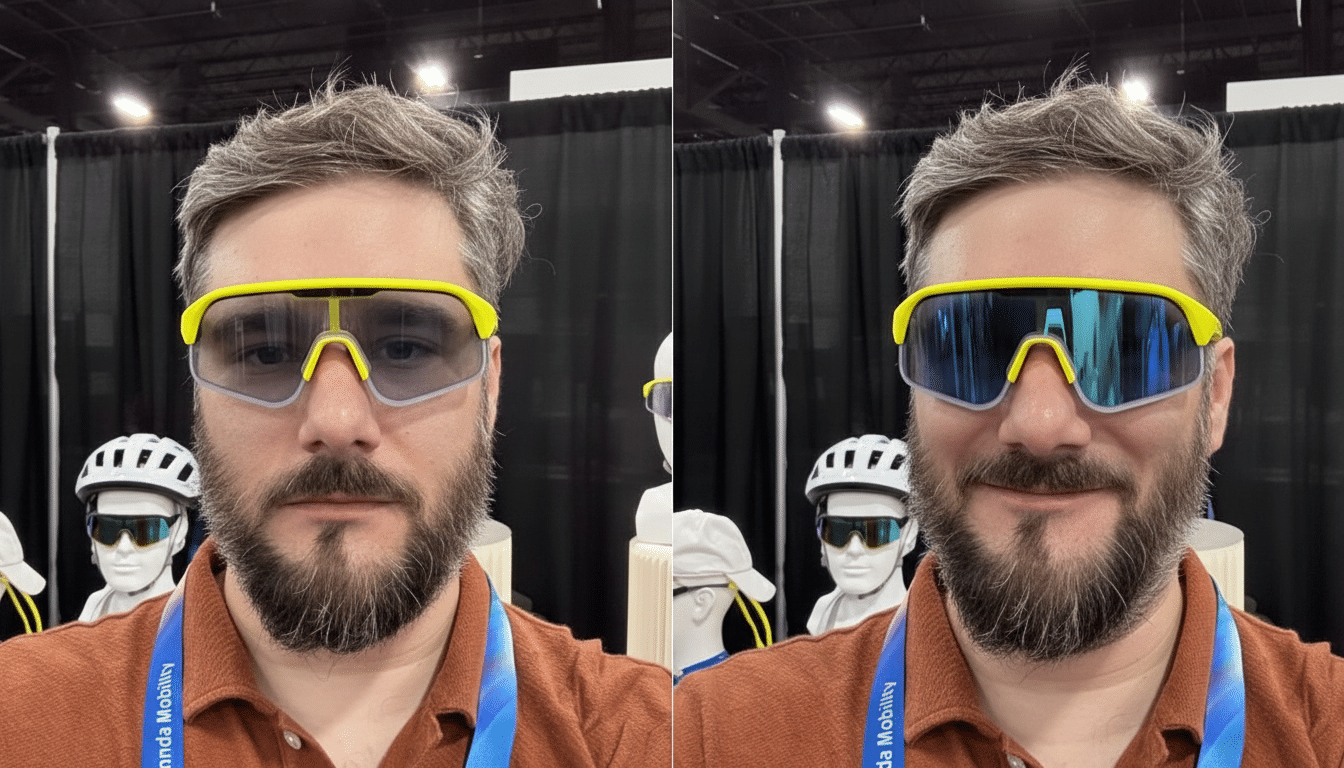
A demo video from the show floor is offering CES attendees their first real look at a pair of sunglasses that automatically change tint at your beck and call.
The prototype, presented by startup Povec Optics, changes from clear to dark with a finger swipe along the frame, getting electrochromic tech — longtime stuff of aircraft windows and luxury cars — down to a lightweight, sports-friendly wearable.
What the CES demo video reveals about the sunglasses
In the clip, the lenses seem to switch evenly across all of their surfaces and no banding or delay is observed. There’s a capacitive touch strip embedded in the temple that acts like a volume slider for shade, allowing the wearer to adjust the lenses to accommodate changing light. Unlike the photochromic lenses that need exposure to UV light and can take time to switch, such as when rolling in a car or beneath a cloud, electrochromic lenses use a small voltage to actively shift between states — which is why you’re seeing an almost instantaneous change in the video.
Povec pegs the C1 model as athlete-first sunglasses with a wraparound attitude. The glasses charge over USB-C, according to the company, and can last up to 28 days between top-ups; it’s a believable claim, as electrochromic materials generally hold their state without constant electrical juice.
How the electrochromic lenses in these sunglasses work
Electrochromic films alter light transmission as a small electrical current drives the movement of ions in layers of material. For a small area like a sunglass lens, switching between dark and clear can take less than a second in both directions, according to technical briefs from suppliers like AlphaMicron and coverage in engineering outlets. Since it’s digitally controlled, makers can specify multiple presets or provide finer-grained control — as we saw with the swipe-to-tint interface.
The tech is not completely novel. Gentex helped bring variable tint to aviation by selling dimmable windows for the Boeing 787, and automakers have employed similar techniques for mirrors and panoramic roofs. What’s new is the engineering and miniaturization required for eyewear that’s light, sturdy and stylish enough to be worn every day.
Who these adaptive-tint sunglasses are designed for
Outdoor athletes are clearly the obvious early adopters. Cyclists blast out of shaded descents into bright valley-bottom roads; skiers transition from tree runs to sun-drenched bowls; sailors and runners cope with glare that shifts by the minute. Today, many swap lenses or rely on those photochromic alternatives that can feel a beat behind. Active tinting eliminates that trade-off and theoretically cuts down on the number of lenses or a second pair of glasses you need to tote around.
And there is a safety angle as well. Dynamic contrast can help a rider discern potholes, or a skier make out the topography of hardpack.
Sports eyewear manufacturers generally aim for visible light transmission (VLT) bands that balance glare reduction with definition. EC lenses offer an extended VLT range far beyond what traditional lenses can achieve — in excess of a 20-point swing — providing athletes with a greater usable envelope within one frame.
Competition and claims around electrochromic sport shades
Povec says the C1 is a first-of-its-kind product, but there have been other attempts in the broader category. Ampere’s Dusk sunglasses and CTRL Eyewear models have already brought app- or button-based electrochromic control to market. AlphaMicron has even been a supplier of fast-switching visors for defense applications. Where Povec seems to stand out is the sports-oriented form factor, analog-feel touch slider, and what appears to be faster, smoother transitions in the demo video.
Like any new wearable, there are key questions to consider:
- Optical clarity versus premium polycarbonate lenses
- Color neutrality of the tint (how teal is your green?)
- How consistently do they switch when it is cold out?
- How resistant to impact are they if you throw them in a bag without a case?
- Does water or sweat penetrate the frame or spoiler behind the sunglasses?
- Do they meet Z87+ safety standards and ISO 12312-1 for sunglasses?
Those specs, as much as the wow factor, are going to count if the company wants to win over cyclists and skiers who already trust brands with lens science pedigrees.
Price, timeline, and the greater trend in adaptive optics
Povec is aiming for a release in spring 2022 with pricing ranging from $250 to $350, on par with performance eyewear and not too far from premium photochromic offerings from established sports brands. That positioning smacks of confidence in durability and optics, not just a funky party trick.
The debut also reflects a larger surge in adaptive optics. Market researchers who follow smart glass expect double-digit growth this decade as materials improve and costs come down. If Povec’s production units yield the same swift, even fades seen in the CES video — and stand up to the sweaty, vibrating, road-salt-riddled reality of pro racing — then adaptive tinting might move past a tech party trick and become a standard feature on high-performance eyewear.
For now, the prototype does what good CES demos should do: It attracts attention, solves a common problem, and gives us a glimpse of that not-too-distant future where your lenses are as quick to react as your eyes.
