


Researchers at Washington University in St. Louis have reported that a blood measurement of a tau protein fragment was higher in people with advanced chronic traumatic encephalopathy, or CTE, confirmed after death than in healthy people. The finding offers an early lead in a long-running effort to identify the disease during life, but it is not yet a test that can diagnose CTE.
The analysis involved stored blood from only 11 people whose CTE was established at autopsy. Levels of the fragment, called eMTBR-tau243, did not reliably identify early-stage CTE, according to accounts of the work by The Guardian and the Associated Press. The result is therefore a research finding in a small, highly selected group, not evidence that doctors can now screen athletes, veterans or others with histories of head impacts for CTE.

What the study found
CTE is a neurodegenerative disease associated with repeated head impacts. It can currently be confirmed only by examining brain tissue after death for its characteristic pathology. That constraint has made it difficult to study how the disease develops, distinguish it from other conditions and enroll people in trials before death.
The Washington University team turned to eMTBR-tau243, a fragment of the protein tau that has also been investigated in Alzheimer’s disease. Researchers reportedly first noticed unusually high levels in one person with advanced CTE who had no recorded Alzheimer’s disease. They then examined stored blood from 11 people with autopsy-confirmed CTE and found higher levels among those with advanced disease than among healthy comparison participants.
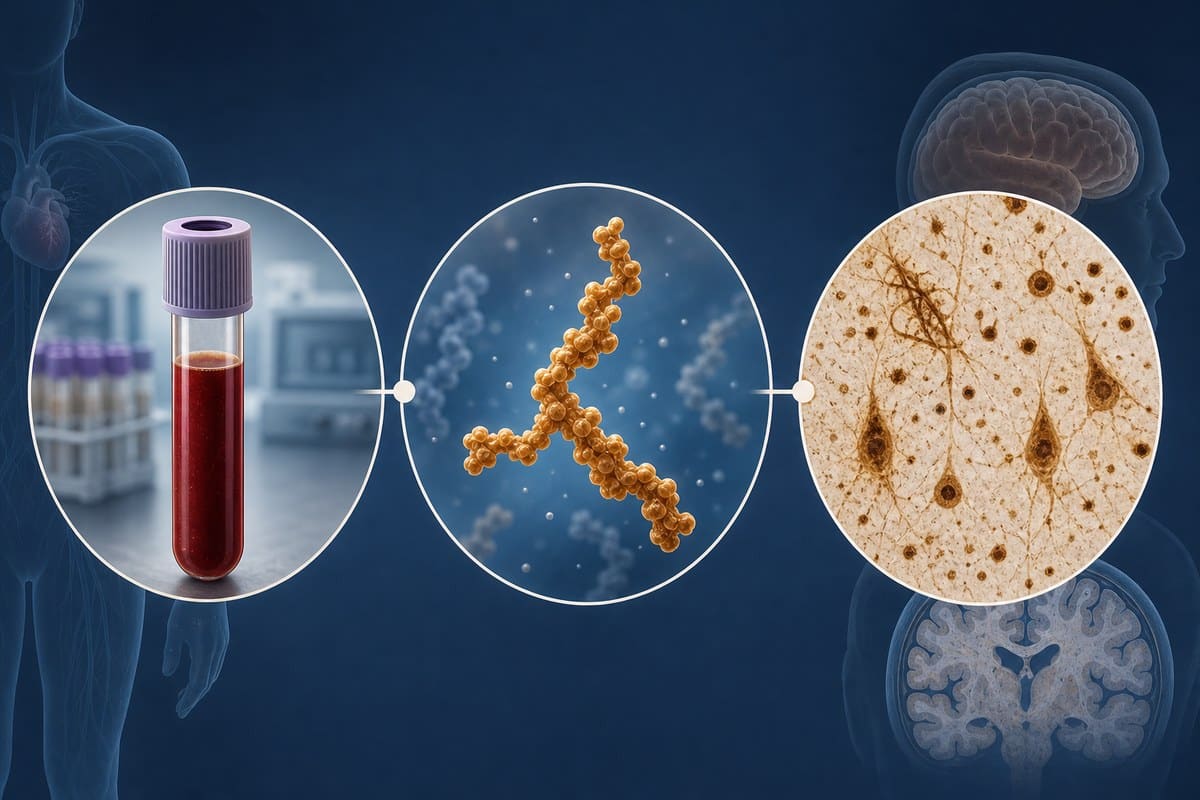
The observation establishes an association in this small sample: advanced CTE cases had higher blood levels of the marker. It does not show that the protein fragment causes CTE, that a person’s history of head impacts will produce an elevated result, or that a single blood measurement can determine whether an individual has the disease.
Most importantly for possible clinical use, the marker did not reliably distinguish early-stage CTE. A marker that, in this early report, was elevated in advanced disease but did not reliably identify early disease would not solve the problem of recognizing CTE at its earliest stages, when an eventual treatment might be most useful.
Why symptoms alone have not settled the question
The need for a dependable biological marker is underscored by a separate autopsy study from Penn Medicine, published in May. Researchers examined records and brain tissue from 1,038 brain donors to assess proposed criteria for traumatic encephalopathy syndrome, or TES, a clinical syndrome intended to identify people who may have CTE during life.
Among 25 donors who met the proposed TES criteria, six had CTE pathology at autopsy, according to Penn Medicine’s report on the Nature Medicine study. Put another way, 19 of those 25 qualifying cases—76%—did not have CTE identified at autopsy. The result does not mean that symptoms are unimportant or that people with cognitive, mood or behavioral concerns should be dismissed. It shows that those symptoms, which can arise from many neurological and psychiatric conditions, have limited specificity for CTE on their own.
The two studies address different parts of the same gap. The Penn work tested how closely proposed symptom-based criteria tracked with pathology after death. The Washington University work asks whether a blood-based molecular signal might help eventually. Neither establishes a way to diagnose early CTE in a living patient.
Large validation studies would be needed
Several barriers stand between this result and clinical use. The sample was very small, and all CTE classifications were made after death. The available reports do not describe a separate validation group, a clinical threshold for an abnormal result, or how the marker performs against the many illnesses that can affect cognition and behavior.
There is also a biological reason for caution. Tau abnormalities occur in more than one brain disease and may overlap, especially in older adults, Northwestern University neuropathologist Rudolph Castellani told the Associated Press. A useful CTE biomarker would need to show that it can separate CTE from Alzheimer’s disease and other disorders, rather than merely signal a broader form of neurodegeneration.
Researchers involved in the work have said that, if the observation holds up in substantially larger studies, blood testing could help monitor people at risk and make therapeutic trials more feasible. Such studies would need to include people across disease stages and compare them with carefully characterized groups without CTE, including people with other neurological conditions.
For now, the finding is best viewed as a potential research tool rather than a result that changes medical practice. Its strongest supported implication is narrower but still important: in a field where confirmation has required autopsy, an elevated tau fragment in advanced, autopsy-confirmed cases offers a candidate signal worth testing much more rigorously.

