


Anthropic is moving its assistant Claude to the browser with a new Chrome extension, providing users an AI that reads pages, navigates sites, fills in forms and performs scheduled tasks across multiple tabs. The release arrives as a beta for paying customers, casting Claude as an “agentic” assistant intended to work on the web rather than just answer in a chat box.
What Claude for Chrome Can and Can’t Do Today
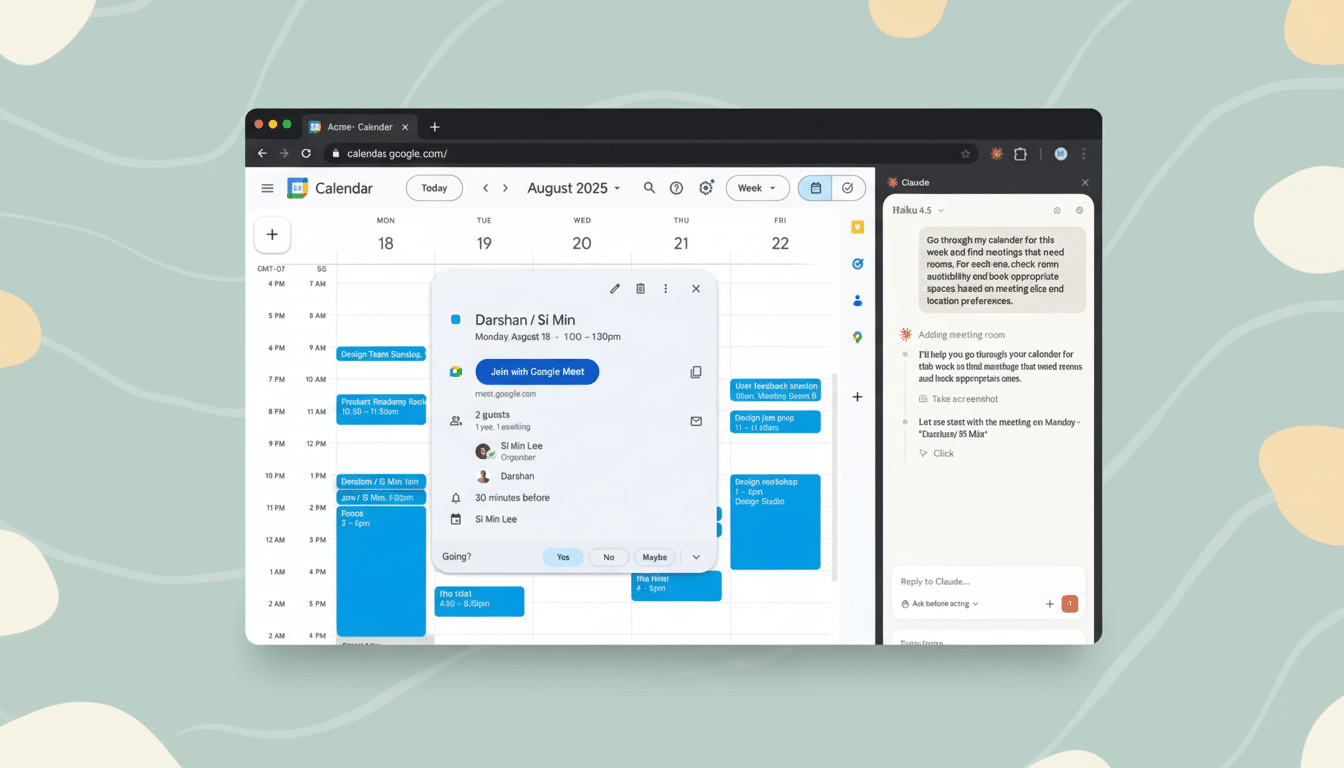
Whitelisting enabled, Claude can read your active page and hop between tabs that you approve to do things like: summarize really long articles, take tables into CSVs, auto-fill in repetitive fields, step through workflows (like filling out returns, putting a trip together through a travel site or navigating some vendor’s interface). Users can also assign periodic tasks, say compiling a report each week from sources you’ve bookmarked and have Claude assemble drafts or notes in a predictable manner.
- What Claude for Chrome Can and Can’t Do Today
- Pricing and Browser Support for Claude’s Extension
- Guardrails and Security Considerations for Browser Use
- Agentic AI on the Browser and How It Changes Work
- Early Use Cases and Realistic Limits for Claude’s Extension
- What to Watch Next as Claude’s Chrome Extension Evolves

In practice, that might mean a marketing lead can ask Claude to scrape pricing updates from competitor pages and drop them into a spreadsheet draft, or a recruiter can have it triage job applications in an ATS interface to produce a shortlist. The dream is pace: fewer tabs, more results.
Pricing and Browser Support for Claude’s Extension
The extension comes with Claude’s paid plans, which begin at Pro. It even works on Chromium-based browsers like Brave and Opera, so those of you who would rather use them can still enjoy the feature set. At launch, Firefox, Safari and Microsoft Edge are not officially supported.
The relocation places Claude in a spot where many knowledge workers already occupy space. Based on StatCounter’s worldwide numbers, Chrome currently commands a little over 65% of the desktop browser market, so crafting a native extension was an efficient way to boost action without encouraging them to switch apps or workflows.
Guardrails and Security Considerations for Browser Use
Allowing an AI agent to run inside a browser poses well-known dangers, especially prompt injection — instructions hidden in page content that are malicious and attempt to corrupt the behavior of a model. Anthropic boasts Claude for Chrome ships with site-level permissioning where users specifically pick what domains the assistant can read or act on, and can ungrant at any time via Settings.
High-risk actions are secured with additional confirmation screens. If a task has anything to do with publishing, making a purchase or sharing personal data, the extension inquires before acting and explains what will come next. It even blocks itself on categories like banking portals, adult sites and known piracy destinations to minimize the blast radius of a bad instruction.
This layered approach is analogous to advice from security organizations studying LLM threats, such as that informed through research driven by the OWASP community’s focus on model risk. The permission model, restrictive scopes and human-in-the-loop approvals are there so that autonomy stays useful but not reckless. That being said, basic hygiene is still required: grant minimal site access where you can, don’t save passwords in task prompts and review the action logs before enabling schedules.
Agentic AI on the Browser and How It Changes Work
Claude’s extension represents one such pivot toward agentic AI — systems that do rather than just say. OpenAI has been pushing the idea in its own tools, and browser makers have been toying with native assistants. For instance, Perplexity’s Comet provides agent-like browsing for free users, highlighting how much the category is changing — and so rapidly.
Anthropic’s approach rests on trust: the company’s models have a reputation for sound reasoning and attentive instruction-following, and from day one the company has stressed safety research. That counts in a browser, where clicking the wrong link could have financial, reputational or compliance repercussions.
Early Use Cases and Realistic Limits for Claude’s Extension
Teams prototyping browser agents tend to begin with low-stakes, high-friction tasks — onboarding forms, knowledge base edits, calendar wrangling, and data crunched out of SaaS dashboards. A day in the life: Get Claude to pull out RFP requirements from a vendor portal across 4 tabs and summarize changes since last quarter and draft the response outline in your voice.
There are still boundaries. Any site behind some heavy client-side rendering, a CAPTCHA wall or strict authentication can interfere with what an agent can do without human intervention. And although Claude can accomplish multi-step tasks, he works best when goals are specific and permissions are limited. Think “fill these fields with information from this document,” not “handle procurement this week.”
What to Watch Next as Claude’s Chrome Extension Evolves
Expect rapid iteration. As users increasingly install agents in their browser, vendors will compete through execution (e.g., invoking calendars, docs and spreadsheets), robustness against adversarial content, and enterprise controls. If Anthropic can maintain its safety-first approach as it grows integrations, Claude for Chrome might be more than a novelty — especially in companies itching to automate the web work that’s suffocating knowledge workers.
