


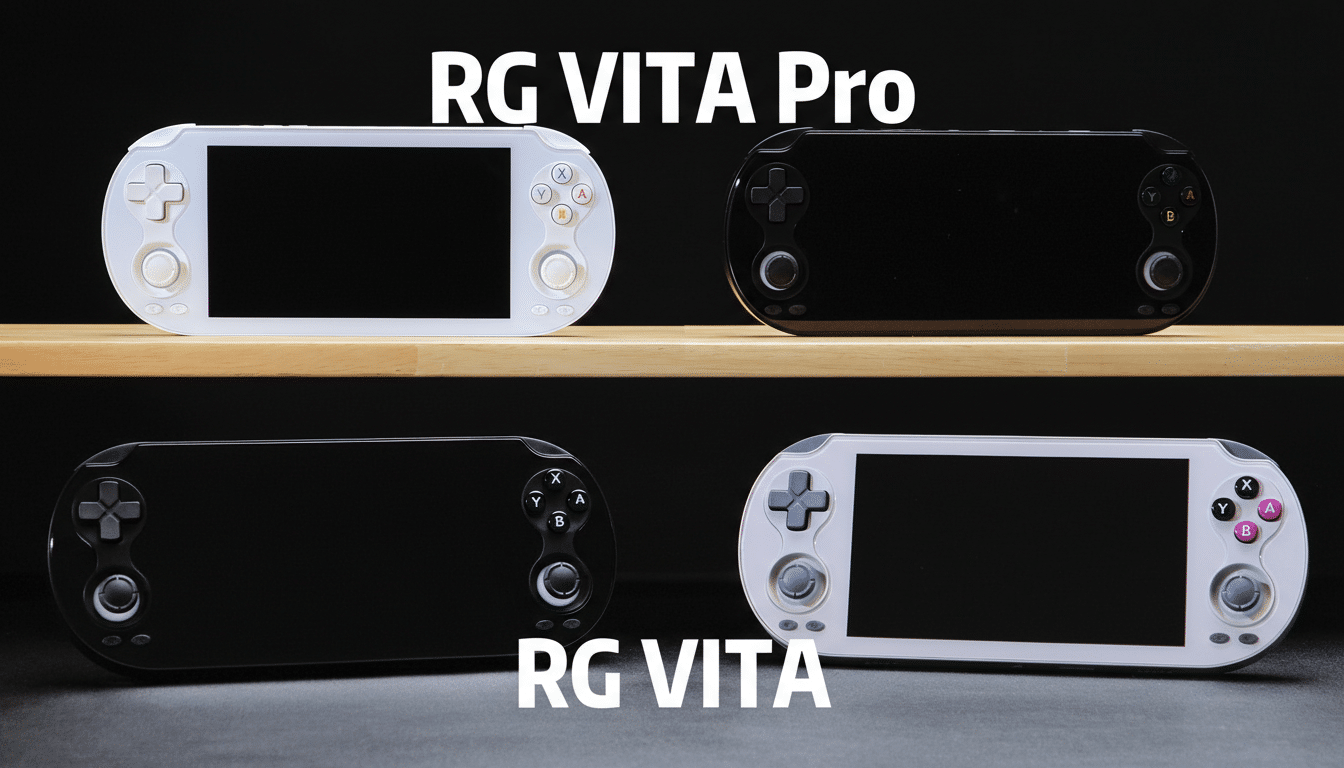
The RG VITA looks like a love letter to Sony’s handheld classic, but early specifications suggest a very different story under the hood. Anbernic’s upcoming Android handheld reportedly ships with a Unisoc T618, 3GB of RAM, and 64GB of storage—components that place it firmly in budget territory and well short of the power many expected from its modern design.
Budget Silicon Limits the RG VITA’s Ambitions
The Unisoc T618 is a 12nm, 2019-era SoC with two Cortex-A75 performance cores and six Cortex-A55 efficiency cores, paired with a Mali-G52 MP2 GPU. In tablets and older handhelds, this chip typically returns AnTuTu scores in the low- to mid-200,000s—fine for Android UI and lighter 3D workloads, but a bottleneck for demanding emulation like GameCube and PS2.
Compounding matters, the RG VITA reportedly carries 3GB of RAM, a step down from the 4GB found in the fan-favorite RG505, which also ran on the T618. Memory headroom matters for higher-resolution rendering, texture caching, and modern Android multitasking; trimming it back narrows the margin for heavier emulators and background services.
Expect solid performance on 8- and 16-bit systems, PlayStation, and PSP via PPSSPP, with some Dreamcast and Saturn success. But for Dolphin (GameCube/Wii) and PS2, the T618 delivers inconsistent results even at 1x internal resolution. That aligns with guidance from emulator teams like Dolphin and PCSX2, which emphasize strong single-core throughput and modern GPUs for reliable performance on these consoles.
Screen Choices Raise Scaling Questions for Emulation
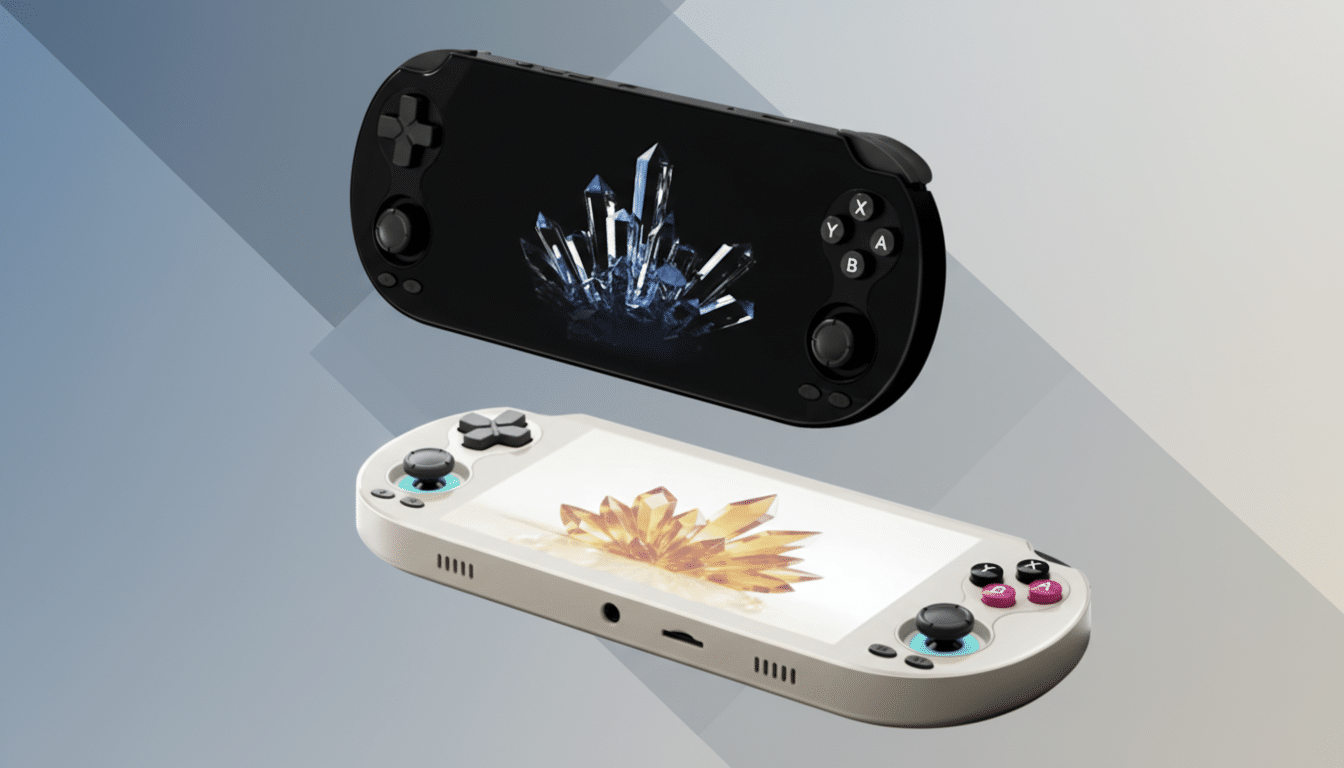
Anbernic’s design nods to the original PS Vita, but the display choice doesn’t quite follow through. The RG VITA is said to use a 5.46-inch 1280 x 720 IPS panel. While 720p is a safe, broadly compatible resolution for Android, it doesn’t neatly map the PS Vita’s 960 x 544 or the PSP’s 480 x 272 via clean integer scaling. The result can be minor softness or shimmering without careful scaling filters.
That trade-off isn’t a deal-breaker—many modern handhelds run 720p for battery life and UI clarity—but it’s a curious pick for a device thematically centered on Vita-era gaming. The OLED punch and perfect fit of the old Vita screen won’t be replicated here, even if the overall silhouette and control layout evoke it.
Vita Emulation Remains A Software Hurdle
If you’re buying the RG VITA to play actual Vita titles, the bigger obstacle is software maturity. The Vita3K project’s Android build is still evolving, with frequent crashes and compatibility gaps reported across devices—even on far more powerful phones. Community testers and creators have shown promising frame rates in some games, punctuated by sudden instability that undermines playability.
That’s not a knock on the hardware alone; it’s a reality of where Vita emulation sits on Android today. Stability will improve as developers iterate, but a modest SoC like the T618 won’t future-proof the experience. Buyers should calibrate expectations toward PSP, PS1, and classic systems first, with Vita support considered experimental.
Pro Model Teased, But Key Questions Still Linger
Anbernic is also prepping an RG VITA Pro, though key specs haven’t surfaced. To materially change the equation, a Pro variant would need a newer process node and stronger GPU—think a leap to something in the class of a recent midrange mobile SoC—and at least 4GB to 6GB of RAM for emulator headroom. Otherwise, users will face the same limits with a nicer shell.
Pricing remains unannounced, but the component list suggests the standard RG VITA will land in budget or lower midrange territory. That would place it alongside compact rivals like the TrimUI Smart Pro S and other lightweight Android handhelds, while sitting below higher-end options that chase reliable PS2 and GameCube performance.
Where It Fits in a Crowded Handheld Gaming Market
Design still matters, and Anbernic’s hardware ergonomics and build quality have long resonated with the retro community. If the RG VITA hits the right price, it could be a stylish daily driver for 2D classics, PS1, and PSP with strong battery life. But judged on raw horsepower, the spec sheet signals a device that looks next-gen and performs last-gen.
Enthusiasts in forums and on communities like r/RetroHandhelds often ask not just “what can it run?” but “how consistently can it run it?” On that question, the T618 and 3GB RAM combination points to a capable nostalgia machine with clear ceilings. The Pro model may rewrite the story—but until specs land, the safe read is that the RG VITA’s sleek facade masks a conservative core.
