


AMD is doubling down on on-device AI in mainstream laptops and mini PCs with the Ryzen AI 400 series, a family of mobile processors that reaches up to a claimed 60 trillion operations per second (TOPS) across its improved XDNA 2 neural processing unit. The chips marry that AI hardware to new Zen 5 CPU cores and RDNA 3.5 integrated graphics, with an eye toward boosting performance across productivity, content creation, and gaming while keeping a lid on power consumption.
Zen 5 CPUs, RDNA 3.5 graphics, and XDNA 2 NPU details
At the silicon level, AMD’s new offering is a bit of a three-act play: higher-clocked Zen 5 cores for general compute, RDNA 3.5 for integrated graphics and GPU-accelerated AI, and XDNA 2 handling low-latency neural workloads. In the leading-edge Ryzen AI 9 HX 475, the NPU reaches a headline 60 TOPS while the bottom end of the product line is a healthy-sounding 50 TOPS. That puts AMD’s ceiling back above the 50 TOPS number bandied about for its rival NPUs with Intel’s next generation, though Qualcomm still advertises an 80 TOPS peak in its upcoming Snapdragon X2 family.
The new Ryzen AI 400 chips advance the Strix Point architecture found in the old-gen Ryzen AI 300, and maintain all three engines for mixed workloads while pushing memory bandwidth and clocks. The pitch to developers is straightforward: more headroom for spreading AI tasks across NPU, GPU and CPU without necessarily leaving performance on the table.
Why 60 TOPS on-device performance matters now
A 60 TOPS NPU goes beyond the threshold set for modern AI PC experiences, including Microsoft Copilot+ capabilities that depend on sustained, low-power local inference. In simpler terms, that can mean smoother real-time transcription and translation, higher-fidelity background effects on video calls without using up CPU cycles, and quicker media search or summarization with minimal battery drain. It also means developers can offload more and more parts of complex multimodal pipelines to the NPU, so that the GPU is left free for rendering or creator workflows.
AMD will rely on its ROCm stack to consolidate tooling from the data center all the way out to the client and across both Windows and Linux architectures. By rallying around common frameworks and runtimes, the company wants models tuned in the cloud to land on these devices with fewer rewrites — a theme voiced by AI platform teams throughout the industry.
Early performance claims versus rivals and peers
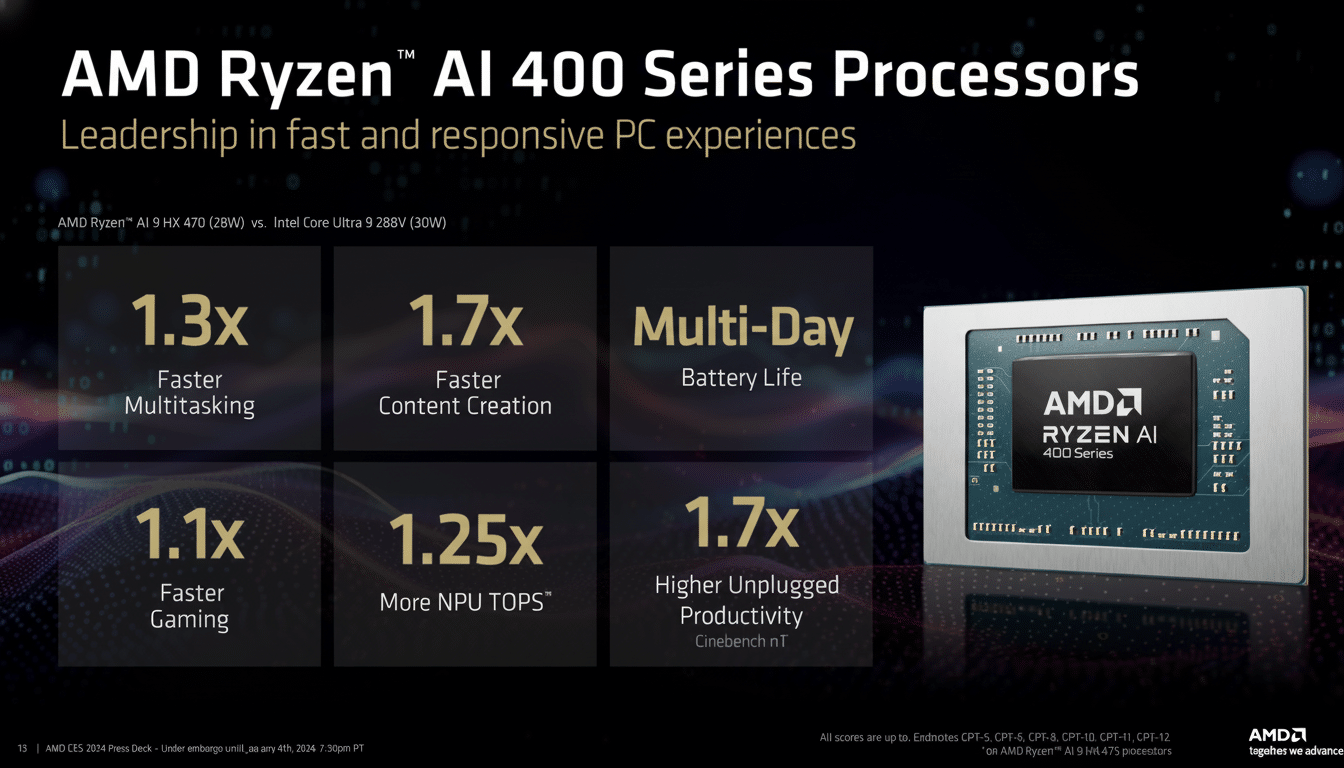
With reference to a Ryzen AI 9 HX 470, AMD claims up to 1.3x faster multitasking compared to an Intel Core Ultra i7-class system and is out in front with a 29% lead for a use case that includes running a Microsoft Teams call for 10 people plus office apps.
For creators, AMD is claiming 1.7x improvements in common content-creation tests, thanks both to better overall Zen 5 throughput and also smarter distribution of AI-heavy filters and effects.
For gaming, the integrated Radeon GPU leverages AMD’s new FSR “Redstone” upscaling to rebuild higher-quality images from lower-resolution frames. At a like-for-like 30-watt configuration, AMD claims that Ryzen AI 400 systems can provide around 10% more performance than an equivalent Core Ultra 9 288V machine. As ever, independent testing will decide how consistently those deltas hold up more broadly across titles and thermals.
Efficiency first with TSMC 4nm for thin-and-light PCs
Using TSMC’s 4nm process, the goal here is to make the concept of an “AI PC” feasible for thin-and-light designs. AMD’s guidance is for multi-day battery life with usual workflows and up to 24 hours of local video playback on a single charge. On the engineering side, it’s straightforward: have meaningful AI features that run all the time without pushing systems into noisy-fan or hot-lap territory.
Ryzen AI Max+: more GPU for accelerated AI workloads
Joining the 400-series, AMD is adding to its workstation-bent Ryzen AI Max+ line with two new SKUs: 12-core Ryzen AI Max+ 392 and 8-core Max+ 388.
These SoCs retain a unique shared-memory architecture—up to 192GB pooled across system and graphics—so that GPU and AI workloads can allocate the capacity they need dynamically without discrete VRAM constraints.
Max+ chips actually have more GPU resources than the non-plus Max parts: 40 GPU cores compared to 32, and vastly beyond the 16 compute units on top of the integrated graphics in typical Ryzen AI 400 series products. The NPU in the Max/Max+ family is still a 50 TOPS unit, but the stouter GPU increases overall AI throughput for GPU-accelerated inference and graphics-heavy compute. The approach also shores up AMD’s high-end “Strix Halo” concept with more granularity for system builders to appeal to various price points of performance.
Who buys what and when for Ryzen AI 400 and Max+
Laptops and mini PCs sporting Ryzen AI 400 and the refreshed Max+ chips are expected to roll out from major OEMs such as Acer, Asus, Dell, HP, and Lenovo. Thin-and-light productivity models will make a dash for the battery gains, creator laptops will flaunt the Zen 5 and GPU uplift, and small-form-factor desktops will play up the NPU for local AI assistants, media indexing, and low-latency vision tasks at the edge.
The competitive framework is already sharp: AMD’s top 60 TOPS figure sits just above Intel’s current AI claims, and falls short of Qualcomm’s 80 TOPS headline. In execution, buyers should look past the raw TOPS number to sustained performance at real power numbers, app support, and how well OEMs are cooling these chips in actual chassis. If early indications from AMD hold true, the Ryzen AI 400 series may offer the most balanced take yet on an AI-first laptop platform.
