


Humans are now a minority on their own internet. The 2026 Imperva Bad Bot Report, published by Thales, found that automated traffic accounted for more than 53% of all web traffic in 2025, up from 51% the year before, while the human share slipped to 47%. The report’s subtitle makes the framing explicit: bots have entered their agentic age.
That milestone collides with an awkward structural fact. The web was built for human eyes, mouse movements, and rendered pixels, not for software visitors. AI agents can now plan multi-step tasks, reason over context, and decide what to do next, yet many still stall at the final step of execution because the page they need sits behind JavaScript rendering, login flows, and interfaces that no public API exposes.
- Agent Adoption Is Outpacing the Infrastructure Behind It
- Where APIs Fall Short
- Inside a Headless Browser
- What a Managed Headless Browser API Handles
- JavaScript Changed the Rules of Web Access
- Five Workloads Where Browser-Level Access Decides the Outcome
- Scale Separates Prototypes From Production
- Evaluating Headless Browser Infrastructure
- Risks and Limits Worth Acknowledging
- The Browser Is Becoming the Universal Interface for Machines
- Final Word
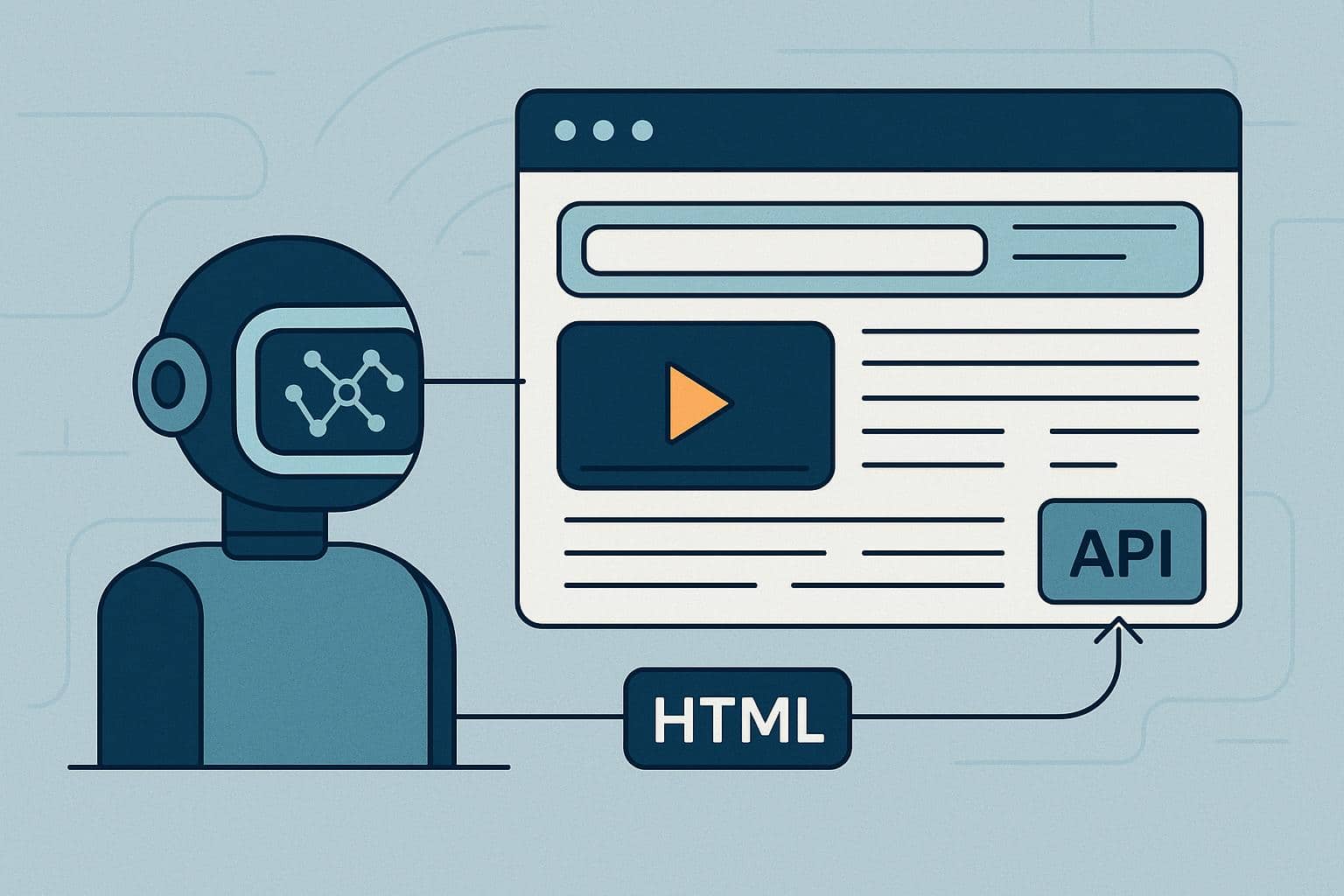
A headless browser API closes that gap. It gives autonomous systems the same access path a person has, a real browser session, delivered as managed cloud infrastructure rather than a fleet of machines someone has to babysit. Understanding why this layer matters requires looking at three forces at once: how fast agent adoption is moving, why APIs alone cannot carry the load, and what the modern JavaScript-heavy web demands from any system that wants to read it.
Agent Adoption Is Outpacing the Infrastructure Behind It
The forecasts around agentic AI are unusually consistent across research firms. Gartner predicts that 40% of enterprise applications will integrate task-specific AI agents by the end of 2026, up from less than 5% in 2025. The same firm projects that 33% of enterprise software will include agentic AI by 2028, compared with under 1% in 2024, and that at least 15% of day-to-day work decisions will be made autonomously by that year.
Spending follows the same curve. MarketsandMarkets values the AI agents market at $7.84 billion in 2025 and projects $52.62 billion by 2030, a 46.3% compound annual growth rate. On the buyer side, MuleSoft’s 2026 Connectivity Benchmark Report, based on a survey of 1,050 IT leaders, found that 88% of organizations describe themselves as on track for partial or full agentic transformation.
| Signal | Figure | Source |
|---|---|---|
| Share of web traffic that is automated (2025) | 53%+ | Imperva Bad Bot Report, 2026 |
| Growth in user-triggered AI crawling during 2025 | More than 15x | Cloudflare Radar Year in Review, 2025 |
| Enterprise apps with task-specific AI agents by end of 2026 | 40% (from under 5% in 2025) | Gartner, 2025 |
| Enterprise software including agentic AI by 2028 | 33% (from under 1% in 2024) | Gartner, 2025 |
| AI agents market size by 2030 | $52.62B (from $7.84B in 2025) | MarketsandMarkets, 2025 |
These numbers describe intent and investment. Execution is where projects break down, and execution almost always means touching systems the agent does not own: a supplier portal, a competitor’s pricing page, a government registry, a customer’s order history. Each of those lives on the open web, and most of them were never designed to be read by software.
Where APIs Fall Short
The standard objection is that agents should simply call APIs. APIs are faster, cheaper, and more stable than scraping rendered pages, and where a good API exists, it should be the first choice. The problem is coverage, fidelity, and workflow, in that order.
Coverage is the most visible gap. Millions of websites, including local business sites, news outlets, industry directories, government portals, documentation hubs, and niche marketplaces, publish no public API at all. The picture is not much better inside organizations that control both ends of the connection: MuleSoft’s 2026 benchmark found the average enterprise now runs 957 applications, yet only 27% of them are integrated. If integration coverage sits below a third inside companies actively spending on it, expecting the open web to offer clean programmatic access to everything an agent needs is unrealistic.
Fidelity is the second gap. Where APIs do exist, they typically expose a curated subset of what the website shows. Live inventory states, flash pricing, user-generated reviews, interactive dashboards, and personalized views often never reach the API layer, or reach it with delay. For monitoring and intelligence workloads, the rendered page is frequently the only complete, current source of truth.
Workflow is the third. Logging in, completing multi-factor authentication, maintaining a session, navigating a wizard, uploading a document, and confirming a transaction are all interactions designed around a browser. An agent that cannot operate a browser is locked out of every task that requires one of those steps.
| Dimension | Public API access | Browser-level access |
|---|---|---|
| Coverage of the open web | Minority of sites | Effectively any public page |
| Data completeness | Curated subset, often delayed | Everything the page renders |
| Authenticated workflows | Only where the vendor built them | Login, MFA, and session flows as a user performs them |
| Dynamic and personalized content | Frequently unavailable | Rendered in full |
| Stability over time | High where maintained | Sensitive to UI changes |
| Speed and cost per request | Low | Higher, browsers are heavy |
The honest reading of that table is that neither column wins outright. Mature agent architectures use APIs wherever possible and reserve browser sessions for the large remainder where no API exists or the API is incomplete. The remainder, however, is not an edge case. It is most of the web.
Inside a Headless Browser
A headless browser is a full browser engine, typically Chromium, Firefox, or WebKit, running without a visible interface. It loads pages, executes JavaScript, builds the DOM, fires events, manages cookies and storage, and produces screenshots or PDFs, all under programmatic control. Developers usually drive it through automation libraries such as Puppeteer, Playwright, or Selenium, issuing commands like “navigate here,” “wait for this element,” “click that button,” or “extract this table.”
From the website’s perspective, a well-configured headless session is close to indistinguishable from an ordinary visitor: the same rendering engine, the same JavaScript execution, the same network behavior. That equivalence is precisely what makes the technology suitable for AI agents, which need to perceive and act on pages the way the pages were designed to be perceived and acted on.
What a Managed Headless Browser API Handles
Running one headless browser on a laptop is trivial. Running thousands of them reliably is an infrastructure discipline of its own. Browser engines are resource-hungry, sessions crash, pages hang, memory leaks accumulate, and websites change their defenses weekly. Teams that self-host browser fleets end up staffing an internal platform team whose product is, effectively, browsers as a service.
A headless browser API moves that burden to a provider. Instead of provisioning and patching browser instances, a development team sends requests, or connects existing Puppeteer and Playwright scripts, to a cloud endpoint that handles deployment, session lifecycle, JavaScript rendering, concurrency, load balancing, geographic distribution, proxy management, and failure recovery. The agent’s logic stays focused on the task; the API absorbs the operational noise.
For AI workloads specifically, this separation matters because agents are unpredictable consumers. A research agent might need two sessions one minute and two hundred the next, depending on what it discovers. Elastic browser capacity, billed by usage rather than by standing servers, fits that demand pattern far better than fixed infrastructure does.
JavaScript Changed the Rules of Web Access
The case for rendering, as opposed to plain HTTP fetching, rests on how the web is now built. W3Techs data shows JavaScript running on roughly 98.8% of all websites as the client-side language. Framework adoption keeps climbing: W3Techs reported in October 2025 that React alone powers 6% of all websites, up from 4.3% a year earlier, with Angular, Vue, Next.js, and Nuxt accounting for further share, particularly among high-traffic properties.
On sites built with these frameworks, a raw HTTP request frequently returns a near-empty HTML shell. The visible content arrives only after the browser executes scripts, fires API calls, hydrates components, and responds to scroll or click events that trigger lazy loading. A crawler without a rendering engine receives the skeleton and concludes, wrongly, that the page contains nothing useful.
Server-side rendering mitigates this for some publishers, but interactive states do not survive the trip: filtered product grids, expanded accordions, paginated results, logged-in views, and dashboard widgets exist only after client-side execution. For an AI agent, the practical rule is simple. If a human needs a browser to see it, the agent needs one too.
Five Workloads Where Browser-Level Access Decides the Outcome
| Workload | Why plain requests or APIs fail | What the browser session provides |
|---|---|---|
| Autonomous research | Source material sits on JS-rendered publications, docs portals, and directories without APIs | Fully rendered articles, tables, and embedded data |
| Competitive and pricing intelligence | Prices, promotions, and availability change on-page faster than any feed | Real-time view of exactly what buyers see |
| Automated QA and monitoring | Bugs and regressions appear in rendered UI states, not in backend responses | True user-journey execution, screenshots, console and network capture |
| E-commerce operations | Marketplace listings, buy-box states, and reviews are page-level artifacts | Continuous observation across thousands of product pages |
| Customer service actions | Order lookups, account updates, and form submissions run through web portals | Completion of multi-step authenticated workflows |
One concrete example illustrates the pattern. A sales intelligence agent assigned to qualify a prospect typically visits the company’s website, reads product and pricing pages, checks careers listings for growth signals, pulls leadership names from an about page, and cross-references a few directories. Not one of those steps has a guaranteed API behind it, and several of the pages involved render their content client-side. Without browser access, the agent’s “research” reduces to whatever stale fragments exist in its training data.
Scale Separates Prototypes From Production
The demand side of this equation is growing faster than most infrastructure plans assume. Cloudflare’s 2025 Radar Year in Review recorded that AI crawling triggered directly by user actions, the category that includes agents fetching live pages to answer queries, grew more than fifteenfold during 2025, against overall internet traffic growth of 19%. Real-time, on-demand web access by AI systems is the fastest-growing form of automated traffic on the network.
Enterprise deployments amplify the math. An organization monitoring 10,000 products, 5,000 competitors, and a few hundred marketplaces is not running a browser; it is running a browser fleet with strict requirements around concurrency, isolation between sessions, regional egress, retry logic, and observability. Each of those requirements is solvable in-house, and each one consumes engineering time that produces no differentiated value. Managed headless browser APIs exist because the build-versus-buy calculation, at fleet scale, rarely favors building.
Evaluating Headless Browser Infrastructure
Teams comparing providers tend to over-index on raw speed and under-index on the factors that decide long-term reliability. A more complete evaluation covers the following.
| Criterion | What to verify |
|---|---|
| Rendering fidelity | Current engine versions, full JavaScript execution, support for modern frameworks |
| Concurrency and elasticity | Documented session limits, autoscaling behavior, performance under burst load |
| Session management | Persistent contexts, cookie and auth handling, reconnect behavior |
| Compatibility | Native support for Puppeteer, Playwright, or Selenium scripts and standard protocols |
| Observability | Logs, screenshots, recordings, and network traces for debugging agent behavior |
| Security and data handling | Session isolation, encryption, data retention policy, compliance posture |
| Responsible automation | Rate controls, robots.txt awareness, and identification options for legitimate agents |
The last row deserves emphasis. As automated traffic becomes the majority of the web, providers and operators that treat compliance as a feature, not an afterthought, will be the ones whose access survives.
Risks and Limits Worth Acknowledging
Browser infrastructure is necessary for agentic systems, but it is not sufficient, and the surrounding risks are real.
Project risk comes first. Gartner predicts that over 40% of agentic AI projects will be canceled by the end of 2027, citing escalating costs, unclear business value, and inadequate risk controls. No execution layer rescues an agent that was pointed at the wrong problem.
Scrutiny risk comes second. Imperva’s 2025 research lists headless browsers and residential proxies among the evasion tactics favored by malicious bot operators, which means legitimate automation now operates under suspicion by default. Its 2026 report argues that site owners are shifting from asking whether traffic is automated to asking whether the automation aligns with their intent. Agents that respect robots.txt, honor rate limits, avoid login circumvention, and identify themselves where mechanisms exist will increasingly be the only agents that keep working.
Legal and maintenance risks round out the list. Data protection law, copyright, and contractual terms constrain what collected content can be stored and reused, and those constraints vary by jurisdiction. Operationally, rendered interfaces change without notice, so production agents need monitoring, fallback strategies, and selector resilience rather than fire-and-forget scripts.
The Browser Is Becoming the Universal Interface for Machines
The long-term trajectory points in one direction. Gartner estimates that by 2028, a third of user experiences will shift from native applications to agentic front ends, and emerging standards for agent identity and machine-readable content will gradually formalize how software visits websites. Those standards will take years to reach the long tail of the web. In the meantime, and likely well beyond it, the browser remains the one interface every website already supports.
That is the strategic logic behind headless browser APIs. They do not replace APIs, data feeds, or future agent protocols. They guarantee that an agent’s reach extends to the entire web as it exists today, rather than the fraction of it that happens to be machine-friendly.
Final Word
AI agents have crossed the threshold from answering questions to performing work, and the data shows the web itself adjusting around them: automated visitors now outnumber human ones, user-triggered AI page fetches grew more than fifteenfold in a single year, and nearly nine in ten enterprises say they are moving toward agentic operations. What has not changed is the web’s basic design assumption, a human with a browser.
Headless browser APIs reconcile those two realities. By packaging real browser sessions as scalable, managed infrastructure, they let agents see rendered pages, complete authenticated workflows, and act across the long tail of sites that will never publish an API. For any organization serious about deploying autonomous systems beyond a demo, browser-level access is not an optimization. It is the difference between an agent that reasons about the web and one that can use it.

