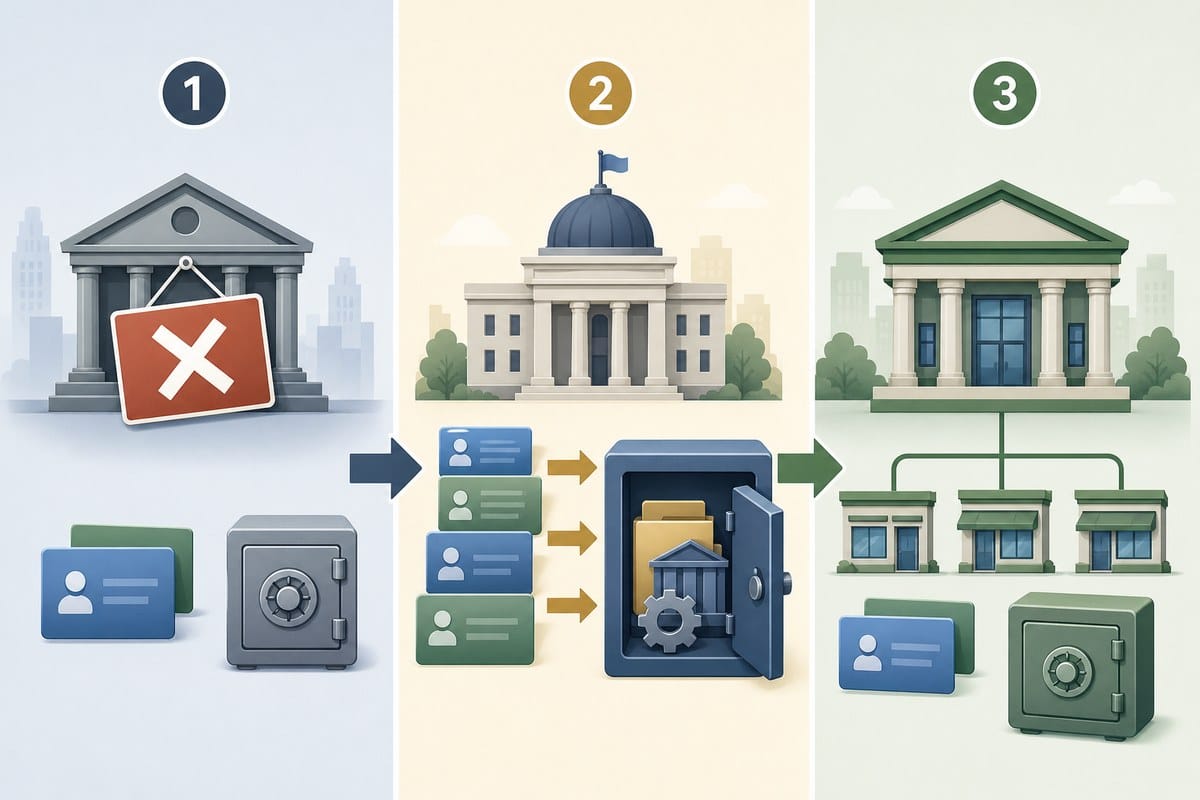
United Fidelity Bank, fsb, of Evansville, Indiana, was closed by the Office of the Comptroller of the Currency on Nov. 27, with the Federal Deposit Insurance Corp. named receiver and First-Citizens Bank & Trust Company taking on substantially all deposit accounts and assets. The resolution avoids a conventional depositor payout and puts the failed lender’s branch network, customer relationships and major operating assets under First Citizens.
The immediate consequence for customers is continuity. Under FDIC guidance, transferred accounts were available immediately after the failure. Former United Fidelity customers can continue using checks, ATM and debit cards, direct deposits and automatic payments, while loan terms do not change because their loans have transferred. Former United Fidelity locations began reopening as First Citizens branches on Nov. 28 during regular business hours.

The transaction is sizable but its reported balances require some care. First Citizens placed the acquired operation at an estimated $5.9 billion in assets, $4.5 billion in deposits and $3.1 billion in loans as of Sept. 30. Those figures are subject to adjustment, and the announced assumed-deposit total excludes certain brokered deposits. That is why a rounded description of the failed bank as a $6 billion institution is useful context, not a precise closing balance-sheet measurement.
What moves to First Citizens
First Citizens said its agreement with the FDIC covers 20 former United Fidelity branches in Indiana, Illinois, Colorado and Florida, plus two Bank of St. Croix branches in the U.S. Virgin Islands. The deal also includes United Fidelity subsidiaries, including Pedcor Homes Corporation, according to the bank’s transaction announcement.
The FDIC’s formulation is important: First Citizens assumed substantially all deposit accounts and acquired substantially all assets, rather than every liability and asset without exception. Both the agency and First Citizens identify certain brokered deposits as excluded from the announced transfer total. The available notices do not set out further treatment for those accounts, so the published $4.5 billion estimate should not be read as a measure of every deposit balance associated with United Fidelity before its closure.
For transferred depositors who also banked with First Citizens before the failure, the FDIC said the transferred deposits will be separately insured from their pre-existing First Citizens deposits for at least six months. Customers with questions about account coverage or the transition were directed to First Citizens, which said all acquired branches would be open during normal business hours by Nov. 30.
Resolution terms and reported failure cost
First Citizens said it was selected through a competitive bidding process. Its winning bid included an approximately $2.6 billion asset discount and no deposit premium, according to its announcement. The company did not characterize the asset discount as a cash purchase price, and the announced terms do not by themselves establish the final value of the assets after adjustments.
The bank’s estimated Sept. 30 loan balance of $3.1 billion amounted to roughly 53% of its stated $5.9 billion asset total. That calculation offers a broad view of the portfolio being absorbed, though it is not a measure of credit quality, loss severity or the final transferred balance. First Citizens said all three transaction figures remained subject to adjustment.
Separately, Reuters reported that the OCC found United Fidelity to be in an unsafe or unsound condition and likely unable to pay obligations or meet depositors’ demands in the ordinary course of business. Reuters, citing the FDIC, also reported an estimated $1.83 billion cost to the Deposit Insurance Fund. The FDIC’s public failed-bank notice available for customers confirms the closure and transfer arrangement but does not provide that estimate.
The event is one of the larger bank failures since the regional-bank disruptions of 2023 and 2024, but descriptions of its exact rank vary. Reuters called it the largest U.S. bank failure in more than two years, comparing it with Republic Bank’s April 2024 closure. Fox Business described it as the largest shutdown in three years. Neither formulation is necessary to understand the transaction, and the available FDIC page does not establish a ranking.
A rapid branch conversion across five markets
The timetable was compressed. First Citizens’ balance estimates were measured on Sept. 30; the OCC closed United Fidelity on Nov. 27; branches began operating under First Citizens on Nov. 28. The acquiring bank said the acquired locations would be open normally by Nov. 30, extending its operating footprint across four states and the U.S. Virgin Islands.
For borrowers and deposit customers, the near-term test is operational rather than contractual: whether account access, payment processing and branch service continue without disruption as systems and personnel move into First Citizens. The FDIC’s instructions preserve existing payment tools and loan terms, while First Citizens’ announced figures leave the final asset, loan and assumed-deposit balances to be settled through the transaction’s adjustment process.