


President Donald Trump has announced a new “Super Intelligence Force” to coordinate the federal government’s engagement with companies, infrastructure operators and outside groups working around artificial intelligence. The task force’s reported leadership draws together the director of national intelligence, the Federal Trade Commission chair, the Pentagon’s research and engineering chief, and the director of the Office of Personnel Management.
The move matters less for a new rule than for the breadth of offices placed around an unsettled technology agenda. Intelligence, competition policy, military research and the federal workforce all have distinct stakes in AI. Yet neither Trump’s announcement nor the White House order that preceded it lays out a charter, enforcement authority, budget, deadlines or a public oversight structure for the new group.

Four officials, broad remit
Trump announced the force on Oct. 4 in a Truth Social post, according to ABC News, CBS News and NBC News. He said it would coordinate engagement with consumers, public-interest and religious organizations, critical-infrastructure providers, and companies in the field the administration is calling “Super Intelligence.”
Several reports identify Director of National Intelligence Jay Clayton, FTC Chair Andrew Ferguson, Under Secretary of Defense for Research and Engineering Emil Michael, and OPM Director Scott Kupor as the force’s leaders. NBC News’ initial description listed Clayton, Ferguson and Michael but did not include Kupor; ABC News, CBS News and other coverage named Kupor, making the four-person roster the better-supported account.
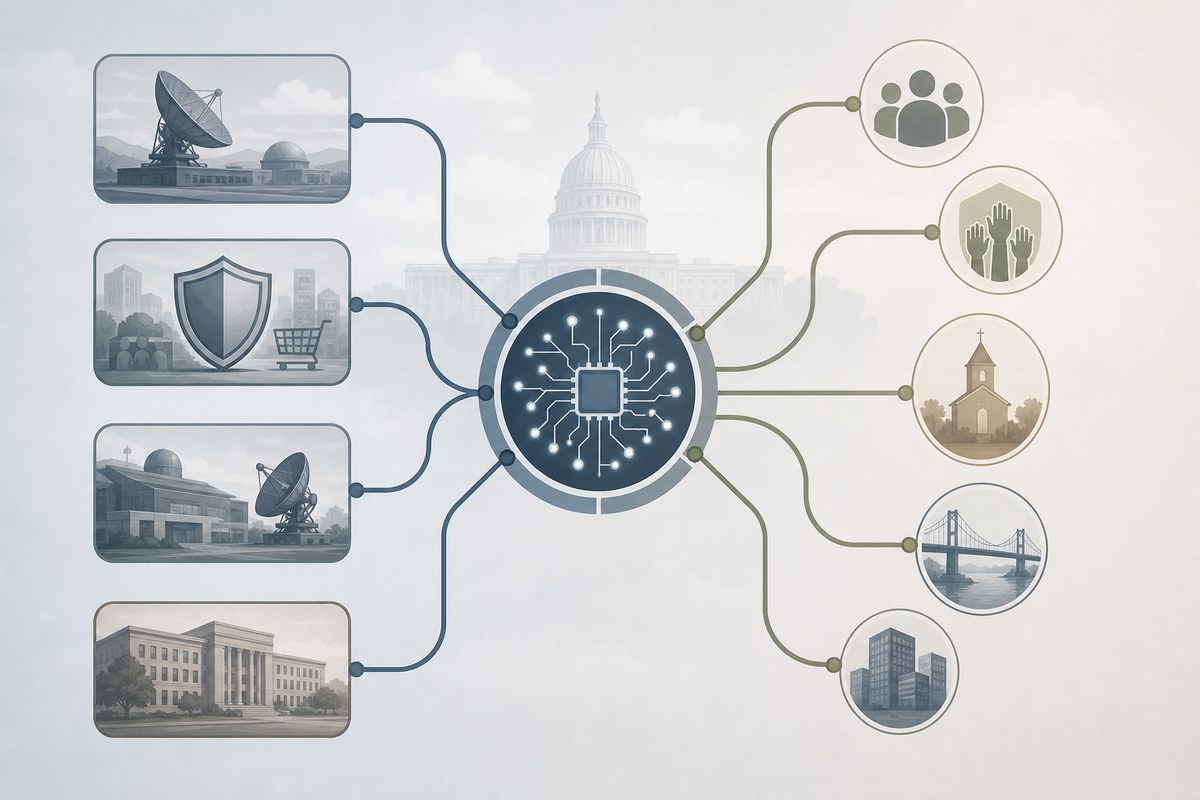
The force is expected to report to Trump and White House Chief of Staff Susie Wiles, as reported by CBS News and NBC News. That reporting line places the initiative close to the White House rather than clearly within a single department. It also makes the group potentially influential even without new legal powers: it could convene agencies and industry, shape priorities, or frame proposals for Congress. Those are possibilities, not authorities announced so far.
A terminology order came first
The task force follows a separate Sept. 29 White House action that is narrower than its name suggests. Executive Order 14434 instructs executive departments and agencies, to the maximum extent permitted by law, to use “Super Intelligence” and “SI” in place of “Artificial Intelligence” and “AI” in official correspondence and other non-statutory documents.
The order does not create the Super Intelligence Force. Nor does it rewrite existing statutes or erase historical records. For the order’s purposes, “Super Intelligence” refers to the same technologies and systems already covered by the statutory definition of artificial intelligence. Agencies must preserve terminology where law requires it and in documents that are legal, regulatory or historical in nature.
That distinction is important because the two actions do different jobs. The Sept. 29 order changes executive-branch language and asks the president’s science and technology assistant to submit proposed legislative wording within 60 days for a federal definition of “Super Intelligence” and “SI.” The Oct. 4 announcement introduces a policy-coordination body, but the available public accounts do not establish what formal machinery it will use.
Coordination is not yet regulation
Clayton told The Wall Street Journal, as summarized by ABC News, that the group would seek mechanisms through dialogue, review current law and consider potential congressional action. That points toward consultation and policy development rather than a newly empowered regulator. The FTC already has consumer-protection and competition responsibilities; the intelligence and defense participants have separate national-security and research missions. No announcement has said that the task force consolidates those mandates.
The absence of details leaves practical questions. It is unclear whether the force will publish recommendations, solicit comments, establish technical standards, coordinate procurement, issue risk guidance, or work through existing agency processes. The White House order offers no answers because it addresses terminology, not the force’s structure. The Next Web has characterized the group as lacking statutory authority and a budget, but those specific claims have not been independently established in the official order or the broader initial reporting.
The announcement also arrives after a White House accord with technology-company leaders. NBC News described that agreement as nonbinding, while CBS News reported that it sets out company commitments involving controls, audits and continuing discussions about standards. The new force could become a venue for those conversations, but no published plan yet connects the accord to a specific task-force process.
For now, the clearest federal action is semantic: agencies are being directed to adopt the administration’s preferred label in covered materials. The harder work—deciding which AI practices government will constrain, encourage or leave to industry—has not been assigned a public timetable.

