


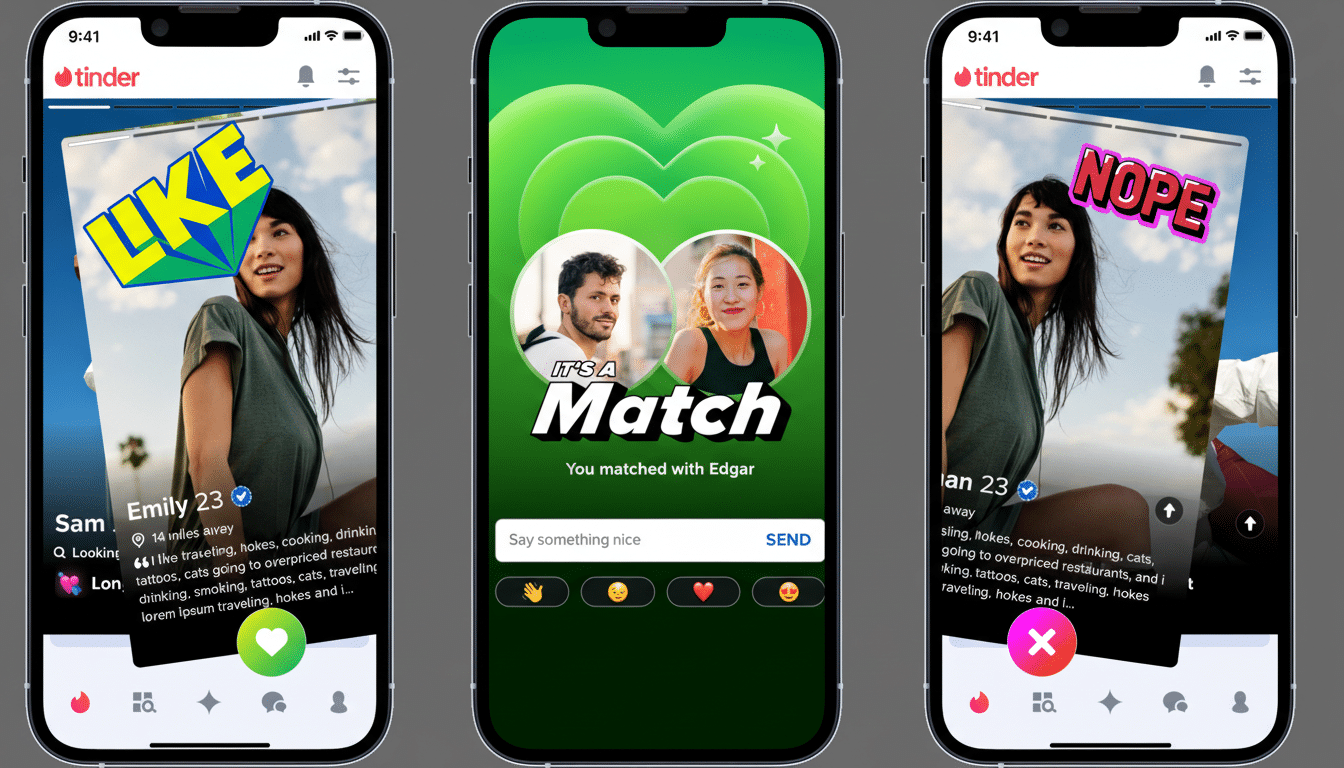
Tinder is piloting an AI-driven experience called Chemistry that aims to ease the endless scrolling many daters say is wearing them out. Instead of swiping through a sea of profiles, users opt in to answer a set of questions and, with permission, let the system review select photos from their Camera Roll to build a richer picture of tastes and personality. The goal is fewer, better suggestions and a calmer path to connection.
The experiment, currently live in Australia, reflects a broader rethink inside the Match Group-owned app: move beyond the dopamine mechanics of swipe culture and toward curated, context-aware introductions. Executives have described Chemistry as a new AI-led way to interact with Tinder that can surface a “single drop” of highly relevant prospects rather than a firehose of options.

Why Swipe Fatigue Became A Product Problem
Swipe mechanics popularized quick judgments and a sense of infinite choice. Behavioral economists have long warned that too many options raise cognitive load and reduce satisfaction, a pattern often called the paradox of choice. That tension has become more visible as user growth slows across dating platforms and complaints about burnout rise. Pew Research Center has reported persistent frustration among dating app users, underscoring a gap between time spent and outcomes achieved.
Tinder’s own metrics tell a story. New registrations were down 5% year over year in the recent fourth quarter, and monthly active users slipped 9%. Those figures were slightly better than prior periods, which the company attributes in part to AI-driven ranking tweaks—such as reordering profiles shown to women—and other product experiments that emphasize relevance over volume.
Inside Tinder’s Chemistry Experiment And Pilot
Chemistry combines a conversational intake with optional photo analysis to assemble a dynamic interest graph. Rather than rely solely on self-reported prompts or superficial tags, the system infers patterns—music tastes, travel styles, social scenes—that can inform stronger recommendations. Users then receive a small, time-bound set of candidates, designed to spur focus and reduce the urge to speed-swipe.
Crucially, the feature is opt-in and permission-based. That’s a requirement for user trust and likely a hedge against regulatory scrutiny. Privacy advocates, and regulators in markets guided by GDPR-like rules, will watch for clear consent flows, data minimization, and transparency about whether analysis happens on-device or in the cloud, what data is retained, and how long it’s stored.
Safety And Authenticity As Pillars For Trust
Gen Z users consistently rank authenticity and safety as nonnegotiables. Tinder says it is redesigning discovery to feel less repetitive and more real, while investing in verification tools. Face Check, the app’s facial recognition-based verification, has already driven a more than 50% drop in interactions with bad actors, according to the company. That kind of measurable impact is critical if AI-curated introductions are to feel trustworthy rather than creepy.
AI can also help spot bots, romance scamming patterns, and policy violations before they reach users. But there’s a flip side: recommendation systems can entrench bias if they over-index on historical engagement signals. Independent audits and fairness testing will matter if Tinder wants to demonstrate that Chemistry broadens opportunity rather than narrows it.
Reading The Early Business Signals At Tinder
Despite headwinds in sign-ups, Match Group delivered an earnings beat, with Tinder contributing to revenue of $878 million and EPS of $0.83 in the latest quarter. Even so, softer guidance tempered investor enthusiasm. Management has signaled a dual-track response: lean into AI to boost quality and pay off long-term, and reignite demand in the near term with marketing.
The company is committing $50 million to Tinder brand campaigns, including creator-led pushes on TikTok and Instagram built around the claim that “Tinder is cool again.” If Chemistry increases satisfaction and marketing brings lapsed users back, conversion to paid features—priority boosts, advanced recommendations—could follow.
What To Watch Next As Tinder Tests AI Matching
Three questions will determine whether AI can truly cure swipe fatigue: Do users feel they are getting better matches faster? Do curated drops reduce churn without killing serendipity? And do privacy safeguards and transparency keep pace with the new data processing?
If the Australian pilot shows promise, expect a phased rollout and rapid iteration in how many profiles appear, how often drops refresh, and how signals from chats and dates feed back into the model. For now, Tinder’s move acknowledges a reality many daters already know: less can be more, and smarter can beat louder when it comes to modern matchmaking.
