


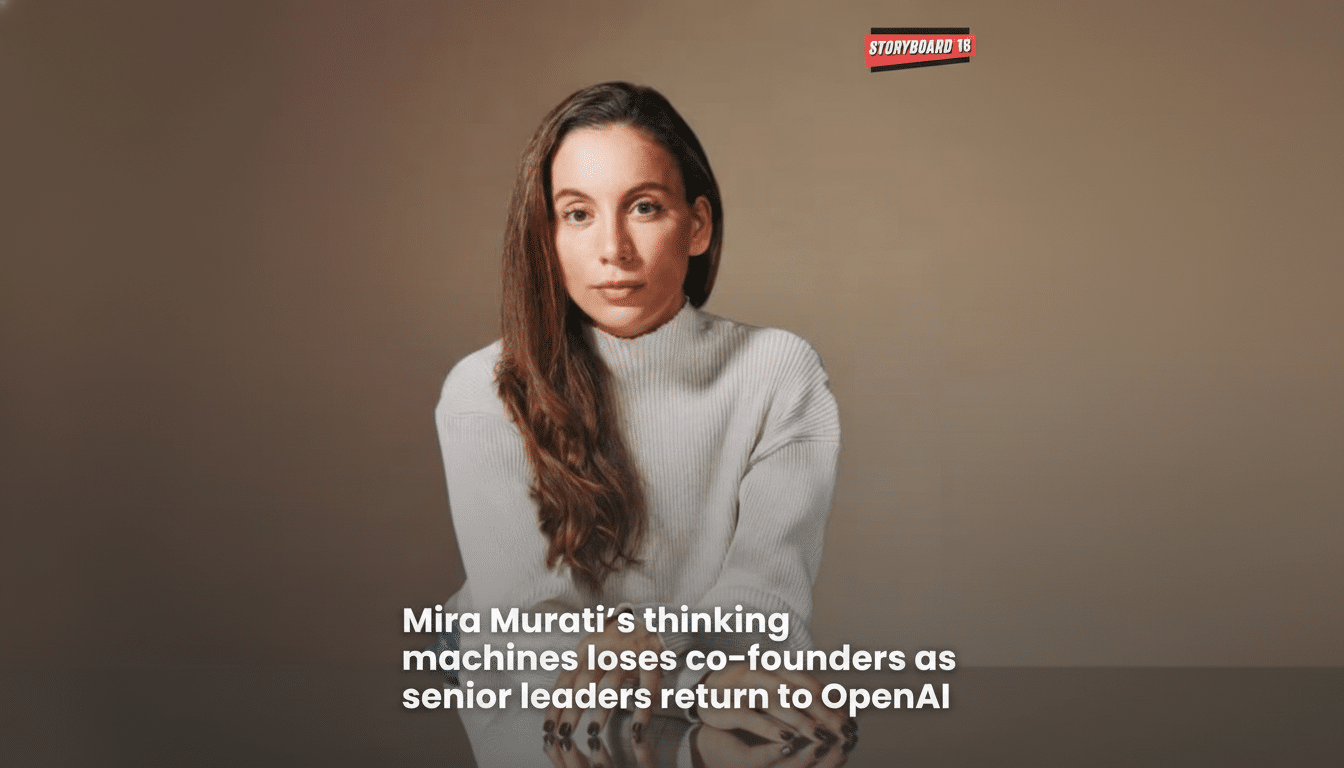
Mira Murati’s AI startup, Thinking Machines Lab, is contending with a sharp leadership shake-up as two co-founders, Barret Zoph and Luke Metz, depart to rejoin OpenAI. The moves underscore the ferocious competition for elite AI researchers and the fluid talent market shaping the next wave of generative AI products.
OpenAI Rehires Barret Zoph And Luke Metz
Zoph, a co-founder and the company’s CTO, and Metz, also a co-founder, are returning to OpenAI after short stints at Thinking Machines. OpenAI’s applications head, Fidji Simo, publicly welcomed them back, signaling the company’s continued push to turn frontier research into consumer-scale products. Sam Schoenholz, another former OpenAI engineer who had joined Murati’s venture, is also returning, according to the same announcement.
Zoph previously served as OpenAI’s VP of research and earlier spent six years at Google, where he co-authored influential work in neural architecture search. Metz is a veteran of OpenAI’s technical staff and a recognized researcher in generative modeling. Their simultaneous exit removes two pillars of Thinking Machines’ early research identity and hands OpenAI a timely infusion of proven leadership and modeling expertise.
Soumith Chintala Steps In As CTO At Thinking Machines
Murati named Soumith Chintala as the new CTO of Thinking Machines. Chintala is best known for co-creating PyTorch at Meta, a framework that has become the backbone of modern AI research and production systems. His profile suits a startup that must stabilize its technical strategy while continuing to recruit at the top of the market.
Chintala’s appointment suggests Thinking Machines will double down on engineering rigor and developer-centric tooling, areas where PyTorch’s community-first approach set a template. For partners and customers, the signal is continuity: while high-profile founders are leaving, the startup is putting an experienced platform-builder at the helm of its technical roadmap.
A Stress Test For An Ambitious Newcomer
The departures land less than a year after Thinking Machines burst onto the scene with a $2 billion seed round that valued the company at $12 billion. The cap table is a who’s who of AI backers and strategic partners, including Andreessen Horowitz, Accel, Nvidia, AMD, and Jane Street. That cash cushion affords runway—but it also raises expectations for rapid progress and visible milestones.
This isn’t the first bout of turbulence. Co-founder Andrew Tulloch left to join Meta, and the company’s early leadership mix has remained fluid as it recruited marquee researchers from OpenAI, Meta, and Mistral AI. Notably, OpenAI co-founder John Schulman exited to Anthropic before later joining Thinking Machines as chief scientist at launch. The crosscurrents reflect a broader reshaping of AI leadership across top labs and startups.
Why The Talent Boomerang Matters For AI Labs Today
In Silicon Valley, rapid movement between companies isn’t new—but co-founders returning to a former employer so soon is striking. For OpenAI, rehiring familiar leaders reduces onboarding cost and aligns with its push to ship polished, high-usage applications. Bringing back Zoph and Metz strengthens the bridge between research breakthroughs and product pipelines overseen by the applications group.
For Thinking Machines, the loss of two co-founders in parallel is a real execution risk. Early-stage AI labs depend on a small number of technical decision-makers to shape model architecture, training infrastructure, and deployment strategy. The transition to Chintala as CTO will be judged on whether the company can maintain research velocity while hardening its platform and recruiting replacements with comparable depth.
The underlying economics explain the motion. Top-tier AI researchers command premium compensation and unique compute access; reporting across the industry has documented multimillion-dollar total packages for senior roles at leading labs. With noncompete agreements largely unenforceable in California, high performers have unusual latitude to follow the most compelling problems and resources—often back to the labs they know best.
Investor Stakes And The Road Ahead For Both Companies
Investors will watch two signals in the coming weeks: the speed of leadership backfill and the clarity of the near-term product plan. With Chintala steering engineering and Schulman guiding research, Thinking Machines retains a bench with deep credibility. The company’s strategic investors, including chipmakers like Nvidia and AMD, also point to a likely focus on efficient training stacks and deployment at scale.
For OpenAI, the hires bolster an applications unit that has been racing to convert model advances into sticky products and developer workflows. Expect Zoph and Metz to slot into efforts that shorten the loop from training runs to real-world features—where marginal improvements in latency, reliability, and safety can compound into major user gains.
Bottom line: Thinking Machines faces a pivotal leadership reset just as it seeks to justify an unprecedented seed valuation. OpenAI, meanwhile, adds veteran hands precisely where the market is hottest. In a cycle defined by scarce talent and abundant capital, the boomerang may be the most telling metric of all.
