


Enterprise spending on cloud services reached $650 billion globally in 2024, with AI workloads accounting for 37% of infrastructure costs. Yet organizations implementing generative AI report that cloud API calls for simple inference tasks consume up to 60% of their monthly AI budgets. This creates a critical inefficiency: companies process trivial computational tasks in remote data centers when their users carry billion-transistor devices in their pockets.
The shift toward on-device AI represents more than a technical optimization—it’s an economic necessity. Enterprises processing customer data through cloud APIs incur costs not just for computation but also for data transmission, latency overhead, and compliance complexity. A Forrester report indicates that companies migrating model inference from cloud to edge devices cut AI operational expenses by 40-70%, while simultaneously improving user experience through faster response times and enhanced privacy.
- The Economics of Cloud-First AI Inference
- On-Device AI: The Technical Foundation
- Why Organizations Struggle to Implement On-Device AI
- Key Competencies for On-Device AI Development
- Building Your On-Device AI Team: Hiring Strategy
- The ROI Timeline and Financial Impact
- 3 Reliable Technology Companies for On-Device AI in the USA
- Conclusion: The Strategic Imperative of On-Device AI
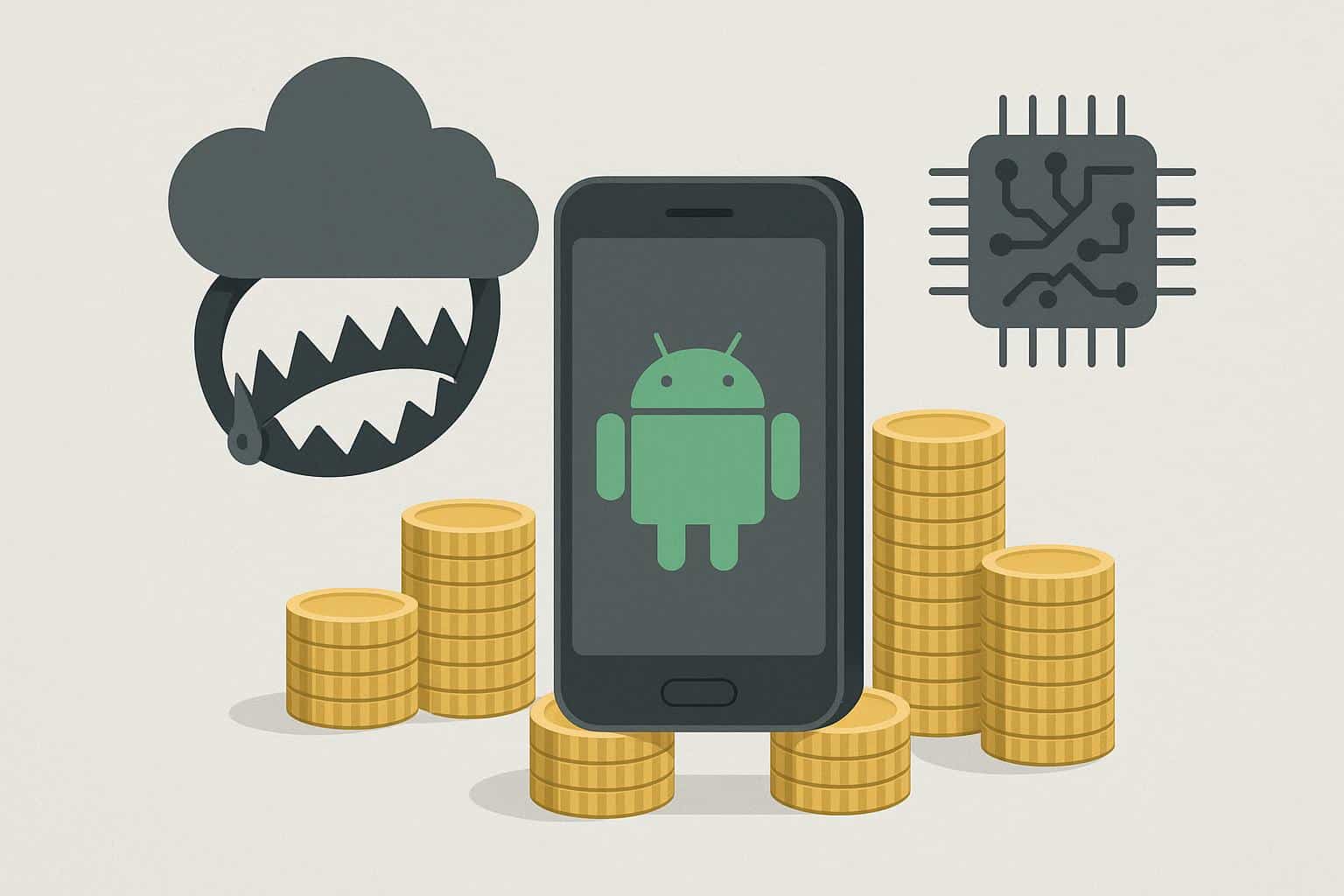
The solution requires hiring skilled Android developers and AI professionals who understand how to architect and deploy AI models directly on Android devices using frameworks like TensorFlow Lite and Gemini Nano. This article explores why this architectural shift matters and how organizations should approach implementation and talent acquisition.
The Economics of Cloud-First AI Inference
Building AI features on cloud infrastructure created a foundational problem that persists today. Every user interaction requiring intelligence—from image recognition to text generation—triggers a network request, API call, and cloud computation cycle.
For an app with 500,000 daily active users performing three AI-powered actions each, this translates to 1.5 million daily API calls. At typical cloud pricing ranging from $0.001 to $0.01 per request, a modest enterprise accumulates $45,000 to $450,000 in monthly cloud bills solely for inference.
Beyond direct cost, cloud dependency introduces latency. A typical cloud roundtrip requires 200-500 milliseconds for network transmission and processing. Users experience perceptible delays in features they expect to be instantaneous. Banking applications detect fraud slower. Photo editing apps force users to wait between operations.
The architecture carries hidden compliance liabilities. Transmitting user data to cloud infrastructure triggers data residency requirements in regulated industries. Healthcare organizations must ensure patient data remains in compliant regions. Each cloud API call represents a data movement event subject to regulatory examination.
On-Device AI: The Technical Foundation
Modern Android devices possess computational power matching infrastructure from five years ago. The latest Snapdragon and Exynos processors include dedicated Neural Processing Units (NPUs) designed specifically for machine learning inference.
Google’s Tensor chip, embedded in Pixel devices, delivers 100 teraFLOPS of AI processing capability directly at the edge. TensorFlow Lite represents Google’s lightweight framework optimized for mobile systems, consuming minimal memory while maintaining high inference accuracy. Gemini Nano runs entirely on-device—delivering natural language capabilities without cloud dependency.
The architectural pattern shifts fundamentally. Organizations no longer transmit raw user data to cloud endpoints. Models execute locally, processing information on the device where it originates. User images remain on phones. Audio stays within apps. Sensitive business documents never leave enterprise networks.
Inference happens instantly—200-millisecond cloud roundtrips become 20-millisecond on-device executions. Features become responsive. The cost advantage compounds across user populations. A mobile app with 10 million users running inference locally costs nothing per operation, compared to $600,000 monthly bills for cloud execution.
Why Organizations Struggle to Implement On-Device AI
Despite obvious financial incentives, most enterprises remain locked in cloud-first AI architectures. The barrier isn’t technical infrastructure—modern devices handle the computation. The barrier is specialized talent.
On-device AI requires developers fluent in both machine learning and mobile platforms. They understand model quantization—the process of reducing model precision without accuracy loss, compressing a 100MB cloud model to 10MB for device execution.
These developers comprehend Android internals: memory management constraints, thread scheduling, battery implications of continuous computation, and integration with device NPUs. They troubleshoot training-to-production gaps where models behave differently on devices than in training environments.
Most development teams lack this intersection of expertise. Mobile developers focus on UI and user workflows. ML engineers optimize models for cloud infrastructure. Few professionals bridge both domains. This talent gap forces organizations to hire specialized professionals or partner with technology firms possessing this expertise.
The investment in hiring AI developers and Android developers skilled in on-device deployment models translates to infrastructure savings exceeding hiring costs within 6-12 months for companies processing millions of daily operations.
Key Competencies for On-Device AI Development
Organizations evaluating candidates should assess specific technical competencies beyond general machine learning or Android experience.
Model optimization represents the critical capability. Developers must quantize models—converting 32-bit floating point operations to 8-bit integer operations—without accuracy degradation. They implement pruning, removing less-critical neural network connections to reduce model size.
Hardware integration expertise matters substantially. Developers should understand NPU scheduling, offloading computation to specialized processors rather than general CPU cores. They profile power consumption, identifying which operations strain battery life. They implement graceful degradation, ensuring applications function when on-device execution reaches resource limits.
Framework proficiency distinguishes capable on-device developers. Deep experience with TensorFlow Lite—understanding its converter pipeline, debugging compatibility issues, optimizing inference through delegate selection—marks genuine expertise. Understanding quantization-aware training reflects advanced capability.
Developers with on-device AI expertise often come from constraint-heavy environments: embedded systems, IoT, automotive, gaming. Organizations should prioritize candidates from these backgrounds who’ve subsequently added machine learning skills.
Building Your On-Device AI Team: Hiring Strategy
Recruiting developers capable of implementing on-device AI requires a different approach than typical technical hiring. The talent pool remains specialized and concentrated in specific geographies and organizations.
When hiring AI developers, assess capability through actual implementation problems. Present candidates with a real quantization scenario and evaluate their knowledge of TensorFlow Lite’s optimization pipeline. Their response reveals whether they understand practical constraints or maintain theoretical knowledge only.
For Android developers, evaluate on-device ML integration experience explicitly. Ask about prior projects incorporating local inference, their approach to managing model updates, and battery impact considerations. Experience in constraint-heavy platforms suggests stronger capability for on-device work.
Consider skill development through partnership with specialized technology firms. Organizations lacking on-device AI talent benefit from collaborating with partners possessing this expertise, accelerating time-to-implementation while building internal knowledge.
When hiring Android developers specifically for on-device AI work, prioritize those with prior ML framework experience. Full-stack capability—understanding model training dynamics, conversion processes, deployment optimization, and device runtime behavior—differentiates exceptional on-device AI engineers.
The ROI Timeline and Financial Impact
Organizations migrating inference workloads from cloud to on-device realize measurable ROI within specific timeframes based on usage volume.
Companies processing under 100,000 daily AI inference operations see ROI primarily through user experience improvements—reduced latency, improved privacy, enhanced reliability. Cloud infrastructure costs remain modest enough that engineering investment may exceed direct savings in year one.
Enterprises processing 1-10 million daily inference operations typically achieve 6-12 month ROI. A 5 million daily operation app spending $90,000 monthly on cloud inference reduces that to near-zero per-operation costs through on-device execution. The investment pays for itself multiple times over annually.
Organizations beyond 10 million daily inferences see immediate ROI. A company processing 50 million daily inferences spends $900,000 monthly on cloud API costs. Shifting those workloads to devices eliminates 80-90% of that expense immediately. Implementation costs become negligible relative to annual savings.
Beyond direct cost reduction, on-device AI unlocks product capabilities unavailable in cloud-dependent architectures. Offline functionality emerges naturally—applications continue operating without network connectivity. This improves reliability and expands addressable markets to regions with inconsistent connectivity.
3 Reliable Technology Companies for On-Device AI in the USA
1. GeekyAnts
GeekyAnts operates as a global technology consulting firm delivering digital transformation, end-to-end mobile app development, digital product design, and custom software solutions. The firm specializes in architecting complex mobile applications leveraging on-device AI, implementing TensorFlow Lite optimization pipelines, and deploying Gemini Nano–powered features on Android devices.
GeekyAnts combines deep expertise in ML model optimization with Android platform integration, addressing the exact talent intersection organizations require. The firm guides companies through the complete journey from cloud-first architecture assessment to on-device implementation, building internal capability while delivering production applications.
Location: 315 Montgomery Street, 9th & 10th floors, San Francisco, CA 94104, USA
Phone: +1 845 534 6825
Email: info@geekyants.com
Website: www.geekyants.com
Clutch Rating: 4.9/5 (111 verified reviews)
2.Topflight Apps
Topflight Apps develops sophisticated mobile applications with particular strength in AI-powered features and edge computing architectures. The firm builds applications where processing moves from cloud to device, directly supporting organizations seeking to minimize cloud API dependency.
Location: 1 Market Street, Suite 3600, San Francisco, CA 94105, USA
Phone: +1 415 580 9100
Clutch Rating: 4.9/5 (40 verified reviews)
3. Sonatafy Technology
Sonatafy provides comprehensive engineering support across bespoke software and mobile development. Known for reliable agile delivery and seamless team integration, they help enterprises iterate and scale products with robust engineering foundations. Their practice includes performance-focused mobile solutions.
Location: 50 California St., San Francisco, CA 94111, USA
Phone: +1 (415) 839-9340
Clutch Rating: 4.8/5 (23 reviews)
Conclusion: The Strategic Imperative of On-Device AI
The cloud cost trap ensnares organizations through outdated architectural assumptions. Companies built AI features assuming cloud infrastructure was the only viable execution environment. Modern hardware renders that assumption obsolete. Devices now possess sufficient computational capacity to run sophisticated AI models—yet most enterprises continue transmitting data to remote servers for operations executing instantly on-device.
The financial case strengthens continuously. Cloud costs rise quarterly. Device computational capacity increases annually. This divergence creates compounding economic pressure favoring on-device architectures. Organizations processing millions of daily AI inferences face decisions impacting millions of dollars in annual infrastructure spending.
Implementation requires hiring developers bridging two specialized domains—machine learning and Android platforms. These professionals remain scarce because few educational programs have historically invested in this intersection. The scarcity creates a competitive advantage opportunity: companies acquiring this talent ahead of competitors build technical moats while reducing infrastructure costs simultaneously.
Production applications already demonstrate 40-70% cost reductions through on-device processing. User experience improves through eliminated latency. Privacy guarantees strengthen through reduced data transmission. Organizations should begin by assessing their inference workload volumes and evaluating their team’s capability in model optimization and edge AI deployment. The competitive advantage flows to companies moving fastest.
