


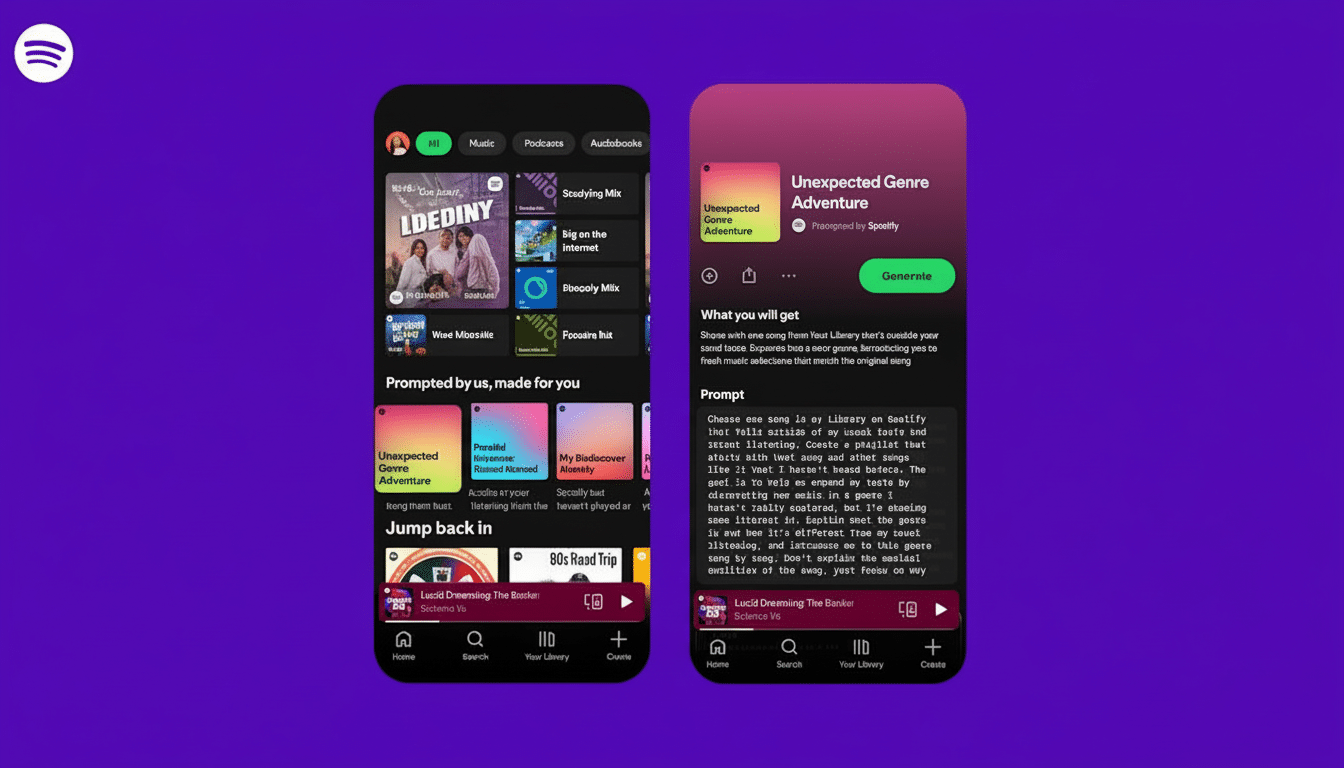
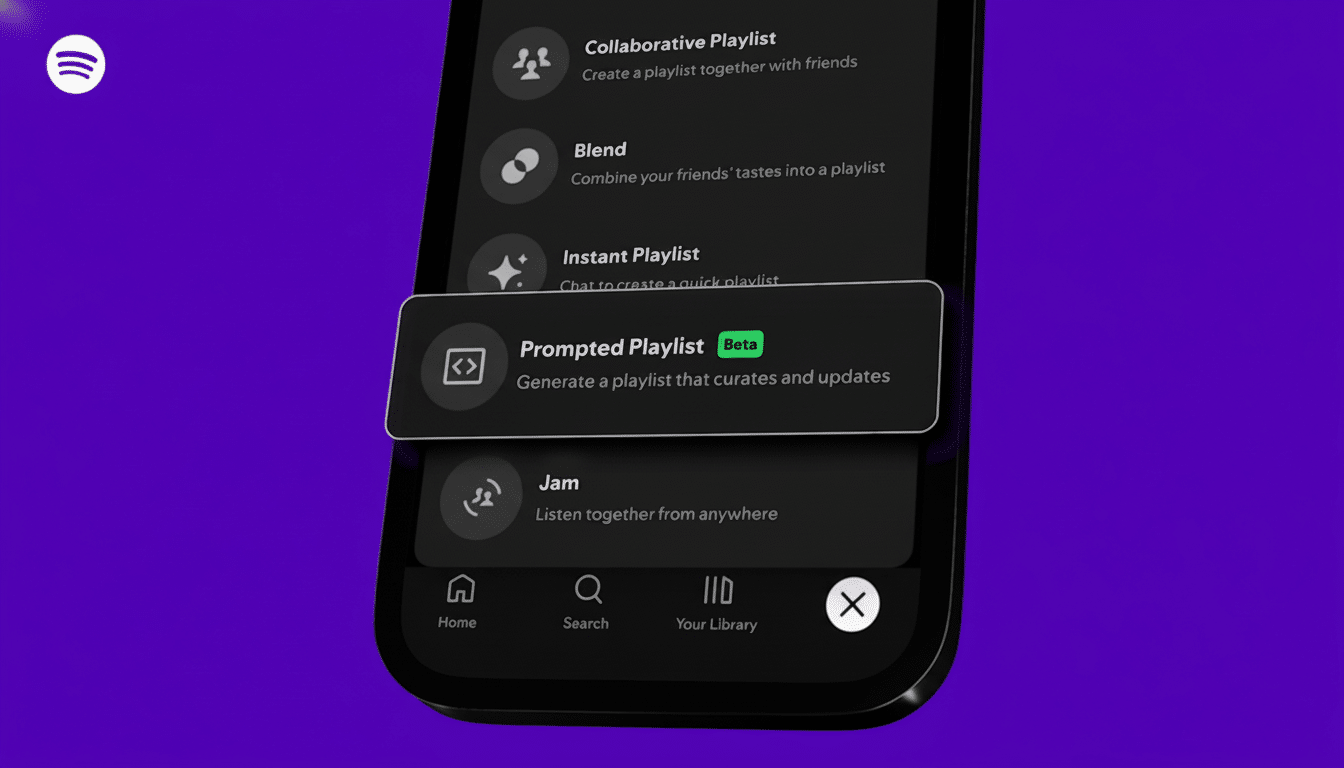
Spotify is experimenting with a feature for its mobile app that makes the music streaming service’s playlists even more personalized for you as an individual versus being purely based on what you listen to. Dubbed Prompted Playlist, the feature allows Premium users to describe the vibe they’re aiming for and then builds a living playlist that updates itself automatically on a daily or weekly cycle. The beta will launch with a small rollout to Premium subscribers in New Zealand, with more users gaining access over time.
The pitch is simple, and it’s ambitious: Instead of passively accepting whatever the algorithm thinks you want (another playlist filled with lite-alternative hits from your formative years), you steer it — once a day! — using plain-language prompts, your own rules for new music, and a period of time to cover, while Spotify’s AI crafts your request around the entire history of what you’ve ever listened to in order to populate a dynamic playlist.
What Spotify’s new Prompted Playlist feature really does
On mobile, from the Create tab, users type a prompt like “late-night ambient without lyrics,” “guitar-driven indie from the 2000s,” or “upbeat Afro-pop for a 5K run.” An Ideas button provides starter suggestions. When you tap Generate, after all, Spotify’s AI uses the prompt and your full listening history — including back to the first time you hit play on a song — to make a playlist that matches your taste arc.
Crucially, there is a brief explanation for why each track made the list — a feature commonly pushed for by recommendation researchers who argue that it builds trust. You can also specify that the list should refresh at a given frequency, and eventually edit your prompt in light of the new facts — so you give the system an explicit, user-defined target rather than a black-box guess.
How it’s different from other AI features on Spotify
Spotify has dabbled with AI in a few places — from its commentary-driven curation in AI DJ to last year’s feature enabling users to generate mixes based on text prompts in the AI Playlist. Prompted Playlist goes the extra mile and introduces playlist persistence, scheduling, and cycling. It remembers what you’ve told it, updates at a schedule of your choosing, and integrates track-by-track explanations — which then create second-order input that almost counts as “co-programming,” rather than just one-off generation.
That move — from reactive suggestions to goal-oriented, user-directed curation — jibes with trends in consumer apps. Instagram recently added tools for you to add or remove topics in Reels, while TikTok includes a feed refresh that can reset those recommendations. The trajectory is obvious: personalization is shifting from opaque automation to systems that are configurable enough for people to express what they want.
Why user-controlled recommendation algorithms matter now
Spotify’s recommendation engine influences a good chunk of what people listen to, and with an estimated 600 million monthly users around the world (based on recent company earnings), even minor UX changes can have a disproportionate cultural and commercial impact. By permitting listeners to guide the algorithm, it may help reduce “algorithmic anxiety” (where we feel that a system has put us under its thumb) and chip away at the entrenchment of narrow filter bubbles by streamlining our ability to move from one mood or genre orbit to another, whenever we want.
There’s a regulatory undercurrent, too. The European Commission’s Digital Services Act would require the very largest online platforms to provide greater transparency and significant control over recommendation systems. Explanations at the level of the track, and offering explicit preference controls, are consistent with that push, and similar ideas have been promoted at the ACM Conference on Recommender Systems as ways to improve user satisfaction and perceived fairness.
Examples and use cases for Spotify’s Prompted Playlist
Think “rainy-day jazz under 90 BPM,” “nostalgic UK garage without explicit lyrics,” or “cinematic sci-fi soundscapes for writing.” Power users can be more specific: “female-led dream pop from Scandinavia,” “post-rock instrumentals with long builds,” or “regional Mexican with acoustic focus.” And by considering the full arc of your listening history, it could base those prompts in what you have actually loved, rather than simply what’s trending globally.
For artists and labels, that level of granularity could shift the discovery calculus. If user queries frequently include mood, geography, and era-based attributes — then not just the quality of metadata but also sonic similarity signals are extremely important. Transparent rationales might also demystify which tracks rise to or fall from a playlist — useful context for artists operating in the increasingly complicated ecosystem of playlists.
Availability and what to watch as Prompted Playlist rolls out
Prompted Playlist is in beta and available only to Premium users in New Zealand. Spotify says that it will add to and, in the future, evolve the new feature — including curated prompt ideas from its editorial and culture teams appearing on one’s home screen. Anticipate iterative tweaks to the way prompts are parsed, updates are scheduled, and how much fine-tuning power users have.
The larger issue is that streaming music appears to be on the cusp of being “promptable,” not just as a means of getting responses but in terms of how it opens up other people’s experiences as valuable objects for abstract manipulation.
If it works, Prompted Playlist won’t replace the classic editorial software lists or algorithmic mainstays such as Discover Weekly — it will live alongside them, offering you a faster, more transparent way to tell the system where you want to go next.
