


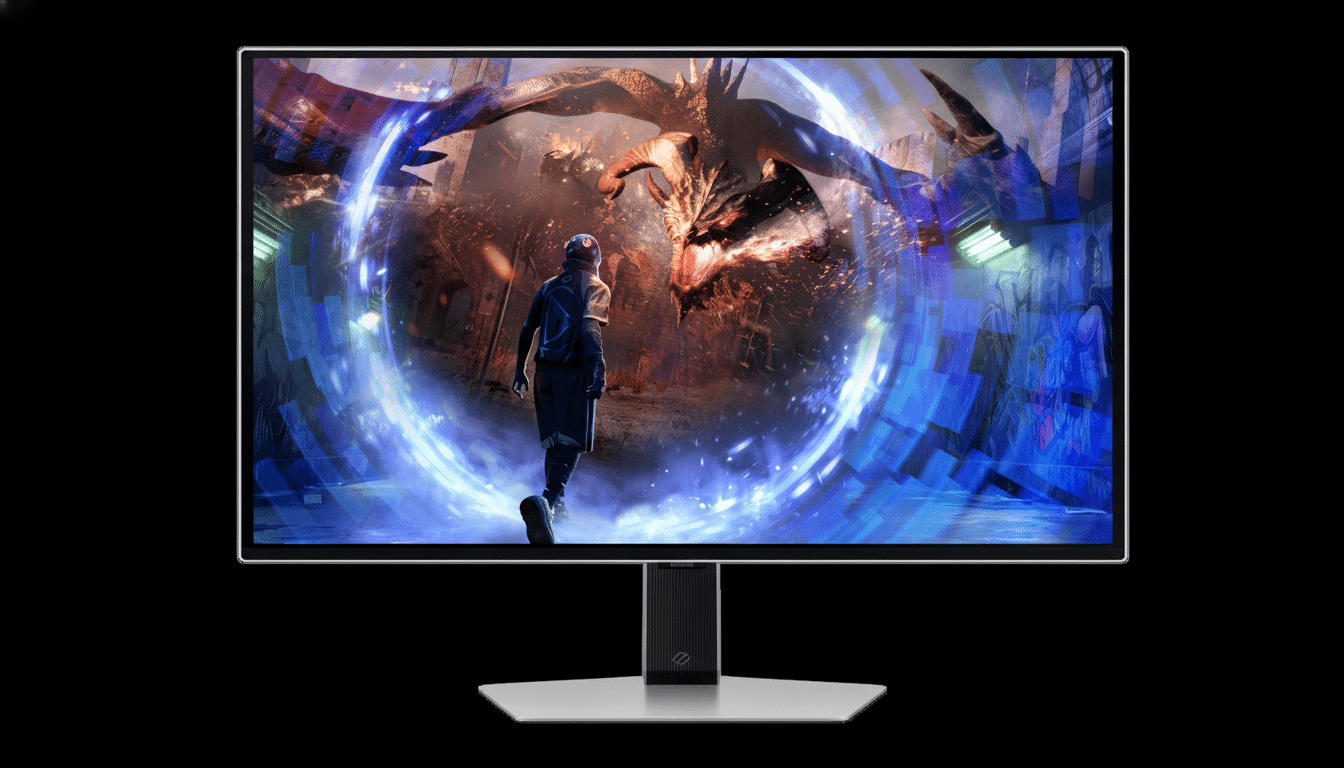
Today’s standout deal is on Samsung’s 27-inch Odyssey OLED G6, also at Amazon, which has fallen to $697 after a one-day price cut on a cutting-edge esports-class OLED. The G6’s headline spec, up to 500Hz at 1440p, places it in rarefied air when it comes to speed, while its QD‑OLED panel delivers black levels and color that rival a pile of IPS units combined.
For competitive types looking for every latency edge they can get without sacrificing image quality, this is about as aggressive a price-to-performance moment on a premium 27-inch gaming monitor as we believe you’ll see.
- Why the $697 price is eye‑catching right now
- What 500Hz really delivers for competitive gamers
- Picture quality beyond speed on this OLED G6
- Real‑world performance considerations at 500Hz
- How it compares to fast IPS and 360Hz OLED rivals
- Who should buy it and who should consider alternatives
- Bottom line on the Samsung Odyssey OLED G6 deal

Why the $697 price is eye‑catching right now
The Odyssey OLED G6 is usually in the ~$1,000 range, meaning a sub-$700 price represents over a 30% savings and $300 off. That’s important because it places a 500Hz OLED firmly in the same deal zone where 1440p 240–360Hz monitors have been competing, with good ones from Alienware and MSI often knocking at $700 during sales. In other words, you’re getting a speed limit with greater headroom without paying too much of a premium above the pack.
Price history trackers have flagged this as a new low at the retailer, so now is an opportunistic buy if you held out for early‑adopter pricing.
What 500Hz really delivers for competitive gamers
At 500Hz, the refresh for each cycle is 2.0ms—compare that to a 240Hz display (4.17ms per frame), or even a 360Hz display (2.78ms), and it becomes clear why ultra‑high refresh matters: the display is sampling your inputs and updating on‑screen information much more frequently.
NVIDIA’s high‑Hz monitor research (including Blur Busters) consistently sees measurable improvements in target acquisition and reaction‑time consistency as refresh rates and frame rates escalate.
Samsung boasts an exceptionally rapid 0.03ms gray‑to‑gray response time for the G6—practically instant by LCD standards. Independent test labs such as RTINGS often report OLED panels to have zero persistence and very low‑to‑zero overshoot, which is why they appear clean even at higher speeds. With support for variable refresh rates to maintain smooth frame pacing during your match, the G6 is designed to keep micro‑stutters at bay.
Picture quality beyond speed on this OLED G6
The 27‑inch QD‑OLED panel in the G6 hits the sweet spot at 2560×1440, perfectly suited for fast‑action gaming while offering clarity and depth for everyday applications. It’s VESA DisplayHDR True Black 500‑certified, which means it does have significant HDR punch to go hand in hand with its true OLED black levels. You can look forward to popping highlights in darker scenes, fantastic shadow detail, and milliseconds‑per‑frame transitions that obliterate dark‑scene smearing.
Samsung’s OLED Glare Free coating is made to control reflections while retaining contrast, so you can use the monitor under overhead lights where glossy OLEDs often look washed out. Color coverage on QD‑OLED is typically very wide—often approaching or even hitting full DCI‑P3—so creators who game won’t need to worry about their content being mired in dull hues when grading or reviewing.
Real‑world performance considerations at 500Hz
To fully leverage 500Hz, your system must be capable of driving extremely high frame rates. Games such as Valorant, Counter‑Strike 2, and Rainbow Six Siege can exceed 400–500 fps at minimum settings with top‑tier GPUs, even at 1440p. Most esports players already turn down visual settings to reduce latency; the G6 adds another dot in that matrix with an increased refresh roof and reduced frame times.
When you step outside of esports, the advantages become apparent immediately: perfect blacks, excellent pixel response time, and HDR where other flat‑panel tech like IPS simply isn’t good enough. Remember that full‑screen brightness on OLED is panel‑constrained, so SDR office work in a sunny room may require reasonably bright settings and intelligent lighting positioning—though the anti‑glare finish does its bit.
How it compares to fast IPS and 360Hz OLED rivals
Against the most popular 360Hz/cyberathlete 27‑inch 1440p OLEDs, the G6 has a little more headroom for your latency‑sensitive play thanks to that 500Hz mode. Compared to 240–360Hz IPS monitors, it sacrifices some maximum full‑screen brightness in exchange for much better contrast and nearly instant pixel response. For multitasking, OLED’s per‑pixel lighting wins you movies and games designed to be played solo (with a side of esports players who get an extra dose of granularity in their motion updates to shave off milliseconds on reaction times).
As with all QD‑OLEDs, text may have slight fringing on smaller edges due to the subpixel design. For desktop work, you can tweak ClearType on Windows or font‑rendering settings. Samsung has its own panel‑care functions like pixel shifting and logo dimming to prevent the possibility of image retention over time, too.
Who should buy it and who should consider alternatives
If your game library skews heavily toward competitive shooters and MOBAs, and you’re already using a high‑end GPU and CPU, the Odyssey OLED G6 at $697 is an enticing upgrade that combines top‑tier motion clarity with OLED image quality. It also appeals to gamers who appreciate HDR immersion in single‑player games but require a monitor that can flick into full esports mode.
Console gamers also get great benefit in the form of OLED contrast and 120Hz, but won’t be able to tap into that 500Hz capability. As an added perk, PC players struggling for every edge will benefit the most from this bargain.
Bottom line on the Samsung Odyssey OLED G6 deal
At $697, the 27‑inch Samsung Odyssey G6 OLED isn’t just fast like an increasing number of flagship‑class displays for gamers; it also has the best characteristics we have seen in OLED imaging—and at a price that undercuts much of its high‑refresh competition. For anyone who cares about latency, motion clarity, and HDR in one 27‑inch package, this is the time to strike.
