


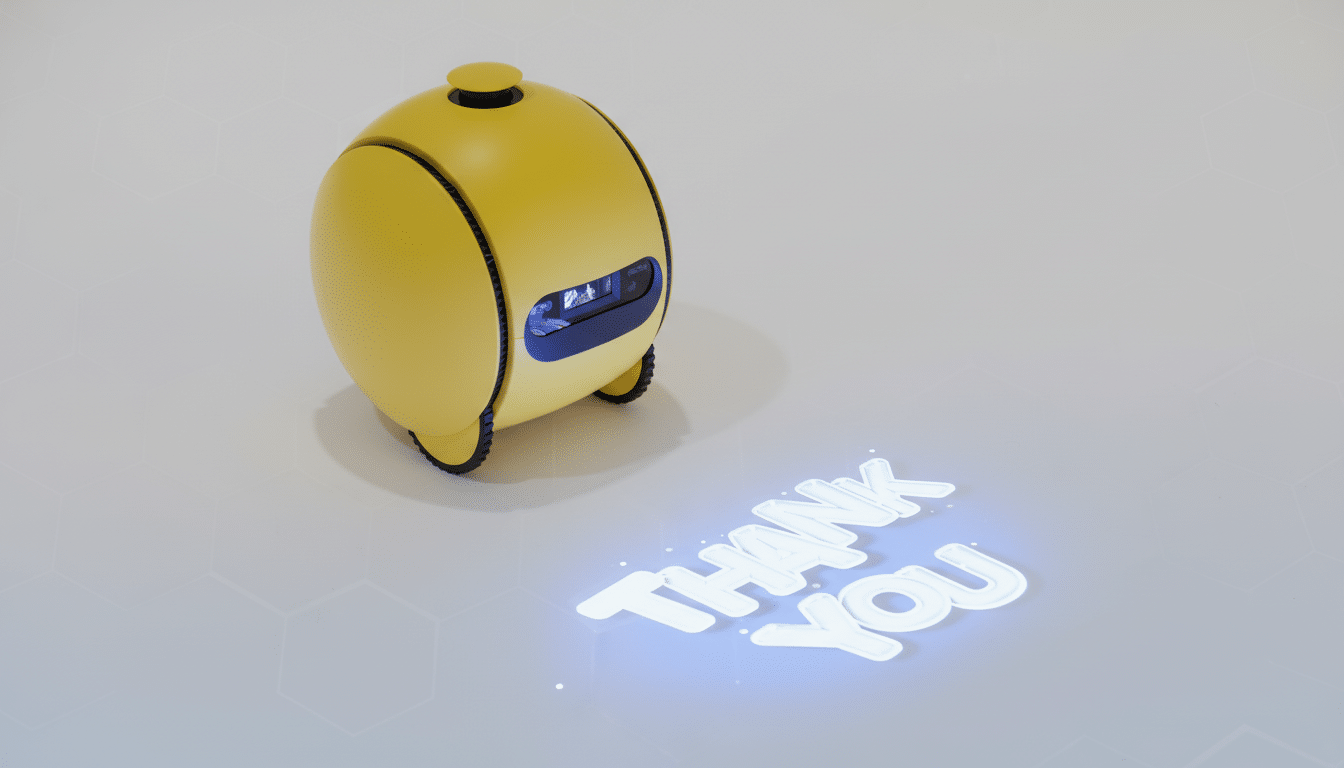
Samsung’s ball-shaped AI sidekick Ballie appears to be doomed to strictly concept status, never quite manifesting as a product you can buy. Following years of demos and a previously announced retail strategy, the company is now describing Ballie as an “active innovation platform,” language that strongly suggests it no longer plans to launch the product to consumers. The robot’s also mysteriously MIA on the show floor this week, even with a teaser page live and still inviting people to pre-register for more information—a weird pairing that either reflects an indecisive stance at best, or silent cancellation at worst.
Ballie has long been described as a sentient smart home assistant that roams where it’s needed, knows context and numbers, projects things around the house, or just chills while commanding all your connected devices. It was a viral CES darling every time it rolled on stage, but turning an impressive demo into a mass-market robot is in a different universe of challenges—one that Samsung now appears to be shying away from.
- From idea to a moving target: Ballie’s shifting launch path
- Why home robots can’t keep up: technical and business hurdles
- A familiar Samsung pattern: concept hardware that stalls
- What the Ballie tech could do across Samsung’s ecosystem
- The market and competitive landscape for companion robots
- What to watch if Samsung revives a Ballie retail push

From idea to a moving target: Ballie’s shifting launch path
Ballie originally showed up as an adorable rolling concept, then came back later with far more advanced AI, and was ultimately promoted as a device Samsung wanted to sell.
The company also threw out a seasonal release window, leading to hopes that an actual launch was near. When that timeline lapsed, Samsung informed TechRadar that Ballie wasn’t canceled and was still “continuing to refine and perfect the technology.”
That changed in a message to Bloomberg that called Ballie an “active innovation platform” that motivates spatially aware, contextually interested experiences, “especially in the areas of smart home intelligence, ambient AI and privacy-by-design.” That is the quintessential corporate language for a research project that is feeding into other products rather than a standalone device on its way to retail. That Ballie wasn’t put center stage during the industry’s biggest party only serves to underscore the new reality.
Why home robots can’t keep up: technical and business hurdles
Companion robots have to overcome a tangle of technical and business challenges. If you want to have a tough time at robotic vacuuming because of clutter and pets of widely varying sizes, across rough floor types, or some other difficult-to-map environment, it would appear that SLAM alone will not be enough—at least not without a representation that persistently makes sense (Scene Understanding) that isn’t based on just keyframes, but whose proximate data points are chained by semantics (Object Detection). Add in the requirement for a natural language interaction that remains useful beyond week one, and you have an eternal integration problem rather than a neat product sprint.
Then there’s privacy. A mobile gadget, equipped with cameras and far-field microphones that moves itself around the home, begs scrutiny from consumers and regulators. Samsung’s “privacy-by-design” focus speaks to that reality. The Federal Trade Commission has consistently issued alerts about data practices in connected devices, and there are state-level efforts to ban the use of AI in children’s products—a sign of how fast the tides can change. Sure, for a global brand, the shadow of one mistake can eclipse years of R&D.
Economics are equally unforgiving. Premium servos, tough testing, and support/replacement networks need to be in place for companion robots. Unlike single-purpose devices—think robot vacuums—multipurpose companions don’t have a killer task that makes their price and complexity worth it. Industry bodies such as the International Federation of Robotics have observed that consumer robot sales are dominated by task-oriented devices—think vacuum cleaners, lawn mowers, and so on—with socially oriented or general-use helpers remaining niche.
A familiar Samsung pattern: concept hardware that stalls
Samsung has been here before. The Galaxy Home smart speaker, announced with a flagship phone, never made it to shelves despite early promises of “more details soon.” The company is practical about stowing hardware that may not have a clear path to scale, even if the concept is polished and press friendly.
The safer play is to mine Ballie’s work for features that fit in established categories. Spatial awareness, multi-device orchestration, and on-device AI models could enhance SmartThings, TVs, projectors, appliances—even robot vacuums—with existing demand and service frameworks.
What the Ballie tech could do across Samsung’s ecosystem
Research from Ballie, as an internal platform, could speed that ambient AI—which would see systems more clearly understand rooms, routines, and context to be able to automatically execute users’ wishes without them having to bark orders all the time. Look for more intelligent scene detection for cameras, a greater sense of the subtleties involved in device handoffs in SmartThings, and context-aware notifications on screens throughout your home. The convoluted projection whizbangs that endeared Ballie to audiences could feature in ultrashort-throw projectors or TV peripherals, where cost control, safety, and reliability are simpler.
To developers, Samsung might selectively expose the APIs born from the Ballie program, which would allow spatial triggers, home mapping, or privacy-preserving inference across devices. That strategy allows the company to demonstrate the ambition of a companion robot while shipping incrementally into categories with more clearly defined margins.
The market and competitive landscape for companion robots
Samsung is not the only one trying to slow down. Amazon’s Astro still mostly feels like a niche experiment rather than a mainstream product, an example of how even giant smart home companies are finding it hard to make rolling robots useful every day. Previous social robots such as Jibo and Anki Vector won acclaim from eager early adopters but failed to maintain sales or support at scale. The moral here is a recurring one: Single, high-value tasks win; generalized wide-ranging companionship hardly ever survives contact with actual homes.
What to watch if Samsung revives a Ballie retail push
If Samsung does rejuvenate a retail push, there are concrete signals to look for:
- Regulatory filings
- Retail certifications
- Developer documentation
- Accessories
In their absence, the smart bet is that Ballie endures as a research mascot whose DNA gradually percolates through Samsung’s broader product selection.
Consumers shouldn’t hold their breath for a rolling helper to ship anytime soon. Instead, expect Samsung to continue yammering about ambient AI and context-driven experiences—served up by your TV, appliances, the SmartThings ecosystem—even as Ballie rolls back into the lab.
