


Razer is offering its AI gaming co‑pilot a body. At CES, the firm showed off a physical manifestation of Project Ava: taking last year’s software-first idea and working it into a desk-friendly device that places an animated, personable assistant beside your monitor, rather than on top of your gameplay.
Be a Virtual Coach on Your Desktop with Project Ava
The new Ava hardware is a little cylinder with a clear shell through which you can see a full-body avatar rendered, as it were, inside the tube—like a tiny, always-present teammate under glass. On the back is a user-facing camera on top, and a perforated base that gives depth to the character. A narrow band of Razer‑green lighting serves as the design’s core language, intended to exist alongside a laptop or monitor rather than infringe on precious screen real estate.
- Be a Virtual Coach on Your Desktop with Project Ava
- Coaching The Game, Not Crowding Your Screen
- Avatars with Fandom Built In for Personalized Play
- Beyond Games to Daily Assistance at Your Desk
- A Clear Signal From CES On The Next Stage Of AI
- Open Questions And Pragmatic Considerations
- Why It Matters to Players and Competitive Gamers
The shift repositions Ava from a virtual floating UI overlay to a physical companion, a pivot that’s reflective of a larger CES trend: AI tools are being given their own space on the desk, not just relegated to another browser tab in the taskbar.
By offloading coaching visuals to a second display, it also bypasses one of the dominant complaints of competitive players (cluttered HUDs).
Coaching The Game, Not Crowding Your Screen
In demos, Ava delivered up-to-the-minute loadout recommendations while standing beside a Battlefield 6 setup that responded to vocal prompts, calling out and delivering bits of advice about weapons, gadgets, and class selection. The noise of the show floor rendered hotword detection hit-or-miss—a perennial CES challenge, as ambient sound levels regularly soar to those that confound microphones—but the recommendations themselves fell in line with common meta logic (in case you were wondering: frag grenades for assault builds are still a good call).
There’s nothing to stop you from detaching the assistant from the game window, however, which could be something that streamers and tournament players who cherish every frame and pixel might want to know. “Many esports broadcasts already depend on second-screen dashboards for stats and chat; Ava’s hardware monitor takes that philosophy to coaching.” The big questions now are related to delay and cross-title compatibility, especially where anti-cheat systems look suspiciously at overlays and data capture.
Avatars with Fandom Built In for Personalized Play
Razer is staking a lot on personality. The company’s default showcase character is Kira, but presets such as Zane, a dapper giant with a snake tattoo, hint at a roster designed for flair as well as function. Razer says that users can customize their avatars or even create new ones. Partnerships are on the road map as well, featuring likenesses from gaming influencers and esports stars like Faker in a fusion of coaching utility with the fan economy that has lifted VTubers, streamers, and team-branded gear.
It’s a savvy bet. Newzoo’s latest market report says creator-driven communities are still the primary path to discovery and engagement on PC and console. If Ava can have a conversation with the familiarity of a face and an appropriate tone, maybe we’ll adopt out of culture as much as off lists of features.
Beyond Games to Daily Assistance at Your Desk
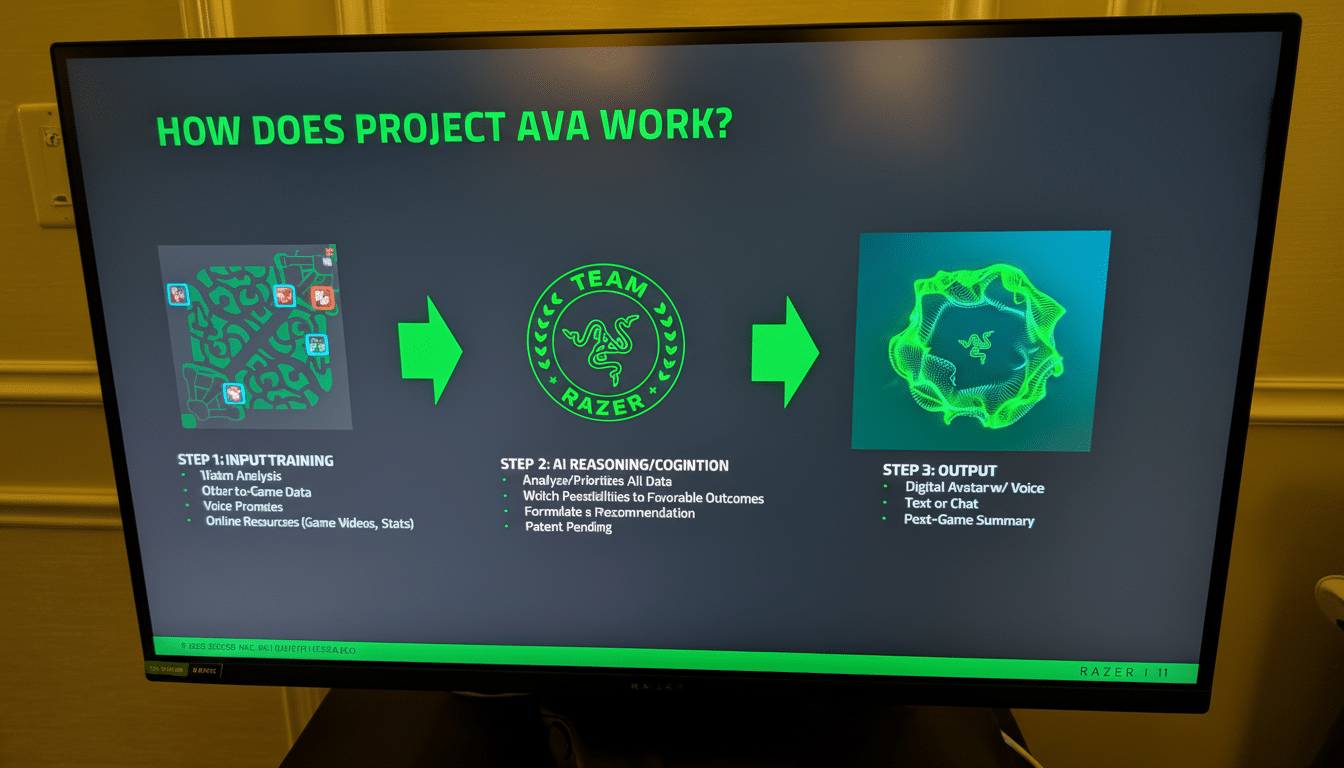
Ava has broadened its scope beyond in-match coaching, Razer notes. While you work, this assistant can discreetly surface guidance when you need it and behave like a general helper with gamer sensibilities. That pitch also places Ava in already crowded company, among which competing offerings include Microsoft’s Copilot and Nvidia’s ACE for Games technologies, as well as agent-style tools built on multimodal models from companies like OpenAI. The distinction here is in the context and placement: Ava is positioned as a desk companion that knows play before productivity.
A Clear Signal From CES On The Next Stage Of AI
Physical instantiations of AI are having a moment. Recent cycles delivered pocketable agents and wearable pins; this year’s show doubles down on countertop companions with persistent presence and glanceable feedback. For players, that presence might be the difference between a mobile assistant you only summon occasionally and one that feels like a constant squadmate: adjacent on your screen, visible, responsive—but never requiring an Alt-Tab.
It also captures how players already act. Industry studies have measured second-screen activity during gameplay, from build guides to map callouts. A voice-first device codifies that habit and, if done well, could remove friction by allowing hands to remain poised on the keyboard, mouse, or a game controller.
Open Questions And Pragmatic Considerations
Pricing, final specs, and a hard launch date remain unknown beyond a fuzzy target window.
Crucial technical details are being kept secret, such as how much processing is done on the device versus in the cloud, what privacy controls govern its always-on camera and microphones, and how this ties into PC platforms without triggering anti-cheat protections.
Those are the kinds of answers that will determine whether Ava is a funky novelty or a lasting staple. Doing processing on-device could cut down latency and protect user data; strong noise suppression and beamforming would assist in crowded rooms; and first-party hooks with publishers would limit exposure to breakage every time a game patches. Without them, the assistant’s charm may have outstripped its reliability.
Why It Matters to Players and Competitive Gamers
Coaching has always been a facet of the hobby, from forum guides to pro VOD reviews. Project Ava’s departure from virtual space is an attempt to collapse that learning loop into the moment-to-moment of play, a presence you can literally look at between respawns. If nothing else, if Razer gets Ava right on the basic principles—i.e., speed, accuracy, and discretion—it could become as ubiquitous an accessory as a headset or mouse mat. If it does not, here’s the fear: that this could be just another Cool Thing at CES that wows on the show floor and dies at home.
