


I had one foot out the door on wireless charging. The heat, the throttling, the molasses-slow top-offs once phones got warm—it all chipped away at the convenience pitch. Then I tried a Qi2 charger with a built-in cooling fan, and the experience flipped. For the first time in years, I’m leaving my phone on a pad without silently worrying about battery wear or wasted time.
Heat Is The Silent Wireless Charging Killer
Wireless charging’s problem has never been a mystery; it’s physics. Inductive power transfer sheds energy as heat, and real-world efficiency often lands between roughly 50% and 80%, according to engineers who contribute to the Wireless Power Consortium’s technical briefs. That lost energy warms the coils and your phone’s battery, and once temperatures rise, phones throttle charging to protect themselves—stretching a 30-minute top-up into a 60-minute wait.
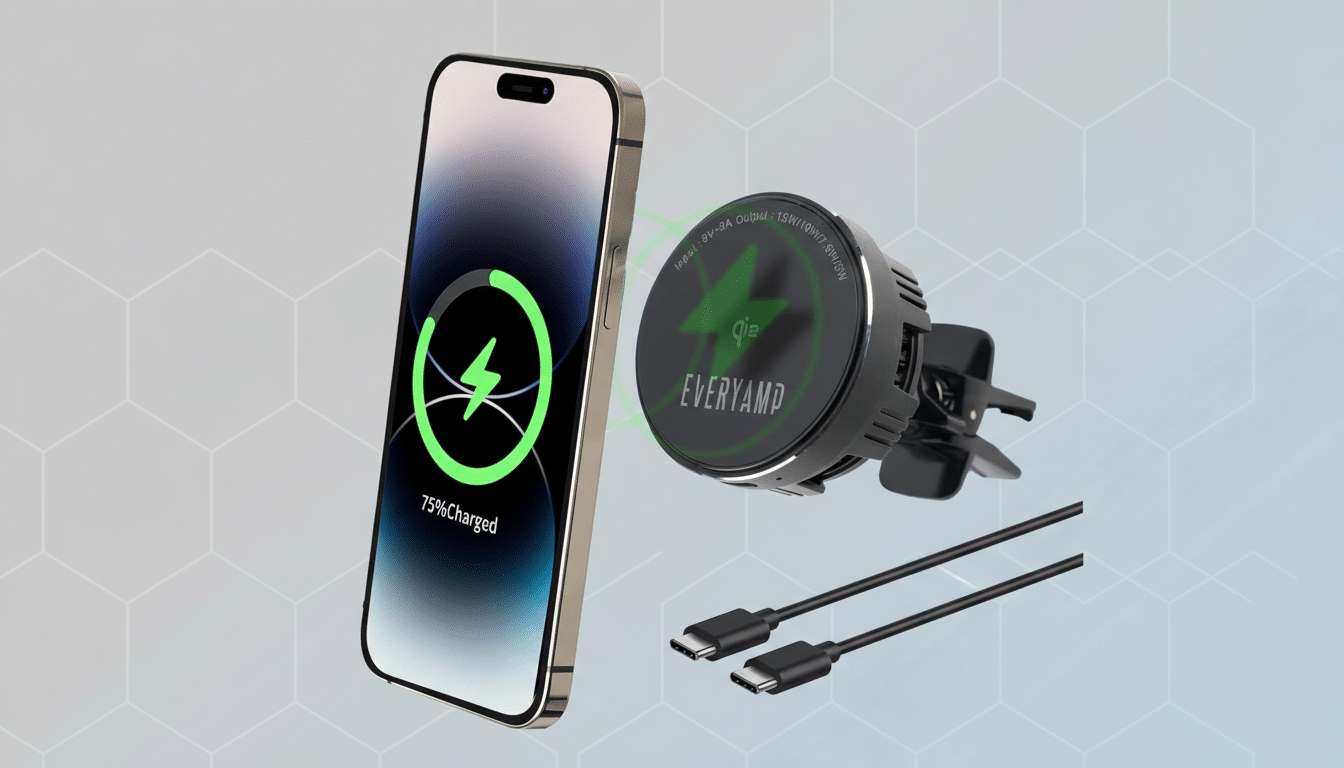
Thermal stress also affects longevity. Research summarized by Battery University and papers in the Journal of Power Sources show lithium-ion cells age faster when cycled hot; even sustained operation above 95°F (35°C) can accelerate capacity fade and increase internal resistance. Translation: cool charging is kinder, and consistent heat is a tax on your battery’s future.
Active Cooling Changes The Equation For Qi2 Charging
The latest Qi2 gear adds two important ingredients: precise magnetic alignment to cut coil mismatch, and in a few designs, active airflow. The charger I tested—Belkin’s UltraCharge Pro 3‑in‑1 with Qi2 fast wireless charging—pairs a 25W magnetic pad with a discreet fan that shrouds the charging face in ambient air as soon as a device docks. Google and Samsung experimented with fan-cooled pads years ago, but this new combo of Qi2 alignment and higher sustained wattage with active cooling is the most convincing execution I’ve used.
Qi2’s magnetic profile already helps by reducing misalignment losses that turn into heat. The fan then attacks the remaining thermal load, keeping the phone’s battery and the charger’s coils closer to a safe, efficient window—critical for holding higher power for longer stretches.
Measured Gains In Temperature And Stability
To separate feel from fact, I ran back-to-back sessions with the fan on and off. Charging a Qi2.1‑ready Samsung Galaxy S25 Edge from zero for 30 minutes, the phone’s glass hit 90°F without the fan and 82°F with it, as read by a secondary device’s temperature sensor. That surface delta matters—cooler glass usually signals cooler internals.
Internal battery readings told the fuller story. Using the phone’s onboard sensor across five 10‑minute intervals, the pack peaked at 91.3°F with the fan active, then jumped to 98.1°F after just 10 minutes when I disabled it. Keeping the fan off pushed the battery to 98.8°F and then 100.8°F. Re‑enabling the fan, without pausing charging, dropped the battery back to 94.8°F in the next 10 minutes. That 6°F–8°F swing was repeatable and, crucially, it coincided with fewer mid‑session speed dips.
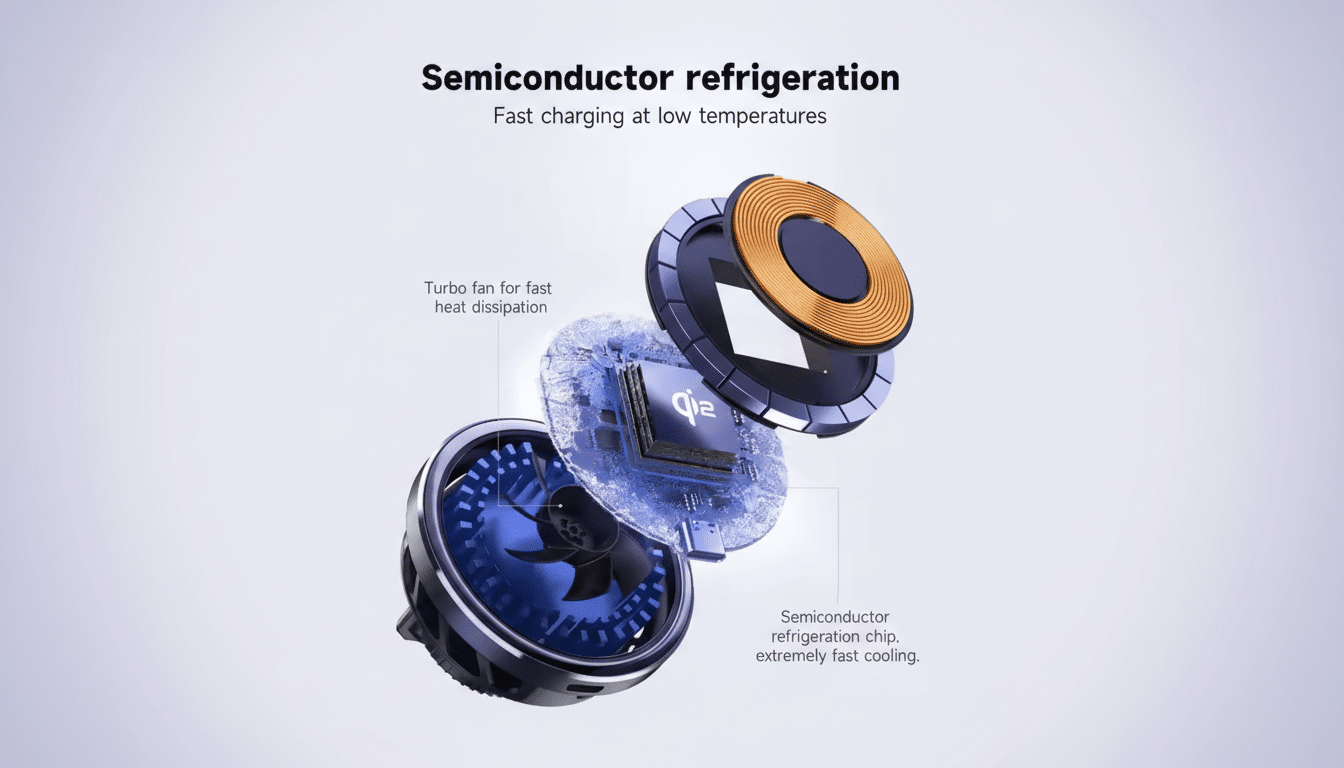
Phones that normally taper quickly—like a Pixel 10 Pro XL that rarely holds its top advertised Qi2 rate for long—stayed at higher wattages for more of the session when cooled. The difference isn’t just a graph; it feels like wired‑adjacent convenience again.
Why Cooler Means Faster And Healthier Wireless Charging
Charging controllers are programmed to protect the battery first, performance second. Once the pack creeps past roughly mid‑90s°F, software dials back current to manage risk. Keep the cell closer to 86°F–95°F (30°C–35°C), and you avoid those emergency brakes. That’s exactly what the fan accomplished in testing: fewer throttling events, steadier power delivery, and less post‑charge sluggishness from a heat‑soaked device.
Long term, the benefits compound. Studies cited by IEEE and battery aging analyses suggest every sustained 10°C rise can markedly accelerate degradation mechanisms like SEI growth. Shaving even 6°F–8°F off typical wireless charging temps won’t rewrite chemistry, but it nudges you back into a saner thermal envelope—cheap insurance for devices you plan to keep.
Trade-offs To Consider With Fan-Cooled Qi2 Chargers
There’s no free lunch. Small fans can produce a faint whine you’ll notice in a quiet bedroom, and multi‑device docks often bundle Apple Watch pucks some Android users won’t need. At $129.99, this 3‑in‑1 isn’t the budget pick either. But if you charge at a desk or living‑room side table, the acoustic footprint fades into background noise, and the thermal headroom more than earns its keep.
The Bigger Picture For Qi2 And Wireless Charging
Qi2’s magnetic alignment is a meaningful leap, but higher power brings higher heat. Expect more premium pads to add active cooling or smarter heat‑spreading materials as manufacturers chase sustained wattage without punishing batteries. The Wireless Power Consortium has been clear about improving real‑world efficiency; pairing those gains with thermal management is how wireless finally matches its convenience promise.
I’m not ready to toss my cables, but a Qi2 charger with a fan made me stop dreading the pad. It’s faster, calmer, and kinder to my phone—exactly what wireless charging needed to win me back.
