


Intel reported a third-quarter profit above analyst expectations but issued a fourth-quarter forecast that fell materially short of Wall Street targets, shifting investors’ attention from the earnings beat to a weaker outlook for personal-computer demand. Shares fell more than 20% in extended trading after the results, according to CNBC’s report on the release.
The numbers illustrate a difficult mix for the Santa Clara, California, chipmaker: its data-center and AI business expanded sharply, while the much larger client-computing operation contracted. Intel also told investors that a disruption at an Israeli facility would weigh on near-term revenue and margins, adding a supply constraint to a demand problem centered on PCs.

Guidance, rather than the reported quarter, drove the reaction
Intel posted adjusted earnings of 52 cents a share for the third quarter, above the 40-cent estimate cited by CNBC. Revenue was $16.51 billion, narrowly ahead of the $16.5 billion forecast cited in the same report and 21% higher than the $13.7 billion reported a year earlier.
For the fourth quarter, however, Intel forecast revenue of $15 billion to $16 billion and adjusted earnings of 25 cents a share. Analysts surveyed by LSEG had been looking for $17.1 billion in revenue and 43 cents in adjusted earnings, CNBC reported. The midpoint of Intel’s revenue range, $15.5 billion, is $1.6 billion, or roughly 9%, below that revenue expectation. Its 25-cent profit outlook is about 42% below the cited consensus estimate.
Other published estimates differed modestly by data provider and timing, but reached the same conclusion. Two Yahoo Finance accounts of the results placed revenue expectations at about $17 billion and earnings estimates between 38 cents and 44 cents a share. Intel’s full guided revenue range remained below those benchmarks, while its earnings projection was also below each of the reported consensus figures.
The extended-hours move indicated that investors focused more on the outlook than on the quarterly earnings beat. Reports of declines ranging from more than 20% to roughly 26% should not be read as competing closing figures: they describe trading at different points in after-hours and premarket activity following the announcement.
AI growth did not offset the PC slowdown
Intel’s client computing and physical AI group generated $8.1 billion in third-quarter revenue, down 5% from a year earlier, CNBC reported. The data-center and AI division generated $7.3 billion, up 78%. The contrast helps explain why total company revenue could rise while Intel still delivered a cautious forecast.
Client computing remains central to Intel’s exposure to desktop and notebook demand. Management expects the PC slowdown to continue at least through the first half of 2027, CNBC reported, while a separate Yahoo Finance report on the outlook said Chief Financial Officer David Zinsner described internal planning assumptions for a roughly 12% decline in the 2026 PC unit total addressable market and a further 10% decline in 2027.
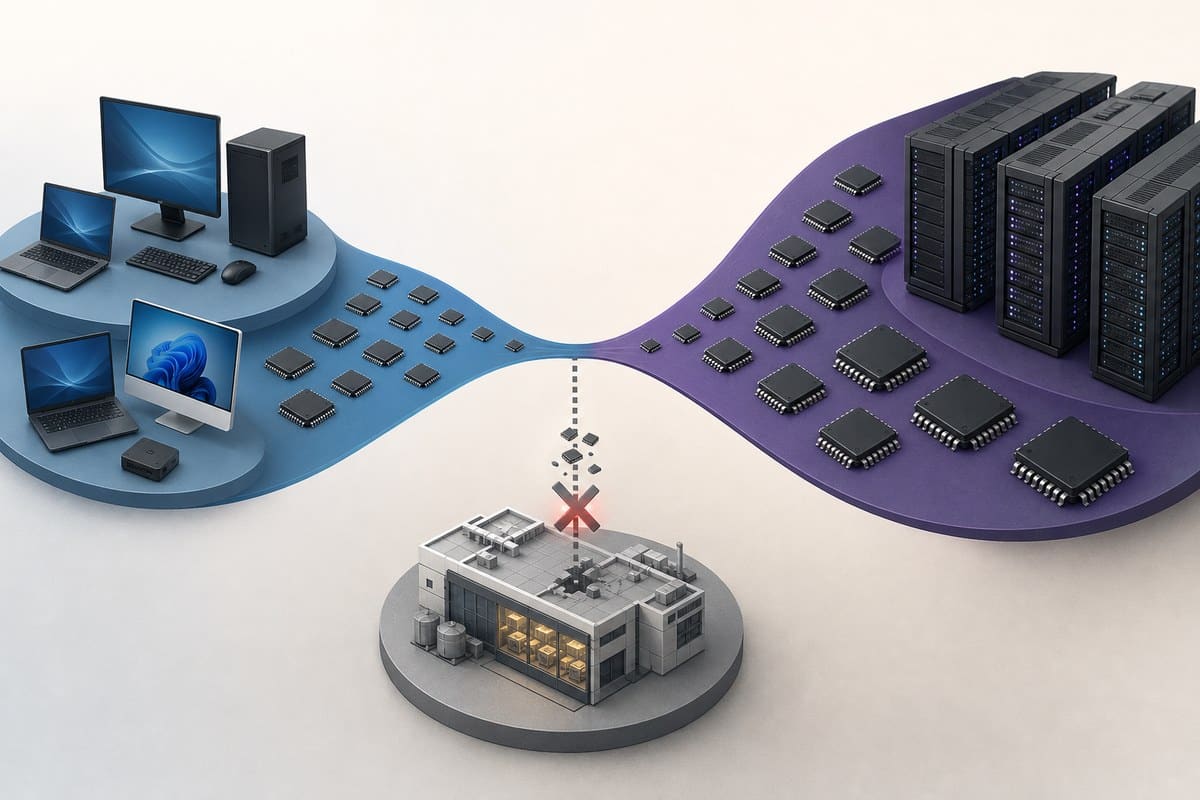
Those are company planning assumptions rather than established industry outcomes. Still, they point to a more protracted weakness than a single disappointing quarter. The reports do not establish how individual computer makers, distributors or corporate customers will manage inventories, but they do show Intel preparing for lower unit demand well beyond the current quarter.
Intel’s view also follows broader evidence of pressure in the PC supply chain. CNBC cited Counterpoint Research data showing global PC shipments fell 4% year over year in the second quarter, with higher memory and other component costs weighing on demand. For Intel, elevated component prices can restrain PC purchases even as AI-oriented server spending supports another part of its business.
Israel disruption adds a separate near-term constraint
Management also cited a disruption at an Intel fabrication facility in Israel. CNBC reported that the company estimated roughly $600 million of lost revenue over two quarters and said shipments of 10-nanometer chips were affected. Yahoo Finance separately reported a roughly $300 million fourth-quarter revenue headwind and a 200-basis-point reduction to fourth-quarter gross margin.
The figures are not necessarily inconsistent. The $300 million estimate appears to describe the fourth-quarter portion of a reported two-quarter revenue effect that CNBC put at about $600 million. But the published accounts do not establish how the remainder would be allocated between quarters, so it is not possible to derive a more precise schedule from the available disclosures.
The combination is important for interpreting the guidance. Intel is dealing with softer expected PC demand, which affects its client-computing revenue base, and with a reported manufacturing disruption that can limit shipments and reduce margins. Stronger data-center and AI revenue may cushion the company’s overall sales mix, but it did not eliminate either pressure in the fourth-quarter outlook.
For semiconductor investors and PC suppliers, Intel’s forecast offers a more specific warning than its third-quarter beat: demand tied to AI infrastructure can be robust at the same time that consumer and commercial PC markets weaken. Intel’s guidance suggests those two cycles are now moving in sharply different directions.

