


Pokémon Legends: Z-A seems like the moment the series slams on the accelerator. Played on Nintendo’s new-gen hardware, its battles forsake the 1996 turn-based rhythm for something swift, physical, and gloriously reactive — more action RPG than ritual menu boogie. It’s still undeniably Pokémon, but the pace has shifted.
Reflective of the answers (sort of) delivered by its trailers, those recent Game Freak experiments — open-world traversal in Scarlet and Violet and the investigative mission of Legends: Arceus — suggested as much. Z-A commits. The result is a system that promotes attentiveness, positioning, and lightning-fast decision-making better than it ever has before, without throwing out the baby of types, status, and team synergy with the bathwater.
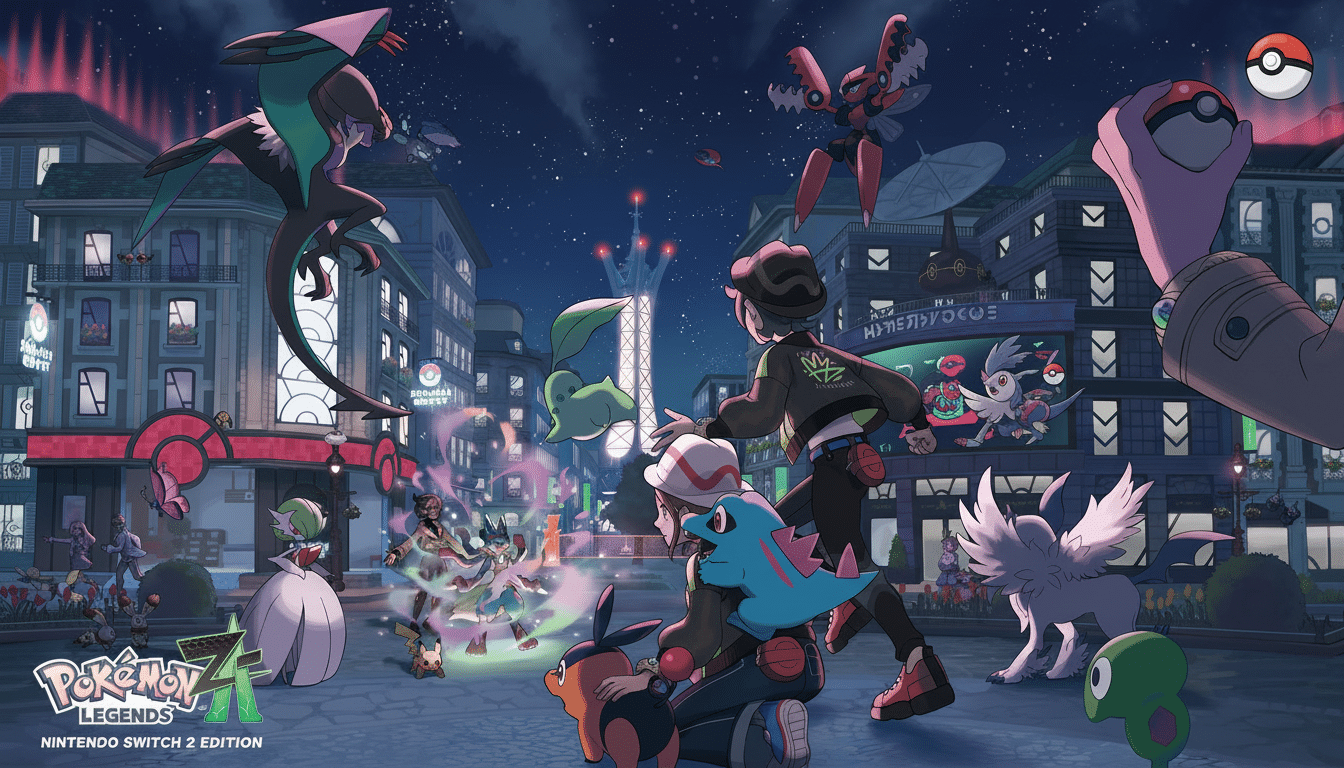
Live battles with a focus on tactical awareness
Controlled mechanically, inspired emotionally. In Z-A, mechanics are mapped to the face buttons and have personal cooldowns. There’s no pause button, and if you hesitate, your opponent won’t: they pile on moves while you recover. It’s a radical elimination of the turn queue and it instantly rewrites your mental math — “Can I even act?” becomes “Should I act now?”
The UI matches the pace. A scrolling combat log replaces the former tap-through text box, allowing the fight to flow without interrupting for text. It can be a little overwhelming at first — animations, area telegraphs, buff icons — but as always with decent action systems, understanding slowly catches up with your fingers. And once it does, you begin weaving inputs as a salty vet might weave type matchups.
Defense and support reveal themselves in play
Support tools that used to feel like “wasted turns” become clutch, in a real-time loop. Protect is no longer a mere bureaucratic chit; it’s a perfectly timed frame of immunity that can wipe out a devastating blow if you call it right. The first time I saw an enemy block my charged-up strike, I shuddered — and then promptly added that very trick to my own arsenal.
Likewise, actions such as Double Teaming and setting screens have immediate value because their opportunity cost can be measured in seconds rather than turns. You’ll throw up a shield, reposition, and fire off a quick punish — all within the area where, in a slower game, you’d just be describing the last attack. The rhythm encourages more expressive play.
Placement and boss design raise the ceiling
Now your partner Pokémon follows you around in the arena and that simple change adds an extra layer of spatial tactics. A lot of attacks have obvious area effects — Flame Wheel cuts a swath, Whirlpool dirties the floor — and cone attacks want sidesteps more than they do damage-racing. Where you stand is as important as what you push.
The point is driven home by a standout boss encounter with a Mega Victreebel. The field is periodically flooded with poisonous pools, requiring on-the-fly route planning under pressure. Occasionally, the most intelligent manoeuvre is a lack of action: withdraw your Pokémon briefly to prevent attrition and then recommit when whoever you’re facing eases off the hazard. Mega Evolution, though, throws in even more of a curveball — you get a meter that ticks down over time (but stops while your Pokémon is still in the ball), encouraging you to bank power for just the right moment. It is a small mechanic and yet has major strategic implications.
An open world that doesn’t roll over or relent
And, like Legends: Arceus, the world has teeth. Wild Pokémon will attack you, not just your team, and one misstep means a hasty retreat to a checkpoint. Stealth, baiting, and smart engagements matter still, but now those have all been largely subsumed into a fighting model that rewards the same vigilance. The loop is a logical, cohesive one: scout, isolate, attack, adapt.
Why this evolution matters for Pokémon’s future battles
Pokémon is also huge — the Pokémon Company’s own figures suggest that it is one of the biggest-selling entertainment brands, while Nintendo’s financial reports list over 24 million copies sold for Scarlet and Violet and more than 14 million for Legends: Arceus. In a field this wide, every mechanical switch has to earn its keep. Z-A’s does since it clings to one of the core identities of now-anarchic fizz — and remedies a long-held complaint: pace.
For the vets, that new system allows for a higher skill ceiling without gatekeeping out the aspiring pros. For a newbie, the immediacy is seductive — press, dodge, and react — but the old rock-paper-scissors of hitting, typing, and status manages to remain visible. The advantages are of course even greater on stronger hardware: more responsive input, denser, smoother animation and readable telegraphs make it all sing.
Legends has been described by Game Freak as a space for experimentation, and Z-A shows the value of that philosophy. This is Pokémon battle rewired into a living duel, rather than a polite game of turns. It’s fast. It’s tactical. And now that I’ve gotten my hands on it, it’s the turbocharged battle system I’ve been craving.
